Defamation Malaysian Cases
Saturday, June 09, 2007
Michael Chong sues Guang Ming daily
9th June 2007, NST
MCA Public Service and Complaints Department head Datuk Michael Chong today filed a defamation suit against Guang Ming Daily for publishing a report which allegedly referred him as
"Ah Long King".
The suit was filed at the High Court (Civil Division) Registry through Messrs Amrit & Co.
Named as defendants in the suit were the Chinese daily’s publisher, Guang-Ming RiBao Sdn Bhd, and chief editor, Ch’ng Li Suang.
In the statement of claim, Chong said that daily had on Dec 8, 2006, published a report which gave a meaning that he was "Ah Long King" and supported unlicensed money lending activities.
The report also carried a meaning that he could not be trusted, a criminal, a liar and a dishonest person and not fit to head the MCA Public Service and Complaints Department, he said.
Because of the report, Chong said, he was hated, ridiculed and humiliated by society members, friends, staff and members of MCA and other political parties.
Also following the report, the public had called him “Ah Long King” and he had been summoned by the MCA president for explanation on unlicensed money lending activities.
He said the publication of the report had severely tarnished his professional status, character and reputation and exposed him to public scandal.
Besides exemplary and aggravated damages, he sought an injunction to prevent the defendants from repeating or publishing the alleged defamatory sentences. He also sought an apology from the defendants and to have it published in all media which had published the alleged defamatory sentences.
Meanwhile, MCA Public Service and Complaints Departmet chief legal adviser Datuk Theng Book told reporters that Chong was seeking RM10 million in damages.
— BERNAMA
Labels: Michael Chong
Wednesday, May 09, 2007
Annas Khatib sued Adam Abdul Hamid
5th. May, 2007 NST
Former D-G sues fisheries authority chairmanKUALA LUMPUR: The former director-general of Malaysian Fisheries Development Authority has filed a libel suit against the authority’s chairman, Adam Abdul Hamid.
Datuk Annas Khatib Jaafar, who retired on April 22, filed the suit through Dasuki and Co at the High Court here yesterday. He is seeking general damages, compensation, and aggravated and exemplary damages.
Annas is also seeking an injunction to restrain Adam from publishing or making statements that would affect him.
He claimed that Adam’s statement to the press last month and what he said in a letter dated Feb 6 to the Anti-Corruption Agency meant that he (Annas) had committed misappropriation of funds with regard to the construction of the authority’s RM55 million new complex at Kuala Kedah, Kedah.
Annas claimed that Adam’s statement also meant that he had committed misappropriation of funds by awarding the project to Pembinaan Zakaria Salleh Sdn Bhd through direct negotiations.
He claimed the allegations made by Adam also meant that the price tag was excessive, that normal tender procedures were not followed, and he did not spend government money economically.
Annas said that it indirectly meant that he had committed corrupt practice by offering the project to Pembinaan Zakaria Salleh.
He claimed that the writing, printing and publication were a vicious attack and campaign to deny him from continuing his term in the administrative and diplomatic service.
Annas alleged that Adam must have known that the allegations were not true as the project was implemented in 2002, long before his appointment as the director-general.
Labels: Corruption, D-G, Fisheries
Wednesday, February 21, 2007
McDonald vs McCurry
McCurry' to pay damages over nameSeptember 08, 2006
The High Court of Malaysian has ordered an Indian eatery called McCurry Restaurant to pay damages to US fast food giant McDonald's for imitating the chain restaurant's name and signature colours.
High Court judge Siti Mariah Ahmad yesterday ruled McDonald's had the exclusive right to the prefix "Mc'', and said the McCurry Restaurant, which has similar red and gold signage, had tried to capitalise on the global company's reputation.
"The act of the defendant was a deliberate attempt to get an unfair advantage to the detriment of the plaintiff,'' she was quoted as saying by the Bernama news agency in ruling on the suit by the McDonald's Corporation against McCurry.
"The plaintiff had suffered damage to their goodwill and reputation and an erosion to the singularity that they had enjoyed vis a vis the Mc mark, either when used on its own or in conjunction with an item of food'' she said.
The sum of the damages award is to be assessed by authorities, Bernama said.
The judge said McCurry could cause confusion amongst Malaysians with its red and gold logo, which features a chicken giving a thumbs up sign, and ordered the curry restaurant to drop the "Mc'' from its name, Bernama reported.
McDonald's in its suit had said the "Mc'' prefix was a trademark used on all its goods and services and was globally recognised.
But the Kuala Lumpur-based McCurry, formerly known as Restoran Penang Curry House, argued that the prefix "Mc'' was not exclusive to McDonald's and pointed to its use in surnames, including Scottish ones.
It also said it served an array of popular Malaysian dishes which were totally different from the typical burger and fries fare at McDonald's.
McCurry, which has insisted its name is an abbreviation of local popular dish "Malaysian Chicken Curry'', said it would appeal the ruling.
There are 174 McDonald's restaurants in Malaysia, and the company is expanding at about 15-20 restaurants annually, according to the McDonald's Malaysia website.
Source:
www.news.com.au
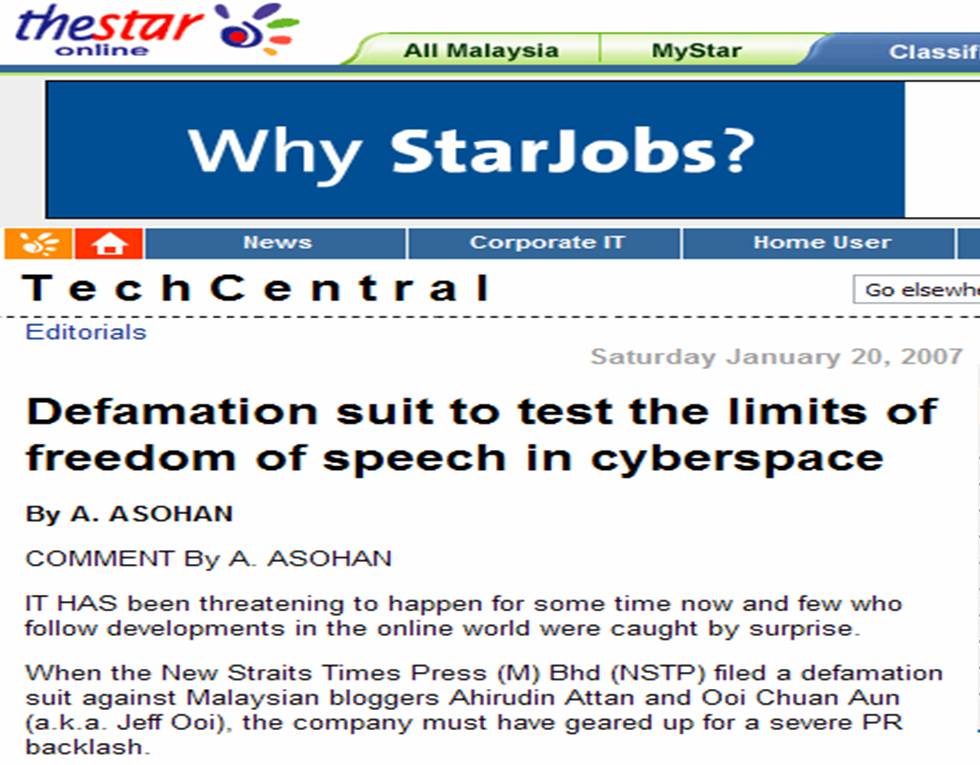
Defamation suit to test the limits of freedom of speech
By A. ASOHAN
January 20, 2007
Defamation suit to test the limits of freedom of speech in cyberspace
IT HAS been threatening to happen for some time now and few who follow developments in the online world were caught by surprise.
When the New Straits Times Press (M) Bhd (NSTP) filed a defamation suit against Malaysian bloggers Ahirudin Attan and Ooi Chuan Aun (a.k.a. Jeff Ooi), the company must have geared up for a severe PR backlash.
The suits were filed by NSTP and its deputy chairman Datuk Kalimullah Hassan, Group Editor-in-Chief Datuk Hishamuddin Aun and former Group Editor Brendan Pereira. NSTP chief executive officer Datuk Syed Faisal Syed A.R. Albar was an additional plaintiff in the suit against Ahirudin.
Ahirudin and Ooi, whose cases will be heard Jan 25 and Jan 30 respectively, must have suspected that something like this was bound to happen sooner or later, and could only hope that they wouldn't be the test cases.
For a few years now, there has been a growing awareness among a cross-section of the local blogosphere that they weren't operating in a legal vacuum, that what they posted on their weblogs or blogs were answerable to the country's laws.
In fact, since last February Ooi had begun carrying a warning on his Screenshots blog (www.jeffooi.com) advising those who posted comments to "bear in mind that whatever is illegal offline is illegal online in this country".
But NSTP would have also known that because it is a major media organisation taking action against two individuals, it would be cast as a David versus Goliath clash. It is going to be an emotionally-charged issue no matter the merits of the case.
One only has to see the reaction of the online community to get an idea. Bloggers are uniting in the face of what they see as intimidation by the powers that be. In various degrees, they see it as a case of mainstream versus alternative media, megacorp versus small fry, old world versus new, controlled versus independent media, repression versus freedom.
Just wait for international media watchdogs and advocates to jump on the bandwagon, too.
Even the foreign wire agencies are painting it in these colours, prominently quoting Opposition Leader Lim Kit Siang's view that the case would have a "chilling effect" on freedom of speech in Malaysia, and that it was a "grave development in the defence of the legal rights of bloggers and citizen journalists in Malaysia to break the stifling monopoly of the mainstream media".
But since when has filing a suit become synonymous with infringing upon one's legal rights? Indeed, wouldn't denying due process to NSTP be an infringement of the plaintiff's rights?
Just as much as bloggers have a right to free and fair comment, those under their scrutiny have a right to legal recourse if they feel they're been portrayed unfairly.
We aren't a failed state yet, the last time I checked.
True, an area of concern would be the ability of Ahirudin and Ooi to mount an effective defence against a relatively deep-pocketed plaintiff, but already supporters of the two bloggers are discussing setting up legal funds for them. Their readers have also noted that some law firms would be happy to defend them on a pro-bono basis.
In a heart-warming way, this is the online community at its best. A movement, Bloggers United, has been formed and has issued a statement that "what you do to any of us, is what you do to all".
The statement added that "as responsible bloggers, we demand and claim our space on the blogosphere for free and fair comment, where important national issues and prominent personalities are discussed."
While there may be extenuating circumstances, which those of us on the outside cannot claim to be privy to, as to why these two bloggers were chosen, a defamation lawsuit involves a third party, in this case the country's legal system, determining if those comments were free and fair.
It also puts the onus on the plaintiff to prove that he suffered "damage" – of reputation, for example – as a result.
The thing is, laws are put in place to protect both individuals and organisations. While they may express their support for the bloggers concerned, surfers should also welcome these lawsuits.
For now lines will be drawn as to what is permissible and what is not in cyberspace; how far you can go in expressing yourself, and more importantly, what legal recourse you have if someone – anyone, including a rival blogger – maligns you on the Net.
Yes, the laws on defamation are there to also protect you, the individual. Given that some political leaders want to introduce new laws specifically for the Internet, that websites and their operators have been threatened with the Internal Security Act, that subtle intimidation has allegedly been tried, and that some media organisations have used their own platforms to unfairly vilify selected bloggers before, it's a welcome change to see existing legislature being used this time around.
Because now, we finally get a case that will also determine just how relevant our laws are in the information age.
Sharifah Aini's Suit - No Complainant?

December 21, 2005
We now hear of a competent Magistrate. His name is Azroul Hisham Azulan.
At the proceedings of Sharifah Aini's defamation suit, all the witnesses were ready. Singer Datuk Sharifah Aini Syed Jaafar was in the courtroom, hoping the defamation against her would begin after a few false starts.
Magistrate Azroul Hisham Azulan would not proceed to hear the case.
Azroul wanted to know whether an official complaint had been filed in this case. He noted that Section 131 of the Criminal Procedure Code stated that no court shall take cognisance of the offence of defamation, among others, except upon complaint made by the person aggrieved by the offence or the Public Prosecutor.
He said the court had examined the charge and found that it did not adhere to the requirements under Section 131 of the Criminal Procedure Code (CPC). Section 131 requires a complaint to be made by the aggrieved person or by the public prosecutor.) “There is no complaint in this case,” he pointed out, saying the court was concerned “whether the proceeding would become a nullity” later.
“Therefore, the court want both parties to submit on this issue before the full trial begins,” added Azroul.
"I want to carry on with the trial but am worried that these proceedings may be nullified or certain irregularities may appear if this matter is not addressed," he said.
Sharifah Aini, 52, is charged with defaming singer Siti Nurhaliza Taruddin in an email to her adopted brother, Ahmad Shaharil Jamaludin, on Aug 24 last year. She is charged under Section 500 of the Penal Code, which carries a maximum two years’ jail or a fine, or both, on conviction.
Sharifah Aini's lead counsel Datuk Muhammad Shafee Abdullah is a well-learned and foxy lawyer. He must have known that if the case proceed, and judgment passed against Sharifah, they would proceed to the Appeal Court to get the Magistrate decision overturned on the point of law as enunciated by Azroul.
Magistrate Azroul has shown his competence in the subject matter.
The judiciary can now be proud of this magistrate's competence. Could other magistrate also show their competence on the legal doctrines and principles? We have yeat to hear of, except the few in the High Court and the great Gopal Sri Ram of the Appeal Court who failed to be promoted to the Federal Court eventhough he is the most senior judge in the Appeal Court, and far senior over the many of the Federal Court judges who had leapfrogged him in promotion over the last decade.
Maunsell, Sharma & Zakaria sues Utusan

March 19, 2006
Civil Engineering Design Consultant,
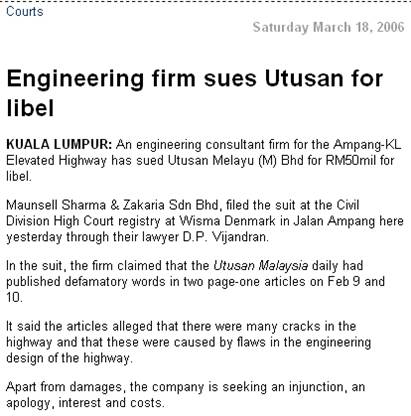
Maunsell Sharma & Zakaria, the consulting firm for the design of Ampang-KL Elevated Highway (KLT) has sued Utusan Melayu (M) Bhd for RM50mil for libel.
Maunsell Sharma & Zakaria Sdn Bhd, filed the suit at the Civil Division High Court registry at Wisma Denmark in Jalan Ampang here yesterday through their lawyer D.P. Vijandran.
In the suit, the firm claimed that the Utusan Malaysia daily had published defamatory words in two page-one articles on Feb 9 and 10.
It said the articles alleged that there were many cracks in the highway and that these were caused by flaws in the engineering design of the highway.
Apart from damages, the company is seeking an injunction, an apology, interest and costs.
Maunsell Sharma & Zakaria is also the design consultant for Middle-ring Road Two (MRR2).

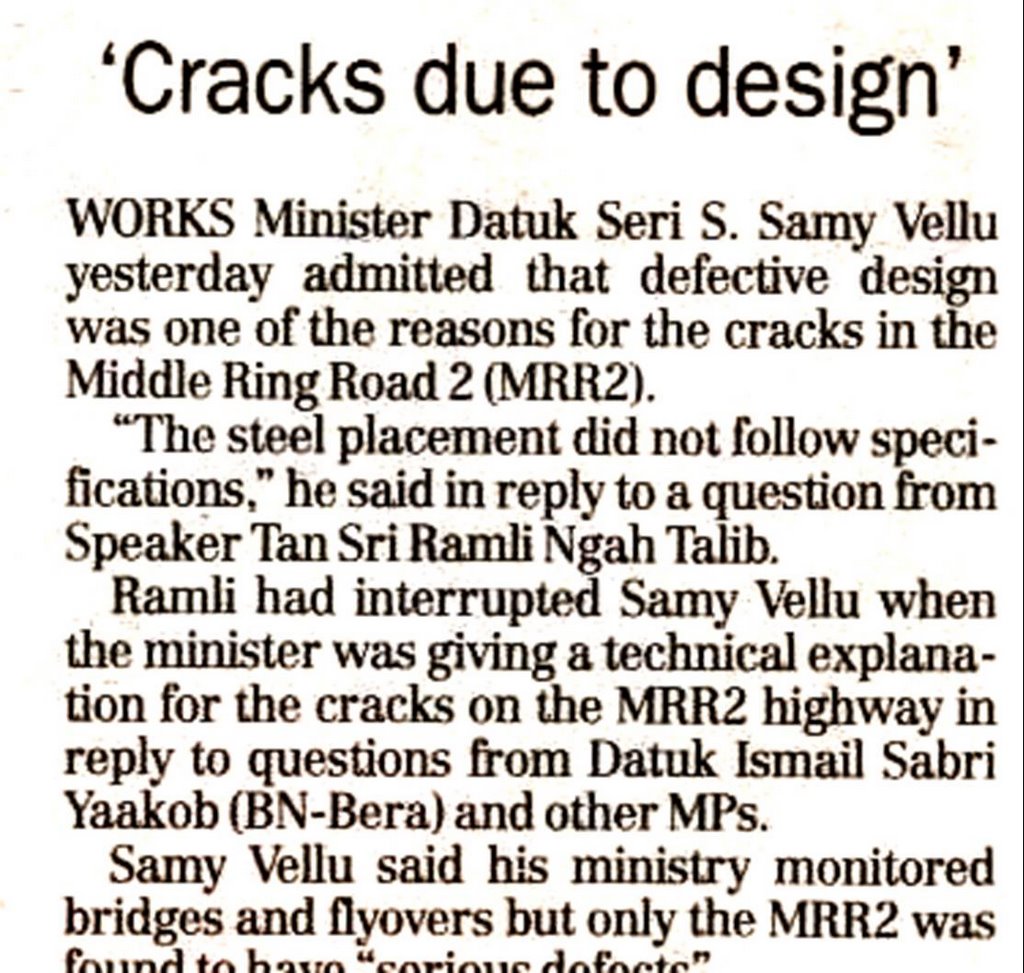
Yesterday, Works Minister
Samy Vellu admitted in Parliament that defective design was one of the reasons for the cracks in the Middle Ring Road 2 (MRR2).
"The steel placement did not follow specifications," Samy said in reply to a question from Speaker Tan Sri Ramli Ngah Talib.
Ramli had interrupted Samy Vellu when the minister was giving a technical explanation for the cracks on the MRR2 highway in reply to questions from Datuk Ismail Sabri Yaakob (BN-Bera) and other MPs.
Samy Vellu said his ministry monitored bridges and flyovers but only the MRR2 was found to have "serious defects".
Wednesday, January 31, 2007
Thiruchelvasegaram v Mahadevi
Thiruchelvasegaram a/l Manickavasegar v Mahadevi a/p Nadchatiram
[2000] 5 MLJ 465
HIGH COURT (KUALA LUMPUR) — CIVIL SUITS NOS S2(S5)–23–04 OF 1997 AND S5–23–08 OF 1997
JAMES FOONG J
22 JANUARY 2000
Catchwords
Tort — Conspiracy —Conspiracy to defame —Allegation of incest —Agreement to conspire — Whether proved
Summary The plaintiff and the defendant are both advocates and solicitors. The plaintiff is the brother-in-law of the defendant, having married the defendant’s eldest sister, Vijayalakshmi. The plaintiff has a daughter, Shanti. The plaintiff claimed that the defendant conspired with her brother (Jega), sister (Saraswathy) and Shanti to defame him. The sting of the defamation was incest by the plaintiff on Shanti. The defamation was said to be contained in: (1) the submission of the defendant to the judge in a civil suit filed by Vijayalakshmi against the defendant; (2) utterance in the court house when the court was not in session; (3) the letter written by Jega to Vijayalakshmi’s solicitor; (4) the letter from the defendant’s solicitors’ firm addressed to the plaintiff’s legal company; (5) remarks written by Shanti contained in an acknowledgement copy of the plaintiff’s letter; (6) the writing on the back of the last page of the serving copy of the writ; (7) the writing on the back of a letter of demand for an apology; and (8) statutory declaration made by Shanti. The plaintiff claimed that the words stated imputed him to be a person of low morals, who had committed the sexual crime of incest and has discredited him and exposed him to hatred, contempt and ridicule in the eyes of the right-thinking members of the society. The defendant pleaded, inter-alia, the defence of absolute and qualified privileged, justification and non-publication. After setting out the substantive defences, the defendant pleaded a general plea.
Holdings
Held:
(1) In a defamation suit, it is well settled that a defendant must expressly plead the particular defence he wishes to rely on against each specific charge of defamation with full particulars; ie the ground and fact on which it is based. The general plea of the defendant related to no particular and distinctive allegation in the statement of claim. The defences raised were not supported by any disclosed facts and grounds. By the defendant’s own admission, this paragraph was intended as a net to capture anything that had been overlooked. This is certainly unacceptable as it will confuse the plaintiffs and take him by surprise. If the defendant is displeased with the so called ‘messy’ pleadings of the plaintiff, she can avail herself of all the remedies provided under the rules and procedures as set out under the Rules of High Court 1980; certainly it cannot be reciprocated with this generalised form of pleading. For this, the court shall not entertain the defences raised in the general plea (see p 482G–H).
(2) After careful perusal of all the relevant evidence and having the opportunity to observe the demeanour of the witnesses, the court found that the claim of incest was not proved, even on the balance of probability (see p 483B–D).
(3) The submissions of the defendant, however defamatory they were of the plaintiff, are protected by absolute privilege. The court accepted the submission when tendered. When this happened, the statements contained in these documents must be considered to be made in the course of legal proceedings (see p 488C–E).
(4) Statements once made remain. When the court expunged them, it was only for the purpose of the court’s process and record. Other than this, the statements remain as statements made. Thus, the defendant’s assertion that since the offending parts of the submissions were expunged by the courts, no defamatory statements exist, was totally unacceptable and was a fallacy (see p 489C–D).
(5) The utterance in the court house when the court was not in session was scandalous based on the finding that there was no truth in the allegation of incest by the plaintiff. Further, the remark was actually uttered by the defendant. A defamatory statement made by counsel outside the court room, with reference to the proceedings, is not entitled to absolute privilege (see p 489D–E, G).
(6) By virtue of ss 5 and 6 of the Defamation Act 1957 in a slander to the plaintiff of his profession, there shall be no necessity for the plaintiff to prove that he has suffered damages. Here, the plaintiff is and was an advocate and solicitor, and the slander inflicted by the defendant on him was calculated to disparage him in his profession (see p 489H–I).
(7) Conspiracy is a cause of action on its own in tort to cover a situation where there is a combination of two or more persons who wilfully injure a man in his trade resulting in damage to him. This cause of action is separate and distinct from that of the tort of defamation which is governed by different factors. By the pleadings of the plaintiff, I am of the view that the allegation of defamation in the letter written by Jega to Vijayalakshmi’s solicitors is more for the tort of conspiracy rather than defamation (see p 490D–H).
(8) The court could not agree to the defendant’s explanation that the letter by the defendant’s solicitors’ firm addressed to the plaintiff’s legal company was to seek clarification. There was no request for clarification nor was there any subject matter that need to be clarified. The contents consisted of derogatory remarks, which had no truth in them. They imply that the plaintiff was a person of low morals, lustful and mean, and for this had exposed him to hatred, contempt and ridicule by the right-thinking members of society. Though the publication of the letter was to the plaintiff’s staff, the defendant was considered liable for defamation when such publication was to the plaintiff’s servant and/or agent (see pp 490I–491A, F).
(9) Though the defendant had clarified that the remarks were written by Shanti, the liability for publication arose from authorization. The defendant is and was the sole proprietor of the legal firm and Shanti was only a legal assistant — an employee of the defendant. By allowing a staff to write defamatory remarks on a document meant and intended for the firm, and approving them amounts to the proprietor of the firm making such statements. For this, the defendant must be held responsible (see pp 491H–492A).
(10) The defendant’s reliance on her assertion that the statement was written in her private office and thereafter placed in a sealed envelope marked ‘private and confidential’ was just not probable. As an advocate and solicitor, the defendant would be aware of the rules and procedures that require such an acknowledgement copy of serving writ to be exhibited to an affidavit of service. With such a practice, she would have known that there could be no confidentiality for this document. So it is most unlikely that she did what she claimed (see p 492C–E).
(11) The plaintiff had not satisfied the court that the defendant directed Shanti to affirm contents in the statutory declaration. Shanti is and was then an adult and a member of the Bar. The court did not think such a serious act as affirming a statutory declaration, Shanti could be forced into it. She must have done this, most probably in furtherance of the conspiracy brought about by inducement by the defendant and Jega. But the court was not convinced to charge the defendant for making this defamatory statement (see p 493F–G).
(12) After considering the evidence as a whole and particularly from the contents of the defamation and how they were executed, the court found the tort of conspiracy proved. The court detected a pattern of concerted actions by the defendant’s group to synchronise their attack on the plaintiff’s reputation and his profession. This is with the sole objective of forcing the plaintiff to influence his wife to compromise on the settlement of the estate property. Though the defendant had expressly denied any part in this scheme to injure the plaintiff in his profession, however the court found that she was and is in the thick and thin of the whole conspiracy as can be noticed by her actions in the carrying out these defamatory remarks in association and in conjunction with the others named. In conspiracy, the tort is committed as soon as the agreement with other conspirators is made, and it continues to be committed so long as the combination persists. The court concluded that the defendant was liable to the plaintiff under this cause of action of conspiracy (see p 494B–F).
(13) Since the slander in this case involved the plaintiff in his profession and imputed him to a crime punishable with a term of imprisonment, there was no necessity for the plaintiff to tender proof of special damages. Undoubtedly, the defamatory remarks by the defendant were of grave and serious nature. The defendant’s act in publishing such defamatory statements over a substantial period; and with malice, had certainly exposed the plaintiff to much hatred, contempt and ridicule by society. The mode of publication of the defamation, especially those on formal and legal documents were contemptuous. It showed the defendant’s total disrespect for the image, integrity and honour of legal profession of which she, herself is a member (see p 495A–B, D–G).
Lawyers
Gurbachan Singh (Malik Imtiaz Sarwar with him) (M Segaram & Co) for the plaintiff.
Lawyers
Mahadevi Nadchatiram (RS Sothi with her) (Mahadevi Nadchatiram & Partners) for the defendant.
Perunding Alam Bina Sdn Bhd v Errol Oh
[1999] 6 MLJ 101
Perunding Alam Bina Sdn Bhd v Errol Oh & Ors
HIGH COURT (KUALA LUMPUR) — SUIT NO S5–23–05 OF 1996
JAMES FOONG J
15 AUGUST 1998
Catchwords
Tort — Defamation — Imputation of unprofessionalism and negligence of architects — Objective test of reasonable man with ordinary intelligence and of general knowledge and experience in worldly affairs applied — Whether defence of justification can succeed — Whether dishonesty and malice proved — Whether public has legitimate right to comment — Whether comments were fair
Summary
The plaintiffs were the architects for plans to build a hospital. The plaintiffs claimed that they were defamed in two articles written and published by the defendants in the newspaper. The plaintiff averred that they were the persons referred to in the articles and, by their natural and ordinary meaning and/or by way of innuendo, it imputed that the plaintiffs were lackadaisical in their supervisory functions as consultant architects, had failed to give out proper instructions, were unethical, unprofessional, negligent, incompetent and were in breach of the architect’s professional code of conduct. As a result of the statements in the articles, the plaintiffs alleged that their credit and reputation were gravely injured and lowered in the estimation of right thinking members of society generally and had also suffered damages. The defendants admitted writing and publishing the articles but raised the defence of justification and fair comment. The issue before the court was whether the words complained of in the articles impute the plaintiffs of some quality which would be detrimental or adverse of such quality which was essential to successfully carry on their profession as architects.
Holdings
Held, dismissing the claim:
(1) To decide on the issue of imputation, the objective test of the reasonable man with ordinary intelligence and of general knowledge and experience in worldly affairs would likely to understand the alleged defamatory words without being fettered with strict legal rules of construction but may include any implications or inferences must be used. In the present case, the first article focused on the unprofessionalism of the architects, ethics and breach of it, safety measures and negligence. These were obviously elements associated with unprofessional conduct. By the natural and ordinary meaning of the words used, an ordinary reasonable person reading the statements would have the impression that the plaintiffs were unprofessional and unethical in their conduct. These statements were therefore defamatory (see pp 106H–107H).
(2) With regard to the second article, except for the paragraph which directly refers to the plaintiffs, the entire alleged defamatory statements relates to the developer. It did not impute the plaintiffs at all. Reading the article as a whole, the court did not believe that an ordinary reasonable man could impute the alleged defamatory statement to the plaintiffs (see p 111A–D).
(3) Though the defence pleaded justification, and even with particulars to certain facts being true, there was no disclosure as to what these facts alleged to be true impute. This particular imputation on the facts alleged to be true was nowhere stated in the statement of defence. Going by the rules of pleadings, where a party’s case must be confined to the four walls of its pleadings, the court found that the defendants’ alleged meaning imputed from the facts disclosed as true could not be accepted. There was no justification asserted that it imputed that the plaintiffs were unprofessional and incompetent in their work. For this, the plea of justification must fail (see p 108B–G).
(4) The articles principally were comments or opinions made by the defendant. Further, the exposure of non-compliance of building plans was certainly a matter of public interest. So was the role of the architects. Not only an honourable and respected profession serving the community was involved, but also the safety factor of structures constructed or to be constructed in this country. On this, the defendant, as a matter of the public had a legitimate right to comment and in the light of the situation, his comments on the conduct and ethics of the plaintiffs were fair. There was no dishonesty and malice on the part of the defendants nor were these ever proved (see p 110C–E).
Lim Kit Siang v Ling Liong Sik
Lim Kit Siang v Datuk Dr Ling Liong Sik & Ors
[1997] 5 MLJ 523
HIGH COURT (KUALA LUMPUR) — CIVIL SUIT NO S3–23–75–1993 CONSOLIDATED WITH CIVIL SUIT NO S2–22–520–1993
ZAINUN ALI JC
7 NOVEMBER 1996
Catchwords
Tort — Defamation — Libel — Whether actual words must be pleaded — Whether words attributed to first defendant capable of bearing defamatory meaning — Whether plaintiff has sufficient cause of action
Summary
The plaintiff, the leader of a political party, brought actions against the defendants. The first defendant was the leader of another political party while the second, third and fourth defendants were the editor, publisher and printer of a local daily newspaper respectively. The causes of action of both suits were based on a statement allegedly made by the first defendant in a speech which was later published by the second, third and fourth defendants. The alleged defamatory statements concerned funds collected by the plaintiff’s political party for the payment of quit rent of Bukit China in Melaka. The first defendant raised the preliminary issues of whether the words set out in the statement of claim were capable of bearing the defamatory meaning as alleged by the plaintiff and whether the statement as published could be defamatory in effect. The issues raised by the second, third and fourth defendants were whether the words published in both reports, read in their ordinary and natural meaning, were capable of being defamatory and whether the plaintiff’s allegations in his statement of claim disclosed a sufficient cause of action against them.
Holdings
Held, striking out the plaintiff’s application with costs:
(1) The alleged defamatory words as uttered must be reproduced in verbatim in the statement of claim and a certified translation must be tendered. To merely describe the substance, purpose or effect of the words was not sufficient. What was important was not the fact that the first defendant had used the defamatory expression but the fact of his having used those defamatory expressions as alleged. Since the alleged defamatory words as pleaded in the plaintiff’s statement of claim (even if it captured the essence of what the first defendant said) was based on the newspaper report and therefore the product of the reporter’s journalistic skills, the statement of claim did not disclose any cause of action against the first defendant (see pp 526D, H–I and 527D–E); Bruce v Odhams Press Ltd [1936] 1 KB 69, Harris v Warre (1879) 4 CPD 125, Workers’ Party v Tay Boon Too [1975] 1 MLJ 47 and Collins v Jones [1955] 2 All ER 145 followed.
(2) With regard to the second, third and fourth defendants, from an objective point of view, the two reports read as a whole did not appear to be capable of bearing any defamatory meaning and thus the statement of claim did not disclose a sufficient cause of action against them (see p 529B–D).
Per curiam
Even if there was a valid cause of action against the first defendant, the statement as reported fell short of being defamatory because there was no identification of the part of the statement which was alleged to be defamatory. Further, a statement is not defamatory merely because it caused damage to the plaintiff. It must either contain the defamatory allegation or the statement itself is false. The alleged statement considered in its natural and ordinary meaning was not capable of being defamatory as alleged and based upon the plaintiff’s answers in the interrogatories, could not be said to be untrue. Thus in the light of this, the plaintiff’s claim would also fail (see pp 527E, H–I and 528A–D); Astaire v Campling & Anor [1965] 3 All ER 666 followed.
Ling Liong Sik v Krishna Kumar
[2002] 2 MLJ 278
Dato’ Seri Dr Ling Liong Sik v Krishna Kumar s/o Sivasubramaniam
HIGH COURT (KUALA LUMPUR) — CIVIL SUIT NO S3(S2)–23–37 OF 2000
ARIFIN ZAKARIA J
9 FEBRUARY 2002
Catchwords
Civil Procedure — Particulars — Application for further and better particulars — Statement of claim and statement of defence — Particulars may be sought only of matters arising from pleadings — Exercise of court’s discretion — Particulars not to be granted of matters of evidence or inference drawn or substitute interrogatories — Whether court should allow application — Rules of the High Court 1980 O 18 r 12(3)
Legal Profession — Professional privilege — Communication between solicitor and client — Information on date and mode of client’s instructions — Privilege applicable to communication for purpose of seeking legal advice — Whether extends to matters observed by solicitors in the course of his retainer
Summary
The claim herein arose out of a letter written by the defendant to the plaintiff, which allegedly contained defamatory allegations (‘the letter’). The defendant claimed that he was at all material times acting for one Dato’ Soh Chee Wen (‘the client’). The contents of the letter were published in the newspapers. Arising from the respective pleadings, the parties applied for further and better particulars pursuant to O 18 r 12(3) of the Rules of the High Court 1980. The plaintiff applied for the following further and better particulars in respect of the amended defence: (a) under para 4, the date when the client left the jurisdiction, the circumstances and reasons why the client had left the jurisdiction and the present address of the client; (b) under paras 6(a) and 6(b), the date and mode of the instructions and the location of the client at the time of the alleged conversation and instructions; (c) under para 6(h), the client’s address and facsimile number to which the letter from the defendant’s office was transmitted and the date and mode of the client’s instruction to do so; (d) under para 6(1), the source of the alleged information or informant, the date of receipt of the alleged information and the position, status and relationship of Lee Chai Huat (‘LCH’) to the client. According to para 6(1) of the defence, the defendant had been informed that LCH had published the letter to the various newspapers. The defendant, on the other hand, applied for further and better particulars of the amended claim. In the plaintiff’s amended claim, the plaintiff pleaded that: (a) the letter was read by the plaintiff’s press secretary (‘OBS’) and the plaintiff’s senior private secretary (‘LLC’) (‘para 5.1(iva)’); (b) the defendant caused or otherwise facilitated the publication of the letter to various newspapers (‘para 5.1(v)’); (c) the defendant had caused or facilitated the publication of the letter on the Internet website of ‘Malaysiakini.com’ (‘para 5.1(vi)’); (d) the defendant, his agents and/or servants had spoken to reporters from various newspapers regarding the letter (‘para 5.1(vii)’); (e) the letter was sent and published in the press two days before the Malaysian Chinese Association’s annual general meeting (‘para 9(b)’); (f) the allegations in the letter were four years old and stale (‘para 9(g)’); and (g) the defendant had acted recklessly and without caring for the truth of the defamatory allegations in the letter or unverified instructions from the client who had fled the country to avoid investigations and charges by the relevant authorities (‘para 10(c)’). The particulars sought by the defendant were: (a) in respect of para 5.1(iva), particulars regarding the person who had allowed OBS and LLC to read the letter; (b) in respect of paras 5.1(v) and 5.1(vi), the time and place of each publication thereof, how and by what way the defendant was alleged to have caused or assisted in the publication of the letter and the identities of the persons to whom the letter had been circulated to and published; (c) in respect of para 5.1(vii), the reporters whom the defendant, his agents and servants had spoken to and the identities of the defendant’s agents and/or servants; (d) in respect of para 9(b), the person by and to whom the letter had been sent; (e) in respect of para 9(g), the person who had made the allegations four years ago; and (f) in respect of para 10(c), the charges that had been or would be brought against the client.
Holding
Held:
(1) The principles governing particulars were that particulars may only be sought of matters arising from the pleading and that the discretion was with the court as to whether to grant an order of particulars. In addition, particulars would not generally be ordered in respect of matters of evidence or inference drawn or substitute interrogatories (see pp 286H–287A).
(2) The particulars sought for by the plaintiff in respect of para 4 of the amended defence were matters of evidence for the defendant to adduce to show whether he had taken reasonable steps to verify the instructions of the client. The circumstances and reasons for the client’s absence from jurisdiction and the client’s present whereabouts did not have any relevance to the present action. Accordingly, the plaintiff’s application for particulars in respect of para 4 of the amended defence was rejected (see p 287F–G).
(3) The particulars sought for by the plaintiff in respect of paras 6(a) and 6(b) of the re-amended defence did not come within the ambit of legal and professional privilege as provided under s 126 of the Evidence Act 1950. The particulars sought for under those two paragraphs were relevant to the issue of verification of the truth of the letter of demand with the client. As such, the defendant was ordered to furnish to the plaintiff the particulars sought for thereunder (see pp 288G, 289C–D).
(4) In respect of the particulars sought for under para 6(h) of the re-amended defence, the defendant was prepared to give the address of the client’s office and the facsimile number to which the letter was transmitted. Legal professional privilege only extended to communications for the purpose of seeking legal advice. It was limited to the information for and the content of any legal advice but it did not extend to matters observed by the solicitors in the course of his retainer. Accordingly, legal professional privilege did not extend to the date and mode of the client’s instructions (see pp 289H, 290A–B).
(5) The particulars sought for in respect of para 6(1) of the re-amended defence were irrelevant to the issue herein and the question of how and from whom the defendant had obtained the information was a matter of evidence for the defendant to adduce at the trial (see p 290F–G).
(6) The particulars sought under para 5.1(iva) of the plaintiff’s claim did not arise out of matters pleaded but rather out of the defendant’s own averment. As such, the defendant’s application for particulars arising under para 5.1(iva) of the amended claim was disallowed (see p 291E–F).
(7) The defendant was not entitled to the particulars sought for under para 5.1(v) of the amended claim. In the re-amended defence, the defendant did not deny the publication in the newspapers except that he did not know that the letter or news feature in respect thereof would be published in the print or electronic media. From the pleadings, it was obvious when the publication had taken place and the defendant had admitted that he had written the letter. It was a matter of evidence as to how the letter got into the hand of the newspapers concerned and it was certainly not for the plaintiff to furnish the particulars thereof (see p 292A–B).
(8) In respect of the particulars sought under para 5.1(vi) of the plaintiff’s claim, the time and place of circulation were matters of evidence and therefore the plaintiff need not give the particulars. The defendant did not deny that he had written the letter, the only dispute was as to how the letter was published on ‘Malaysiakini.com’. Again, this was a matter of evidence. As such, the defendant’s application on matters arising under para 5.1(vi) was disallowed (see pp 293G, 294D).
(9) In so far as the plaintiff’s pleading in para 5.1(vii) related to the defendant’s agents or servants, the plaintiff properly ought to give particulars of the agents or servants and the reporters of the respective newspapers as it would be a difficult task for the defendant to prepare his defence without knowing who the relevant servants or agents were and the reporters to whom they were alleged to have spoken to (see p 294H–I).
(10) The particulars sought for in respect of para 9(b) of the plaintiff’s claim were irrelevant for the purpose of para 9(b) as the facts pleaded therein were only to support the plaintiff’s claim for exemplary damages (see p 295G–H).
(11) As for the particulars sought under para 9(g) of the amended claim, since the plaintiff had raised the matter in his pleading, it was fair that the plaintiff provide the particulars asked for to enable the defendant to prepare his case (see p 296C–D).
(12) The particulars sought by the defendant in respect of para 10(c) were highly relevant to the issue of the credibility of the client. If the client had in fact fled the country to avoid investigations, the defendant ought therefore to exercise more care in acting on the instructions of the client. This was relevant to the issue of whether the defendant had in the circumstances acted recklessly or without caring (see p 296H–I).
Ummi Hafilda v Karangkraf Sdn Bhd
[2000] 6 MLJ 532
Ummi Hafilda bte Ali & Anor v Karangkraf Sdn Bhd & Ors (No 2)
HIGH COURT (KUALA LUMPUR) — SUIT NO S2(S5)–23–38 OF 1999
KAMALANATHAN RATNAM J
31 MAY 2000
Catchwords
Tort — Defamation — Libel — Allegation of wedding reception of single woman and involvement in defaming Deputy Prime Minister — Attempt to stir hatred against plaintiffs — Deprivation of opportunity to court someone of the opposite sex — Re-publication of internet webpage, whether amounted to publication of defamatory statement — Test applied — Compensatory damages awarded — Whether exemplary damages ought to be awarded
Summary
The plaintiffs sued the defendants for publishing an article about them in Bacaria. Both plaintiffs played a key role as witnesses in the corruption trial against the former Deputy Prime Minister of Malaysia. The headline on the front page of Bacaria stated: ‘Ummi Hafilda NIKAH’. The article alleged that the first plaintiff had married one Khairuddin, which the second plaintiff maintained that the name referred to him. The article further alleged that the wedding reception had to be on a modest scale because it was not well received by the local folk because of the plaintiffs’ involvement in defaming the Deputy Prime Minister. The plaintiffs claimed that the article was untrue and false and thus had defamed them. Both plaintiffs claimed a sum of RM10m as general or compensatory damages and for exemplary damages. The defendants submitted that the impugned passages in the article were picked up from the Internet news and that by reporting such news the defendants had in fact shown the falsity of such news. Further it was submitted that whilst the headline read ‘Ummi Hafilda NIKAH’, yet the final passage on that same front page quoted the first plaintiff’s brother as denying that the first and second plaintiffs were married. Therefore it was urged to apply the balm of the brother’s denial to soothe the bane of the headline.
Holdings
Held:
(1) Whilst the words per se ‘she is married’ are not defamatory but when they are directed towards a single woman who upon the admitted knowledge of the defendants had her face on the front page of major newspapers and whose character and personality had been exposed in the newspapers as a star witness in the Anwar Ibrahim corruption trial, under such circumstances the innuendoes and inferences that an ordinary man in the street would draw from the headline and the subsequent passages would convey the meaning attributed to the words by the plaintiffs (see pp 539I–540A).
(2) The allegation that the plaintiffs had conspired to defame Dato’ Seri Anwar Ibrahim was a serious allegation and an attempt to stir the hatred of the villagers against the plaintiffs. If left uncorrected, this article would tend to cause a rift between the plaintiffs, their parents and the villagers. The allegation was an attempt to label the plaintiffs as liars and/or perjurers. It cast serious aspersions upon the conduct and character of both the plaintiffs (see p 541G–H).
(3) The passages in the article suggested that both the plaintiffs were married. This is an unfair statement to make, knowing full well that they were indeed not married. Such a statement had clearly deprived the chance of each of them being free to meet someone or to court someone of the opposite sex (see p 542F–G).
(4) The court accepted the plaintiffs’ submission that the impugned publications had injured their reputation and credibility. The publication when read by a fair minded and ordinary member of the public would hold the plaintiffs in odium and contempt (see p 542G–H).
(5) The defendants’ failure to produce the printed Internet webpage must be held against them. Alternatively their failure to produce the writer’s or journalist’s notes as the source of the articles must also be held against them. The journalist did not make any effort to ascertain the truth or otherwise from the plaintiffs themselves. In any case, even if there was a re-publication of the Internet webpage, this in itself is publication of the defamatory statement (see p 543A–C).
(6) Whilst the headline stated in black bold print ‘Ummi Hafilda NIKAH’, the defendants had juxtapositioned the words ‘Azwan Ali jelas status adik’ in white print embedded in a splash of black with ray-like edges to highlight what Azwan Ali had said. Had that juxtapositioned statement not been positioned as it had been, the court might have been persuaded to reject the first passage as having any defamatory connotation applying the bane and the balm principle. However, far from soothing the wound, the defendants had indeed exacerbated the hurt (see p 544B–C).
(7) The court was satisfied that this was a case where compensatory damages ought to be awarded against each of the defendants. Taking into consideration the fleeting appearance of both the plaintiffs in the limelight of publicity generated solely due to the Anwar Ibrahim corruption trial, the court awarded each of the plaintiffs a sum of RM25,000 against each of the defendants (see p 544D–E).
(8) The defendants were out to sensationalize the so-called marriage of the plaintiffs to sell their Bacaria. They must therefore pay. Therefore the court awarded each of the plaintiffs a further sum of RM25,000 against each of the defendants. However, the court found that this was not a case for exemplary damages. Whilst there was the element of gain in the form of profits by the sale of Bacaria, the plaintiffs had failed to show that there was such extensive profit as to warrant an award under this head (see p 544H–I).
JB Jeyaretnam vs Goh Chok Tong
JB JEYARETNAM v GOH CHOK TONG
[1985] 1 MLJ 334 (also [1984-1985] SLR 516)
OCJ SINGAPORE — SUIT NO 4474 OF 1981
THEAN J
28 NOVEMBER 1984
Catchwords
Defamation — Slander — Words published by defendant at press conference — Whether defamatory of plaintiff Fair comment — Qualified privilege — Damages and injunction — Defamation Act (Cap 32), s 5
Summary
The plaintiff, the secretary-general of the Workers’ Party in Singapore, was invited as the only guest speaker on September 21, 1981 at the inauguration of the Singapore Democratic Party. After his speech he left the meeting and at that time or immediately following his departure a large section of the audience also left. The Parliamentary by-election for the constituency of Anson was to be held on October 31, 1981. The defendant, the Minister for Defence and second Minister for Health in the Singapore Government, was the first organizing secretary of the Peoples’ Action Party and was therefore most concerned at securing the return of the PAP’s candidate at the by-election.
On October 26, 1981 the defendant held a press conference at which representatives of the media were present. He said:
“SDP had their inaugural (sic) earlier this month. Mr. Jeyaretnam attended. After Mr. Jeyaretnam had spoken, he left the hall, and when he left the hall 200 participants left with him. I believe the exodus was engineered. I don’t think it was a spontaneous exodus. If it was, it did not speak well for the SDP. It shows that the crowd, the limited crowd still look towards Mr. Jeyaretnam, for the time being, as a leader of the opposition. But I am inclined to believe that the exodus was contrived by the leader of the Workers’ Party to show who is boss at this stage. And surely Mr. Chiam cannot take that trick lightly.”
The plaintiff complained that these words were defamatory of him and he sued the defendant claiming damages and an injunction. The plaintiff also relied on section 5 of the Defamation Act, claiming that the words were calculated to disparage him in his office as leader of a political party and in aspiring to be a Member of Parliament.
The defendant denied that the words in their natural and ordinary meaning were calculated to disparage the plaintiff in his office as the secretary-general of the Workers’ Party. The defendant also raised the defences of fair comment and qualified privilege.
Holdings
Held: dismissing the claim:
(i) the words spoken by the defendant were capable of a defamatory meaning and were defamatory of the plaintiff. The words imputed to the plain tiff dishonourable or discreditable conduct or motive or a lack of integrity and such an imputation was defamatory of the plaintiff. However, the words though defamatory of the plaintiff were not calculated to disparage him in his office as the secretary-general of the Workers’ Party. They did not ipute any want of integrity or corrupt or dishonest conduct or any other misconduct in the discharge of that office. On this issue the plaintiff failed;
(ii) the defendant had succeeded in establishing the four elements necessary to find his defence of fair comment;
(iii) the plaintiff has failed to discharge his burden of proving that the defendant was actuated by malice when he uttered the words complained of. The action was accordingly dismissed with costs.
MGG Pillai vs Vincent Tan
MGG Pillai v Vincent Tan Chee Yioun & other appeals
COURT OF APPEAL (KUALA LUMPUR)
— CIVIL APPEAL NOS W–02–221–94, W–02–222–94 AND W–02–223–94
LAMIN PCA, GOPAL SRI RAM JCA AND ABU MANSOR JCA
[1995] 2 MLJ 493
22 MAY 1995
Catchwords
Tort — Defamation — Libel in magazine — Apology — Whether sufficient and unqualified apology — Whether merely conditional apology
Tort — Damages — Defamation — Apportionment of damages — Defendants severally liable — Whether damages may be awarded separately against each defendant — Defamation Act 1957 s 18
Evidence — Conspiracy — Whether must be proved only by direct evidence — Whether circumstantial evidence sufficient
Summary
The respondent, a well-known and successful businessman in Malaysia and internationally, brought an action against the appellants and other persons claiming damages for defamation and for conspiracy to defame. His complaint was in respect of a series of articles (‘the articles’) appearing in a magazine called Malaysian Industry(‘the magazine’). At all material times, the third appellant was its editor-in-chief, while the first appellant authored one of the articles complained of. The second and fourth appellants were the printer and publisher, respectively, of the magazine in question. Prior to the commencement of the action, the third and fourth appellants published an apology, without first sending a draft thereof to the respondent’s solicitors for approval, in a later issue of the magazine which, inter alia, stated that ‘we further apologize if the said articles tarnished the reputation of the [respondent]’. The writ in these proceedings was served on 28 February 1994. Amongst the appellants, only the second delivered a defence to the action. The court then made an order on 22 August 1994, pursuant to a summons for directions, setting the action down for trial which commenced on 10 October 1994. The trial then went on from day to day, even exceeding the period originally assigned to it, until its conclusion. After reserving judgment for a few days, the High Court judge found the appellants and the other defendants liable and awarded separate sums of general damages against them. [See [1995] 1 MLJ 39 .] The appellants then appealed to the Court of Appeal. At the appeal, counsel for the first and second appellants argued that: (a) the trial had proceeded with undue haste; (b) the damages claimed had not been proved; and (c) the award made by the trial judge was too high and out of line with the usual trend of awards for plaintiffs in defamation actions. Counsel for the third and fourth appellants contended that: (a) the trial judge was wrong in finding the third and fourth appellants liable; (b) the award made was too high; (c) the trial judge failed to take into account the apology published by the third and fourth appellants which should have reduced the award made against them; and (d) the trial judge erred in making separate awards against each app ellant.
Holdings
Held, dismissing the appeals:
(1) (Per Lamin PCA) Where a person’s character was being assailed and the facts were so fresh in everyone’s mind, justice could not have been better served than with the judge making an immediate assessment of the evidence and delivering his findings without delay.
(2) (Per Gopal Sri Ram JCA) A judge who had scheduled a case for a limited number of days was entitled to proceed beyond the period to complete the trial. Indeed, it was desirable that such a course be adopted in all cases. To avoid problems, inter alia, of recalling the evidence and exhibits, it was best that trials be proceeded with to their conclusion instead of being adjourned midstream.
(3) (Per Gopal Sri Ram JCA) The grant or refusal of an adjournment was a matter within the discretion of a judge and an appellate court ought not to interfere with such a decision unless it could be demonstrated that the refusal resulted in the deprivation of essential justice from an appellant. The only legitimate expectation which a plaintiff or a defendant had was that he would obtain justice according to law. Applying this principle, it was clear that the trial judge had acted correctly in directing the trial to proceed to completion, in handing down an early decision and in making available his written reasons shortly thereafter.
(4) (Per Gopal Sri Ram JCA) The contention that the trial judge was wrong in finding the third and fourth appellants liable was baseless considering that they had not delivered a defence. It was well-settled practice that a defendant who elected not to plead to a statement of claim in a libel action was confined only to challenging the measure of damages which the plaintiff ought to receive.
(5) (Per Gopal Sri Ram JCA) Libel is a tort actionable per se, ie without proof of actual harm. The law presumes that when a man’s reputation is assailed, some damage must result. While a claim for special damages must be specifically pleaded and proved, the claim by the respondent was only for general damages which need not be so pleaded and proved. Although the respondent was the only witness called to prove his case ,when considering the quality of evidence, each case depended upon its own facts. In the present case, the venom with which the respondent was attacked by the first appellant in his article coupled with the respondent’s status in society were sufficient indicia of the extent of harm suffered. The trial judge had correctly accepted the respondent’s evidence. Thus the argument that the damages claimed had not been proved could not succeed.
(6) (Per Gopal Sri Ram JCA) There are certainly no comparables as regards quantum of damages in libel actions in Malaysia unlike those which exist in personal injury cases. Thus it could not be argued that the award in the present case was out of line with the trend of damages usually awarded in libel actions.
(7) (Per Gopal Sri Ram JCA) In assessing damages, there is no basis for any judicial policy that is directed at awarding very low damages for defamation. Injury to a person’s reputation may occasion him at least as much, if not greater, harm than may injury to his or her physical self.
(8) (Per Gopal Sri Ram JCA) In appropriate cases, the profession or standing of a defendant in society is a relevant factor to take into account when a court considers what damages to award against a defendant. In the absence of any special or exceptional circumstances, it will be proper for a court to award substantial damages against a journalist who has, without any or any sufficient basis, taken a plea of justification. Further, the wider his readership or popularity, the greater should be the award.
(9) (Per Gopal Sri Ram JCA) A court is entitled and should have regard to the conduct of a defendant in a libel action. Such conduct will have a bearing on the making of an award for exemplary damages.
(10) (Per Gopal Sri Ram JCA) The second appellant expressly placed a plea of justification on record with no material in support. The first appellant, while he did not deliver a defence, conducted a cross-examination of the respondent on the footing that the facts appearing in his article were true. As damages multiplied when justification failed, and having regard to the facts of the case, the trial judge’s awards against the first and second appellants were neither excessive nor exorbitant. The Court of Appeal should not interfere with the exercise of the trial judge’s discretion upon a matter where opinions could, and did, vary quite widely. Similarly, the awards against the third and fourth appellants were not too high and should not be interfered with.
(11) (Per Gopal Sri Ram JCA) An apology, although not exonerating a defendant, has the effect of reducing the quantum of damages, in some cases substantially so. In the present case, the apology published by the third and fourth appellants was conditional and was not a full and frank withdrawal of the libel contained in the articles and neither was it a complete and unqualified apology or a fair retraction. Thus it could not be argued that the apology should have reduced the awards made against the third and fourth appellants.
(12) (Per Gopal Sri Ram JCA) The appellants together with the other defendants were sued and found liable as several and not as joint tortfeasors. Thus the trial judge could make separate awards against each appellant.
Per curiam:
(1) (Per Gopal Sri Ram JCA) A plaintiff in a libel action was not bound by O 19 r 7 of the Rules of the High Court 1980 to enter default judgment following the failure of a defendant to serve a defence. He was entitled to proceed and set the action down for hearing for the purpose of vindicating his reputation and to have damages assessed.
(2) (Per Gopal Sri Ram JCA) Conspiracy is a tort that is not always capable of proof by direct evidence. An agreement to do an unlawful act or a lawful act by unlawful means may be established by evidence of circumstances from which such an agreement may be inferred. However, there must be proof and not mere conjecture.
(3) (Per Gopal Sri Ram JCA) While it is settled law and practice in libel actions tried with a jury that a judge does not give any direction or guidelines as to assessment of quantum of damages, actions for defamation in Malaysia are tried by a judge alone who is obliged to provide reasons for every decision which he hands down. Thus there is warrant to rely on guidelines for assessment of damages appearing in non-jury jurisdictions such as India and Singapore, although this is a matter upon which our courts must evolve their own criteria based upon our own values and conditions that prevail here.
(4) (Per Abu Mansor JCA) It is trite law that no special damage need be pleaded and proved if the defamatory matter speaks of a plaintiff in the way of his profession, office or calling and the plaintiff only claims general and not special damages.
(5) (Per Abu Mansor JCA) I think the court has to take a stand and deliver the message to all journalists and the media alike that they must act responsibly. They ought to know that they have a large following and that the reading public holds them in high esteem and has the tendency to accept what is written as gospel truth. They should, therefore, act with responsibility.
Lawyers
1. Karpal Singh (Karpal Singh & Co) for the appellant in Civil Appeal No W–02–221–94.
2. Karpal Singh (J Ramdhari with him) (KC Yap, Kamaludin & Partners) for the appellant in Civil Appeal No W–02–222–94.
3. Shamsul-Baharain (Chan Chong Choon with him) (Skrine & Co) for the appellant in Civil Appeal No W–02–223–94.
4. VK Lingam (W Satchithanadhan, V Sivaparanjothi and Adam Bachek with him) (Adam Bachek & Associates) for the respondent.
Read Gopal Sri Ram's full judgment
here
Tuesday, January 30, 2007
Reynolds v Times Newspapers Ltd
Reynolds v Times Newspapers Ltd and others
[1998] 3 WLR 862, [1998] 3 All ER 961, [1998] EMLR 723
Court of Appeal (Civil Division)
Lord Bingham of Cornhill C.J., Hirst and Robert Walker L.JJ.
Defamation - Privilege - Qualified - Newspaper publication concerning public figure engaged in political events - Whether defence of qualified privilege available - Whether privilege attaching to publication
The plaintiff, a prominent public figure in Ireland, began proceedings for defamation against the defendants, the publishers of an article contained in the British mainland edition of a national newspaper. The publication related to the political crisis in Ireland in 1994 culminating in the plaintiff's resignation as Taoiseach, and the collapse of his coalition government which had, during its course, progressed the peace process in Northern Ireland. The plaintiff claimed that the words complained of bore the meaning that he had deliberately and dishonestly misled the Dáil by suppressing crucial information about the Irish Attorney-General, whose appointment to the Presidency of the High Court he had sought to promote, and had similarly misled his cabinet colleagues by withholding the information and by lying as to when he had obtained it. The defendants pleaded, inter alia, the defence of qualified privilege at common law on the ground that, consonant with article 10 of the European Convention for the Protection of Human Rights and Fundamental Freedoms,fn1 the public interest in the general publication of information and discussion relating to political issues and the public conduct of elected politicians engaged in them justified such protection. The judge ruled that the defence was not available. The jury returned a verdict in the plaintiff's favour and he was awarded the sum of 1p by way of damages.
On the plaintiff's appeal and the defendants' cross-appeal: -
Held, (1) dismissing the cross-appeal, that the common welfare of a modern plural democracy was best served by ample dissemination of information to the public and vigorous discussion of matters relating to the public life of the community and to those who participated in it; that, in maintaining a proper balance between freedom of speech and a public figure's right to his reputation and consistently with article 10, the defence of common law qualified privilege was available where the defendant had a legal, moral or social duty to publish the information to those, including the general public, who had a corresponding interest in receiving it, such tests to be more readily satisfied than formerly, and where the nature, status and source of the information and the circumstances of its publication were such that it should be protected in the absence of malice; that since the task of the press in informing the public on a matter which was of general concern in Great Britain constituted such a duty and since there was a general public interest in receiving that information, the duty and interest tests were satisfied, but that, since the nature, status and source of the information and the circumstances of its publication were not such, on the facts, as to justify its protection, the defence was not available (post, pp. 899E-G, 900G, 905G, 906A, 909B-C, 910A-B, 911A).
(2) Allowing the appeal and ordering a new trial, that since the judge's factual misdirections in the summing up, taken cumulatively, were such as to deny the plaintiff a fair trial, the jury's verdict and the judgment would be set aside (post, pp. 880B-D, 881H-882A, 887D-E, 888B-D, 889H-890D).
Appeal and Cross-Appeal from French J. and a jury.
By a writ and statement of claim dated 18 August 1995 the plaintiff, Albert Reynolds, claimed:
(1) damages for defamation against the defendants, Times Newspapers Ltd, Alan Ruddock, John Burns and John Witherow, in respect of an article written by the second and third defendants and published by the defendants in the issue of The Sunday Times" for 20 November 1994 and
(2) an injunction restraining further publication of the same or similar words. The plaintiff asserted that in the context of the article as a whole the words complained of in their natural and ordinary meaning meant and were understood to mean that (1) in promoting the appointment of the Irish Attorney-General to the Presidency of the High Court of Ireland the plaintiff had deliberately and dishonestly misled the Dáil by suppressing information he possessed which would render the promotion out of the question; (2) by withholding the information from his coalition cabinet colleagues the plaintiff had deliberately and dishonestly misled them and (3) the plaintiff had lied to those colleagues about when the information came into his possession.
By their amended defence re-served on 4 November 1996 the defendants (1) denied that the words bore or were capable of bearing such meanings, alternatively (2) claimed that the words were published on an occasion of qualified privilege, in particular since (i) they were published in the course of public discussion and political debate concerning the views and conduct of the plaintiff and of other public officers of the Irish government in respect of the discharge of his and their public functions and in particular in the context of the collapse of the coalition government and the plaintiff's resignation as Taoiseach; (ii) the words related wholly to the plaintiff's conduct in his public roles and/or as an elected representative and leader of Fianna Fáil party and to his suitability for such roles; (iii) the reasons for the collapse of the coalition were of considerable importance and interest in the United Kingdom because of the critical stage of the peace process in Northern Ireland; (iv) the words correctly reported the stated reasons for the break up of the coalition, as stated, inter alia, by the spokesman of Mr Dick Spring, the leader of the Labour party, and accordingly (v) the defendants were under a duty, had a legitimate interest and were entitled as publishers, journalists and editor of "The Sunday Times," to communicate the information and opinions contained in the words complained of to their readers who had a legitimate interest in receiving them; alternatively the words were true. By his reply the plaintiff asserted that the defendants had been actuated by express malice.
During the course of the trial, John Burns gave evidence from which it was apparent that he bore no responsibility for the article and the judge accordingly directed that the action be discontinued against him. On 19 November 1996 the jury found in the plaintiff's favour but declined to make any award by way of damages. By his order the judge substituted an award in the sum of 1p, ruled that the defence of qualified privilege was not available to the defendants, and dismissed their application for costs up to the date of a payment into court, refusing them leave to appeal from that part of his order.
By a notice of appeal dated 20 December 1996 the plaintiff appealed on the grounds, inter alia, that (1) the summing up, which required particular care and thoroughness because the facts were complex, the evidence interrupted by illness and an interval of seven days occurring between the plaintiff's closing address and the retirement of the jury, was so confusing and unstructured, with large tracts of evidence unsummarised, that it was of no material assistance to the jury; (2) the summing up might have misled the jury into thinking that the words complained of could be defended as fair comment; (3) when purporting to summarise key factual issues the judge showed a fundamental misunderstanding of them; (4) in purporting to sum up, at the plaintiff's request, crucial factual issues the judge gave confusing directions; (5) the judge mistakenly transposed plaintiff and defendants in referring to issues of fact and to the submissions such that the transpositions were particularly prejudicial to the plaintiff; (6) the judge failed to sum up the plaintiff's factual case on malice; (7) the judge gave a seriously inadequate direction of the question of damages; and that in all the circumstances his misdirections and failure to put the plaintiff's case fairly to the jury resulted in justice neither being done nor seen to be done.
By notices of appeal, dated 23 December 1996 and 31 January 1997, and pursuant to leave granted by McCowan L.J., the defendants cross-appealed on the grounds, inter alia, that the judge (1) erred in law in holding that the defence of qualified privilege at common law was not available to them on the facts found by the jury; (2) misunderstood the meaning and relevance of the chilling effect" of libel actions, referred to in Derbyshire County Council v Times Newspapers Ltd [1993] AC 534, as inhibiting freedom of speech; (3) erred in considering that the defence of qualified privilege failed where the matters published did not constitute an urgent warning to the public about an imminent danger; (4) failed to have regard to the constitutional importance of the public interest considerations underlying the defence; (5) failed to recognise the reciprocity of duty and interest between the media and the public where the defamatory material was published in the course of public discussion and debate about political matters; (6) failed to have regard to the principle of freedom of speech contained in article 10 of the European Convention for the Protection of Human Rights and Fundamental Freedoms (1953) (Cmd. 8969) which accorded with the common law principle of free speech; and (7) failed to have regard to the political nature and content of the publication complained of; (8) erred in law in ruling that the jury were not entitled to award the plaintiff no damages and in substituting a nominal award; (9) failed to direct himself on the established principles that costs should be awarded to the party which had in substance and reality won the action; and (10) erred in holding that the plaintiff had obtained something of value and was therefore entitled to his costs.
The facts are stated in the judgment of the court.
Lord Lester of Herne Hill Q.C., James Price Q.C. and Emma Dixon for the defendants.Andrew Caldecott Q.C. and Benjamin Hinchcliff for the plaintiff.
Cur. adv vult.
8 July. Lord Bingham of Cornhill C.J. handed down the following judgment of the court.
Introduction
I
This is the judgment of the court to which all members have substantially contributed.
This is an appeal by the plaintiff, Mr Albert Reynolds, seeking a new trial in a libel action which was heard by French J sitting with a jury. The outcome was that Mr Reynolds was awarded 1p damages and was ordered to pay the defendants' costs as from the date of a payment into court. The defendants (Times Newspapers Ltd as publisher of the Sunday Times and the individuals who were at the material time editor and Irish editor of that newspaper) have a cross-appeal raising important issues as to qualified privilege, and a further cross-appeal relating to costs down to the time of the payment-in. The libel action was concerned with the political crisis in Dublin in November 1994 which culminated in the resignation of Mr Reynolds as Taoiseach (Prime Minister) and leader of Fianna Fail. Before going further into the issues in the appeal and cross-appeals it is necessary to summarise the course of the political crisis and also the course of the proceedings in the libel action.
II
Mr Reynolds had been a member of the Dail Eireann since 1977. In February 1992 he became Taoiseach, heading a coalition of his own party (Fianna Fail) and Labour under Mr Dick Spring. Mr Spring was Tanaiste (Deputy Prime Minister) and Minister for Foreign Affairs. As is well known, during the course of this coalition Mr Reynolds and Mr Spring together did much to promote the Northern Ireland peace process. The future of the coalition was a matter of public interest in Great Britain as well as in Ireland.
However the coalition had its tensions and difficulties. The final difference, which developed into the political crisis at the centre of this case, was over the Attorney General, Mr Harold Whelehan SC, and the inaction of his office in the matter of an extradition warrant. Mr Whelehan had been appointed as Attorney General in September 1991 and had become a rather controversial figure. (Under the Irish Constitution the Attorney General acts as an impartial legal adviser to the government; he regularly attends cabinet meetings but does not sit in the Dail and is not a member of the government.) Since about October 1993 Mr Reynolds and Mr Spring had been discussing forthcoming vacancies in the senior judiciary, including an expected vacancy in the office of the President of the High Court (the second highest judicial office in the Republic) if, as in fact occurred, the incumbent President was appointed as Chief Justice. Mr Reynolds favoured the appointment of Mr Whelehan. Mr Spring was initially against the appointment but then took the position that he would not oppose it if there was a comprehensive review of the system of judicial appointments and a new Court of Appeal.
The fragile understanding over the appointment of Mr Whelehan was then shaken and destroyed by the Smyth affair. Father Brendan Smyth was a Roman Catholic priest wanted by the Royal Ulster Constabulary on charges of sexual abuse of children in Northern Ireland. An extradition warrant prepared by the RUC had been in the Attorney General's office for seven months without any substantive action being taken on it. The matter was exposed in the Irish press in October 1994. It received wide publicity and caused wide public concern. It raised a new issue as to the suitability of Mr Whelehan for appointment as the Republic's second senior judge.
The appointment was to have been discussed at a meeting of the coalition cabinet on Thursday, 10 November, but a terrorist incident at Newry preoccupied the cabinet on that day and a further meeting was arranged for Friday, 11 November. Before that meeting Mr Reynolds had obtained from Mr Whelehan a written memorandum dated 9 November in which Mr Whelehan sought to explain the handling by his office of the request for the extradition of Father Smyth. That memorandum (which ran to some ten pages) stated that Mr Whelehan himself had been unaware of the warrant, that the matter did not appear to be urgent, and that there were several legal issues to be considered, including para (bbb) of s 50(2) of the Republic's Extradition Act 1965 (that paragraph having been added by the Extradition (Amendment) Act 1987). The memorandum stated:
'This provision . . . had never had to be applied until this case. My interpretation of its meaning and effect would establish the criteria which would be applied in this office for future requests, whether for simple burglary or for serious subversive offences.'
At the cabinet meeting on Friday, 11 November Mr Reynolds supported Mr Whelehan's appointment as President but Mr Spring and his Labour colleagues opposed it. When Mr Reynolds persisted and said that he intended to invite Mrs Maire Geoghegan-Quinn, the minister for justice, to move Mr Whelehan's appointment, Mr Spring and the other Labour ministers withdrew from the meeting (so ensuring that their absence would be minuted; an adverse vote in the cabinet would not be minuted). Despite their withdrawal the Fianna Fail members of the cabinet decided on the appointment and Mr Whelehan (who was in attendance at the cabinet meeting but not present for the discussion of his appointment) was that evening appointed as President of the High Court by Mrs Mary Robinson, the President of the Republic. He was not however sworn in on that day. Mr Eoghan Fitzsimons SC was appointed as the new Attorney General.
Two significant events occurred during the course of the weekend. On the Sunday evening there was a meeting of the Labour parliamentary party at which the Labour deputies decided to attack Fianna Fail over the Smyth affair and the lack of accountability in the Attorney General's office. The meeting was followed by a press conference. On the same day (and either in anticipation or in consequence of the Labour decision) Mr Reynolds, through Mrs Geoghegan-Quinn, asked the new Attorney General to undertake a full and urgent investigation of the Smyth file, and Mr Fitzsimons telephoned some of the officials in the Attorney General's office in order to put the investigation in train first thing on Monday.
The political crisis developed and reached its climax during the next three days (and nights): Monday, 14, Tuesday, 15 and Wednesday, 16 November. In brief summary (more detail will have to be added in considering the judge's summing up) Mr Fitzsimons discovered on the Monday that there was an earlier case in which s 50(2)(bbb) had been considered, and moreover had been considered by Mr Whelehan. This was the Duggan case, although the new Attorney General did not know (or could not recall) its name until prompted by Mrs Geoghegan-Quinn from notes which she had. This information was conveyed orally to Mr Reynolds on the same day but without any clear advice as to its significance. Mr Fitzsimons indicated that a senior civil servant in his office was taking a different view from that which he (the new Attorney General) was disposed to take. Mr Reynolds said that he did not want 'on the one hand, on the other hand' advice and asked Mr Fitzsimons to discuss the matter with Mr Whelehan and to produce definitive written advice. Mr Fitzsimons was told of potentially grave consequences for Mr Whelehan and was asked to request Mr Whelehan to postpone his swearing-in as President of the High Court. Mr Fitzsimons saw Mr Whelehan that evening. He declined to postpone his swearing-in.
On the Tuesday morning Mr Fitzsimons did further work on the Smyth and Duggan cases and prepared an answer (to the question 'was this the first time that the section was applied?') to be given in the Dail by the minister for justice, Mrs Geoghegan-Quinn. His morning's work was interrupted by his attendance at Mr Whelehan's swearing-in at the Four Courts. Mr Whelehan gave Mr Fitzsimons a letter setting out his (the former Attorney General's) position. Mr Fitzsimons delivered his written advice and the draft answer to the Taoiseach's office, but by then (about 2.25 pm) Mr Reynolds had left his office for the Dail chamber.
On the Tuesday afternoon Mr Reynolds, who had not himself received Mr Fitzsimons' written advice, made a statement in the Dail which was broadly supportive (although by no means wholly uncritical) of Mr Whelehan. Mr Reynolds said that he was giving a full account. He spoke of a failure in 'the system' within the Attorney General's office. He made no reference to the Duggan case. Then on the Tuesday evening after the debate was over Mr Reynolds read Mr Fitzsimons' written advice. On reading it he was agitated and upset (in his own words, he 'hit the roof'). He decided that he must make a further statement to the Dail. Mr Fitzsimons was asked to visit Mr Whelehan again and invite him to resign as President of the High Court. The President declined to resign. Mr Fitzsimons joined Mr Reynolds for discussions and drafting which lasted for most of the night. Meanwhile a motion of confidence had been put forward for debate on the following day and urgent negotiations had been taking place between senior members of the Fianna Fail and Labour parliamentary parties in the hope of saving the coalition.
The Dail was to have sat at 10.30 am on the Wednesday morning to debate the motion of confidence. A few minutes before then Mr Spring signed a note recording that on the basis of a prepared statement being incorporated into the Taoiseach's speech he would lead his ministerial colleagues back into government. The Dail sat briefly but adjourned until about noon. During that adjournment Mr Spring had a meeting with Mr Fitzsimons, as a result of which Mr Spring decided that he would not continue in a coalition headed by Mr Reynolds. The meeting is described in a memorandum which Mr Fitzsimons prepared soon after the events in question:
'He asked me about the Duggan case. I gave him details. He asked me when the file was found. I informed him that it was found on Monday. He then asked me when the Taoiseach was told but also said that I needn't tell him if I did not wish to do so. I informed him that he was the Tanaiste and that I would tell him. I then told him that the Taoiseach was informed of the Duggan case on Monday. I expressly recall Dick Spring's response to this information. He said: "Oh Lord, Eoghan, we will both be back in the Law Library".'
Mr Spring declined the suggestion of a meeting at which the Smyth and Duggan cases could be further explained or discussed. When the debate was resumed Mr Reynolds' speech was much more critical of Mr Whelehan. It included the three sentences which had been agreed on during the earlier negotiations. But the coalition had effectively collapsed. In his speech at the end of the debate Mr Spring said of the Duggan case:
'It was immediately apparent that the Taoiseach should have included this vital information in the statement he made to the House yesterday, if he wished to give a full explanation of all these events. Had he done so, it would have completely altered the thrust of his speech, and had a profound effect on the subsequent debate and questioning.'
Mr Reynolds resigned as Taoiseach on the morning of 17 November, and as leader of Fianna Fail soon afterwards. The new President of the High Court also resigned.
At this point it is appropriate to set out the basic facts of the Duggan case, while emphasising that the timing of their coming to the knowledge of different people, and the significance which different people attached (or should have attached) to them, were matters of acute controversy at the heart of the libel action. Section 50(2)(bbb) of the Extradition Act 1965 as amended provided that the High Court or the minister might direct the release of a person detained with a view to extradition where --
'by reason of the lapse of time since the commission of the offence specified in the warrant or the conviction of the person named or described therein of that offence and other exceptional circumstances, it would, having regard to all the circumstances, be unjust, oppressive or invidious to deliver him up . . .'
The Duggan case concerned a request for the extradition of Mr John Duggan to England on charges of indecent assault on a male person and conspiracy to pervert the course of justice. Mr Duggan was described in the Dail as an ex-monk but that was, it seems, incorrect. Draft warrants prepared by the West Mercia Crown Prosecution Service were received by the Chief State Solicitor's office in Dublin in March 1990. The two alleged offences of indecent assault were stated to have taken place at dates not earlier than 1 August 1986 and 9 June 1988. The Chief State Solicitor identified certain defects in the draft warrants. The file was received in the Attorney General's office on 12 April 1990 and directions were given and communicated to the West Mercia CPS in July and August 1990 (that is, before Mr Whelehan became Attorney General). Then on 4 February 1992 the case was raised again in a fax from the English Attorney General's office, which itself raised the issue of delay. On 13 February 1992 a civil servant in the Irish Attorney General's office prepared a submission to the effect that neither the lapse of time nor any other exceptional circumstances would render the extradition of Mr Duggan unjust, oppressive or invidious. The written submission referred expressly to s 50(2)(bbb). Mr Whelehan (who had then been Attorney General for about six months) approved the memorandum on the same day. The actual warrants then reached the Attorney General's office on 2 March 1992, and were dealt with by the civil servant and Mr Whelehan within a day. Mr Duggan was extradited to England and the file was put away in the registry, which did not at that time have any retrieval system by reference to subject matter.
The lapse of time in the Smyth case was longer than in the Duggan case. Father Smyth was charged with offences on unknown dates between March 1964 and March 1971, and with further offences between December 1982 and December 1988. The Smyth file was dealt with by a different (and more senior) civil servant in the Attorney General's office, Mr Matthew Russell, who explained his lack of urgency to Mr Whelehan (in the words of the latter's memorandum of 9 November 1994):
'In the first place the nine alleged offences had been committed between 29 and 5 years before, against four children in the same extended family. The facts supplied by the United Kingdom authorities were that the offences had ceased some 22 years, 17 years, 8 years and 6 years respectively before the request. There was nothing to suggest that offences were continuing, or were likely to continue, either here or in Northern Ireland.'
It is also convenient to identify at this point certain contemporary documents which are of some importance, not least because it has been submitted that the judge confused some of them in the course of his summing up. The documents are identified in chronological order of their production (but some, it must be noted, were revised before reaching their final form).
(i) Mr Whelehan produced a two-page report on the Smyth case at some date early in November 1994. This report was generally regarded as inadequate and it was not put in evidence; it is identified here simply for completeness.
(ii) Mr Whelehan then produced the ten-page memorandum dated 9 November to which reference has already been made.
(iii) At some stage on Monday, 14 November Mr Fitzsimons produced a two-page report consisting of typescript with manuscript amendments in Mr Fitzsimons' own hand. This document was sometimes referred to during the trial as 'the red-ink document'. It refers to (but does not wholly accept) the views of Mr Russell. It appears that Mr Fitzsimons had this document with him during at least one of his meetings with ministers on Monday, 14 November, but it is common ground that Mr Reynolds did not see it until after his resignation.
(iv) There was a letter dated 15 November from Mr Whelehan to Mr Fitzsimons. This was handed by the former Attorney General to the new Attorney General at the swearing-in which took place that morning at the Four Courts. It maintained that the memorandum of 9 November was accurate in that the section had never before been applied, and that the full consequences of the amendment had to be considered for the first time in the Smyth case.
(v) There was the letter of advice dated 15 November which Mr Fitzsimons had delivered to the Taoiseach's office just after Mr Reynolds had left for the debate. It stated Mr Fitzsimons' view that 'it would be absolutely incorrect to inform the Dail that this was the first time that the Section was considered. It was considered -- though not in a profound manner in the Duggan case'. The letter was accompanied by the draft parliamentary answer of which the letter said candidly, 'The reply is the best I can do. It does not in fact answer the question.' Although the letter was intended to convey definitive advice (and was delivered signed) it was altered by Mr Fitzsimons in the early hours of 16 November, retyped, and signed again. One of the amendments was the omission of a paragraph (originally the last paragraph) referring to the letter received that morning from Mr Whelehan. For that reason the judge referred to it to the jury as 'the shrinking letter'.
(vi) Mr Fitzsimons' letter was accompanied by his draft answer to the question 'Was this the first time that the section was applied?' So far as the draft answered the question at all, it described the Smyth case as 'the first case giving rise to delays of this magnitude'. It did not refer to the Duggan case.
III
On Sunday, 20 November 1994 the Sunday Times published in the World News section of its British mainland edition an article headlined 'Goodbye gombeen man' with the subsidiary headline, 'Why a fib too far proved fatal for the political career of Ireland's peacemaker and Mr Fixit'. It occupied most of one page. The authors of the article were stated to be Mr Alan Ruddock (the newspaper's Irish editor) and Mr John Burns. It later became apparent, but only when Mr Burns gave evidence, that he had had no responsibility for the article and the judge gave leave for the case against him to be discontinued. On the same day the Irish edition of the newspaper (which circulates in Northern Ireland as well as in the Republic) published a three-page article headlined 'House of Cards'. Its authors were (correctly) stated to be Mr Vincent Browne and Mr Burns, two experienced Irish journalists. The article in the Irish edition contained a more detailed and more factual account of the crisis which Mr Reynolds, in his evidence, accepted as being very largely accurate and on the whole unobjectionable. He learned of the British mainland edition article through a telephone call from one of his daughters, Mrs Fogarty, who lived in Scotland.
Mr Reynolds took strong exception to the article but delayed action during an inquiry into the affair by a Dail select committee (evidence given during hearings of the select committee was recorded in transcripts and video recordings parts of which were subsequently admitted at trial under the Civil Evidence Act 1968). His solicitors wrote to the editor of the Sunday Times on 24 March 1995 seeking an apology and proposals as to damages. That approach was promptly rejected. A writ followed on 18 August 1995.
The statement of claim complained of the two headlines, of three selected passages from the first 26 paragraphs of the article, and of the entirety of the next ten paragraphs. It is not necessary to set out these passages at length. It is sufficient to set out most of the last three paragraphs of the matter complained of. After referring to Mr Fitzsimons having discovered a 'replica case' and after describing the meeting between Mr Spring and Mr Fitzsimons the article stated:
'Spring was thunderstruck. Reynolds had known all along that Whelehan's excuse did not hold water, yet in the dail on Tuesday he had backed his promotion to the High Court. At 11.40 am Spring and three Labour lieutenants made the short journey to Reynolds's offices in government buildings to tell a shaken man that the deal was null and void. "There was no question in our minds that Reynolds had misunderstood what Fitzsimons had told him. The deal was all based on a lie", said one of Spring's colleagues. The coalition government, formed so unexpectedly less than two years earlier, was over. When the dail resumed on Wednesday afternoon, Reynolds went ahead with his volte face, to gasps of astonishment in the house, but to no avail. Spring's hand had been dealt. At 6.35 pm Spring rose to address a hushed house and in a masterly speech, he demolished Reynolds' reputation, exposed the lies he had been told and announced that his party would resign its cabinet posts and vote against the government. He sat down, drained by the occasion, to spontaneous applause from the opposition benches. Neither Reynolds nor Whelehan had any choice but to resign.'
It was pleaded that the words complained of meant and were understood to mean (i) that Mr Reynolds had deliberately and dishonestly misled the Dail on Tuesday, 15 November by suppressing vital information; (ii) that he had deliberately and dishonestly misled his coalition cabinet colleagues, especially Mr Spring, by withholding that information from the Monday afternoon until the Wednesday morning; and (iii) that he had lied to them about when the information had come into his possession.
The original defence put in issue the meaning of the words complained of; it pleaded that they were published on an occasion of qualified privilege at common law, or alternatively qualified privilege under s 7 of the Defamation Act 1952; it also pleaded defences of fair comment and justification. In reply the defences of qualified privilege and fair comment were met with a plea of express malice. In the course of the trial the defendants abandoned reliance on statutory qualified privilege and fair comment, and those changes in the defendants' position appear from the amended defence. So by the time it came to the closing speeches and the summing up there were essentially five issues for the judge and jury: (i) meaning; (ii) qualified privilege at common law; (iii) justification; (iv) malice; and (v) damages.
The trial began on Monday, 14 October 1996. Its course was on any view not particularly smooth. One juror had to be discharged because of illness on the seventh day of the trial (when Mr Reynolds was spending his sixth and penultimate day in the witness box) and several other days were lost (some in the middle of the judge's summing up) as the result of illness and other difficulties encountered by members of the jury. Apart from Mr Reynolds' evidence there were few other witnesses who gave oral evidence. Mr Reynolds' daughter, Mrs Fogarty, was the only other witness for the plaintiff. Mr Ruddock, Mr Burns and Mr Witherow gave oral evidence for the defendants. But there was a large volume of Civil Evidence Act material put before the jury, including the video recordings already mentioned. Both sides relied on parts of the recorded evidence of Mr Spring, Mr Fitzsimons, Mr Whelehan, Mr Noel Dempsey (then the government chief whip and minister of state at the department of the Taoiseach) and Dr Michael Woods (then the Minister for Social Welfare). Diary entries made by Dr Woods during the week of the crisis were referred to in the course of the trial and are of some importance in this appeal. The plaintiff also relied on recorded evidence of Dr Martin Mansergh (then the Taoiseach's special adviser on Northern Ireland and other political matters) and Mr Bertie Ahern (then the Minister for Finance, and Mr Reynolds' successor as leader of Fianna Fail). The defendants also relied on recorded evidence of Mr Brendan Howlin, then Minister for Health and a Labour member of the coalition government.
The Civil Evidence Act material (partly in the form of video recordings and partly in the form of transcripts) was viewed by or read to the jury on 28 October and 4 November 1996, with four days lost between those two dates. Closing speeches were made on 5 and 6 November. The judge began his summing up on Friday, 8 November. It continued on Monday, 11 November. Two more days were then lost through illness of a member of the jury (which was already down to eleven members); part of the lost time was taken up with legal submissions. The summing up occupies about 170 pages of transcript together with about 60 further pages of submissions made, at intervals during the summing up, in the absence of the jury. The summing up was concluded on Thursday, 14 November and the jury retired at about 1 pm.
On the morning of Friday, 15 November the jury asked for transcripts of the whole of Mr Reynolds' evidence. This request was refused. The foreman said in response to a question from the judge that they were particularly interested in why the Duggan case was not mentioned in the Dail on Tuesday, 15 November 1994. Passages in the evidence of Mr Reynolds dealing with that matter were identified and read to the jury. The jury had not reached a verdict by Friday evening. On Monday, 18 November they resumed their deliberations. In the course of the morning they asked for a dictionary. That request also was refused. The foreman explained that they were concerned with the meaning of 'true in substance' and with any difference between 'fib' and 'lie'. They were told that these were matters for them to decide. On the Monday afternoon the judge directed the jury as to a majority verdict.
On the afternoon of Tuesday, 19 November the jury returned and gave a majority verdict (10-1) on the five questions put to them. The questions which had been posed, and the jury's answers, were as follows.
1. Is the allegation complained of by the plaintiff true in substance? -- No.
2. Was Mr Ruddock (the journalist and Irish editor) acting maliciously in publishing the words complained of? -- No.
3. Was Mr Witherow (the editor) acting maliciously in publishing the words complained of? -- No.
4. How much do you award the plaintiff by way of damages? -- Zero costs.
5. Do the words complained of correctly report Mr Spring's stated reasons for withdrawing from the coalition government? -- Yes.
After some questions from the judge the foreman corrected his answer to the fourth question to 'zero damages'. The fifth question had been included because it was a disputed issue of fact thought to be relevant to the plea of qualified privilege.
The judge then heard submissions on the legal significance and effect of the jury's verdict and gave judgment for Mr Reynolds for the sum of 1p. He awarded the defendants their costs as from the date of the payment into court but made no order as to costs down to the date of payment in. He then heard further lengthy submissions on the issue of qualified privilege, the defendants' counsel contending for a wide qualified privilege at common law for 'political speech'. The judge decided that issue in favour of the plaintiff and awarded the plaintiff his costs of the argument on that issue. He did not grant leave to appeal from his refusal to award the defendants their costs down to the date of the payment in, but leave for the defendants to appeal on that point was granted by a single Lord Justice.
The Grounds Of Appeal
IV
It is plain from the foregoing summary that the events in issue in this action very largely occurred within a single week beginning on 11 November 1994. There were relatively few contemporary documents, and relatively few witnesses were called to give oral evidence. The crucial issue in the action concerned Mr Reynolds' honesty, in what he said to the Dail on 15 and 16 November and in what he told his Labour colleagues in the coalition. On this level the action could be portrayed as relatively simple. But over the period in question events moved quickly. On Monday, 14 November, for example, the new Attorney General had four meetings with Mr Reynolds. Of the documents brought to the jury's attention, some made no reference to Duggan; and some did not come to Mr Reynolds' notice until later. The evidence disclosed differences of legal opinion which, however intelligible to a lawyer, would be less readily so to others. Some of the evidence called before the jury was relevant to one issue but not to others. Much of the evidence adduced by way of Civil Evidence Act notices was likely to make less impact than oral evidence would have done. The underlying issue on justification was, at any rate arguably, more elusive than a stark choice between honesty and dishonesty might suggest. The case was one which called for a clear account of the chronology, so as to enable the jury to make a judgment on Mr Reynolds' state of mind at relevant stages; a clear definition of the issues; and a clear summary of the evidence relevant to those issues.
In any case of this kind the evidence will be followed by submissions on behalf of both parties. In submission, each advocate will, inevitably and properly, concentrate on the strengths of his own client's case and the weaknesses of his opponent's, seeking to persuade the jury of the soundness of the case for the plaintiff or the defendant as the case may be. The judge in summing up is not seeking to persuade the jury of anything. He has three main tasks.
1. To ensure so far as he can that the jury understand and apply the law relevant to the decision they have to make. It is not necessary, nor indeed desirable, that he should attempt a complete exposition of the relevant law. He should give a statement of the governing principles (dealing with such matters as the functions of judge and jury, the burden of proof, the standard of proof, etc) and a summary of the law, put as succinctly and simply as possible, so far as relevant to the jury's decision. This account of the law should be 'bespoke', not 'off the peg'. (In this appeal no criticism has been made of the judge's summary of the relevant law).
2. To summarise the factual narrative relevant to the jury's decision, identifying the facts which are not in dispute and (even more importantly) identifying the significant factual issues between the parties. In almost every case some facts are uncontroversial, and sometimes the facts in issue are very limited. It is necessary to identify these issues, so that the attention of the jury is focused on the area of factual dispute.
3. To summarise the significant admissible evidence (oral and documentary) relevant to each issue the jury have to determine in a clear, accurate and fair manner. The way in which evidence is adduced ordinarily means, almost inevitably, that the evidence of one witness, or the evidence contained in one document, relates to more than one issue, and sometimes evidence admissible on one issue is not admissible on another. In a case of any complexity, the jury is very greatly assisted in its task if the evidence is analysed and broken down by the judge so that the jury have in mind the evidence which they should consider in relation to each of the questions they have to decide.
This is of course a counsel of perfection, and there is no such thing as a perfect summing up. A new trial will not be ordered because the trial judge has in some minor or immaterial respect deviated from these high standards. RSC Ord 59, r 11(2) provides:
'The Court of Appeal shall not be bound to order a new trial on the ground of misdirection . . . unless in the opinion of the Court of Appeal some substantial wrong or miscarriage has been thereby occasioned.'
This is an exacting test for an appellant to satisfy. But it is argued for Mr Reynolds that it is satisfied here. That submission, strongly contested by the defendants, is based on a number of general and specific criticisms of the summing up. It is convenient to consider first the specific complaints, related to the issues of meaning, justification, malice and damages.
V
Meaning
Mr Reynolds complained of the words published in the sense already mentioned. The defendants, in para 5 of their amended defence, justified the words as meaning --
'that the collapse of the coalition Government led by the Plaintiff and his resignation as Taoiseach and leader of Fianna Fail were occasioned by the fact that he knowingly misled the Dail and his coalition partners in relation to the appointment of Mr Whelehan as President of the High Court.'
During the trial the point was made for Mr Reynolds that although the article had made reference to 'a lie' the defendants had not sought to justify that stark meaning. In summing up to the jury the judge failed to remind them of that point and counsel for Mr Reynolds asked him to do so.
In response to counsel's request, the judge said to the jury:
'There is another matter which, in fairness, I should deal with. The defendant is concerned that I should point out to you that the plaintiff, in his statement of claim, does not allege that the words complained of mean that the plaintiff lied to the Dail. The plaintiff alleges the meaning (or meanings) are somewhat different and may be thought less harsh than the use of the word "lying" -- and that is a matter for you to consider.'
The judge then read to the jury the meanings pleaded by the plaintiff, which he had already done earlier in his summing up, and added:
'That assertion in (3), that the words meant that the plaintiff had lied to his coalition Cabinet colleagues is confined to the coalition Cabinet colleagues and does not extend to telling lies to the Dail. That I understand to be the nub of the point which I am asked to stress to you.'
In ground 9 of his notice of appeal Mr Reynolds complains that in the first of these passages the judge referred to the defendant when he meant the plaintiff and referred to the statement of claim when he meant the defence and either misunderstood or failed accurately to express the point made to him. Plainly this is so. But the point had been very clearly made by Mr Reynolds' counsel in his closing speech, and the judge was not asked to correct the error at the time. It seems unlikely that the jury were misled. In our judgment this point is in itself of little significance.
VI
Justification
1. When, in the course of the trial, the defendants abandoned their defence of fair comment, the defence was amended to delete that plea. By an understandable oversight, however, the defendants failed to amend a heading which read 'Particulars of justification and of the facts and matters on which the comment was based'. Following the amendment there should have been no reference to the facts and matters on which the comment was based. In summing up to the jury the judge made reference to 'the particulars which the defendants supply of justification and of the facts and matters upon which the comment was based' and to 'the particulars of justification upon which the comment was based, that comment being what was set out in the particulars of meaning which I read to you at the start'.
Later in his summing up, when commenting on the evidence given by the defendant journalists, the judge observed that he did not understand the distinction which they drew between an opinion piece and a feature piece, adding that perhaps the distinction did not matter very much.
In ground 2 of his notice of appeal Mr Reynolds complains that the jury may have been misled into thinking that the words complained of could be defended as fair comment. We do not accept this criticism. The judge erred in making any reference to comment, but the defence of fair comment was never opened or explained to the jury and it was made quite plain that the central issue they had to decide was whether the words complained of were true. The first question framed for the jury's decision was unambiguously directed to that issue. There is in our judgment no risk that the judge's inadvertent reference to comment may have misled the jury.
2. In ground 3 of his notice of appeal Mr Reynolds complains of a passage in the summing up where the judge said:
'One important question which you may think, though it is only a suggestion of mine and does not bind you, is: Did the plaintiff know on Monday 14 November 1994 that there had been an extradition case, the Duggan case, a couple of years before the Smyth case and which was or might be relevant to the Smyth case? Did he know that this was so because the Attorney General, Mr Fitzsimons, had told him on that Monday afternoon, or was the first time that he really appreciated the significance of the Duggan case at about 9 pm on that Tuesday, Tuesday 15 November, after he had returned to his office, well after the Tuesday's proceedings in the Dail were over, having had a wash and a meal, at about 9 o'clock on that Tuesday? You may think, though again I emphasise that it is a matter for you and not for me, that that question lies at the heart of the case . . .'
It is complained that in this passage the judge misstated the issue before the jury, since it was common ground that Mr Reynolds did learn of the Duggan case on Monday, 14 November and did appreciate that it might be relevant to the Smyth case: hence his request to the new Attorney General to investigate the matter and report back, and his request to Mr Whelehan that he should defer his swearing in as President of the High Court until the matter had been clarified. It was, however, Mr Reynolds' case that it was only on receipt of Mr Fitzsimons' written advice on the Tuesday evening after the debate in the Dail was over that he appreciated what was then thought to be the true significance of the earlier case. It is accordingly argued that the judge invented a false dichotomy and wrongly failed to direct the jury's attention to the first major issue for their decision, which was whether, given his knowledge and state of mind on the Monday evening, Mr Reynolds knowingly misled the Dail in his speech on the Tuesday.
The defendants argue that in this passage the judge posed a true dichotomy. They further argue that any defect is in any event cured by a later passage in the summing up where the judge said:
'Monday, 14 November is an important date, and it is a matter for you, but you may think in some ways the events for that day are at the centre of a good deal of the dispute that arises. The key question, you may think, though I emphasise it is a matter for you, is did the plaintiff learn or did he not learn on that Monday the fact that the Duggan case had involved a consideration by Attorney General Whelehan of the "lapse of time" provision in the legislation which deals with extradition? The plaintiff, Mr Reynolds, answered that question in the negative, but a qualified negative, because, as we shall see, Mr Reynolds did agree that there was some mention of the Duggan case by Mr Fitzsimons on that Monday. The defendants, on the other hand, answered that question with a very positive "yes, he did know". That is one of the matters that you will have to consider, and consider, of course, in the light of the very hectic events which took place on Monday and on Tuesday and indeed Wednesday, and of course, I will remind you of those.'
In our judgment the passage complained of was a misdirection. It was clear beyond argument that Mr Reynolds did know on the Monday of the Duggan case and did appreciate that it 'might be relevant' to the Smyth case. He learned that from Mr Fitzsimons on the Monday afternoon. But it was also common ground that he did not receive clear written advice on the significance of the case until he received Mr Fitzsimons' letter on the Tuesday evening. We do not consider that this defect was rectified by the passage on which the defendants rely, and the suggestion in that passage that Mr Reynolds had been hesitant to agree that the Duggan case had been mentioned on the Monday was not a fair reflection of his evidence on the point, which was very clear. It is true that in his summing up the judge recited at great length the evidence given by Mr Reynolds, but that does not in our view make good the judge's misstatement of the issue for decision, which was the more serious because of the emphasis which the judge gave to it.
3. In the course of his summing up the judge reminded the jury of events on Friday, 11 November when Mr Reynolds and his fellow Fianna Fail ministers resolved to go ahead with the appointment of Mr Whelehan as President of the High Court despite the objection of the Labour ministers, who left the meeting. The judge then continued:
'The new Attorney General, Mr Fitzsimons, was asked by the plaintiff to investigate further the Father Brendan Smyth matter and report. That he duly did and we have the report on pages 37 and 38 of our bundles. You see at the top of page 37 Mr Fitzsimons records the advice given to the Attorney General by Mr Russell, who I am sure you will remember was a very senior official in the Attorney General's office.'
The judge then quoted the advice of Mr Russell, as set out in the document, and the written comments of Mr Fitzsimons on it. The judge told the jury that they would no doubt wish to consider the whole of that advice in due course and would take the document with them when they retired to consider their verdict. Having quoted further from the document and referred again to the recommendation on Friday, 11 November that Mr Whelehan be appointed, the judge continued:
'The plaintiff told you that he was not satisfied with the explanation that had been given. On the other hand, the cabinet were satisfied that the Attorney General had done nothing worthy of criticism. Of course, in this context the Attorney General is still Mr Whelehan. The Attorney General had not seen the file, nor had he been told about the Duggan file. Mr Russell, the senior official, had handled the matter. Then the plaintiff referred to the long report, pages 20-30, which he had asked Mr Whelehan to prepare. He regarded that report as inadequate. He asked for a fuller report when he spoke to Mr Fitzsimons. He requested a fuller report than the two-page report that we have just been looking at. "So far as I remember", said Mr Reynolds, "I gave back the short report". He said: "On the Friday 11th I had given to Mr Spring a copy of the Whelehan report. No one thought Whelehan had seen or been told of the Duggan file. There was no question of bad faith. This was the last issue on the agenda. We discussed it for about an hour and a half, and Mr Whelehan left when the question of his appointment to President of the High Court was raised."'
In ground 4 of his notice of appeal Mr Reynolds criticises this part of the summing up as seriously inaccurate and misleading. It is true that the new Attorney General, Mr Fitzsimons, was asked to investigate further the Smyth case, but that request was made through the Minister of Justice on Sunday, 13 November at Mr Reynolds' behest, and not on Friday 11 November as the judge's chronology might suggest. Mr Fitzsimons did investigate the Smyth case, but the report at pages 37 and 38 of the jury's bundles was the red ink document which Mr Reynolds never saw until after his resignation. The document was introduced into evidence simply to show how uncertain Mr Fitzsimons was about the Duggan case and its significance at his meetings with Mr Reynolds on Monday, 14 November, and the judge gave it exaggerated significance by suggesting that the jury might wish to take the document with them and consider it, without reminding them of its limited relevance. Mr Reynolds' expression of dissatisfaction with the explanation that had been given related to Mr Whelehan's ten-page memorandum dated 9 November, and that referred back to the Friday. Mr Reynolds did not ask Mr Fitzsimons for a fuller report than the two-page report which the jury had just been looking at, since Mr Reynolds had never seen that document (the red ink document). He had asked Mr Whelehan for a fuller report than the two-page report on the Smyth case which Mr Whelehan had produced early in November 1994, and it was in response to that request that Mr Whelehan had written his ten-page memorandum. We understand that it was his two-page report which Mr Reynolds gave back. It is argued that these errors could seriously have misled the jury, since they could have gained the impression that Mr Reynolds had the red ink document (which made express reference to the Duggan case) on the Friday, when in truth the evidence was quite clear that the first mention of it to him was on Monday, 14 November.
Counsel for the defendants accepted that this passage was open to criticism but submitted that in the context of a long case and a long summing up there was no risk that these errors could have been prejudicial to Mr Reynolds. He furthermore relied on a passage some ten pages later in the summing up where the judge recited the evidence given by Mr Reynolds that he did not see the two-page report prepared by Mr Fitzsimons at page 37 of the bundle on either the Tuesday or the Wednesday of the relevant week.
In a case which very largely turned on what Mr Reynolds knew and thought at different times, it was in our judgment essential that the factual narrative, most of which was not in issue, should be very clearly understood. The passages complained of in this ground can only have served to confuse the jury, and may well have been misleading. Standing alone, this misdirection might not vitiate the judge's summing up. Its significance must, however, be judged in conjunction with such other complaints, if any, as Mr Reynolds can make good.
4. After further reference in his summing up to events on the Friday and the Sunday, the judge continued:
'The plaintiff's case [after] that is that he received no advice from the Attorney General following the disclosure to him on the Monday. As we read a few minutes ago as part of the plaintiff's speech in the Dail, he recalls being told on the Monday that there was another case. That may be explained though I do not think (I shall be corrected if I am wrong) the plaintiff specifically relied on this as a reason for not recalling that remark by the new Attorney General, Fitzsimons, but he did imply that the hectic events of the night of Tuesday/Wednesday may well have put the matter out of his mind. The defendants' case is that he could not possibly have overlooked the possible significance of the Duggan case, and that it was the question to Fitzsimons: "When did the Taoiseach first know about the Duggan case?" and the reply which Mr Fitzsimons gave "On Monday", that let, so far as that was concerned, the cat out of the bag.'
In ground 5 of his notice of appeal Mr Reynolds complains of this passage as an incorrect summary of his evidence. The defendants accept that the reference should have been to Monday/Tuesday and not Tuesday/Wednesday, but submit that the judge's summary was not an unfair reflection of Mr Reynolds' evidence and of his case. They rely in particular on the following passages of his evidence:
'The Duggan case wasn't uppermost in anybody's mind in Ireland, my colleagues or anybody else, on the Tuesday . . .
Q. When you say that the Duggan case was not uppermost in your mind as you were speaking in the Dail on Tuesday, are you trying to persuade the jury that you had forgotten about it? A. I'm not trying to persuade the jury I had forgotten about it. I am trying to say to the jury precisely and truthfully what was in my mind on the Tuesday. I had dealt with the Duggan case on the Monday, and it had not been brought back in front of me up to that stage. That's what I am trying to say to the jury -- the truth of what happened . . . And I can assure you, it is my honest opinion and I am quite certain that was clearly in my mind at the time, if there's anything said about anything like that, but basically put that aside, I had cleared my mind on Monday that until the day the Attorney General came back with the legal definitive position on which I could act I was not going to move but as soon as I got it I would move. That was my decision and that's the one I took and that is the truth . . . As of Tuesday I gave a straightforward indorsement of Harry Whelehan's ability or his integrity and everything based on everything I knew up to that. Every factual position that I had in front of me. As I said, I put the Duggan case out of my mind; that was not the focus of the day for anybody. I waited on the Duggan case to come back, and in the light of that, I could not do less.'
We do not consider that the summing up fairly reflected Mr Reynolds' evidence. There was nothing to suggest a failure to recall what he had been told by the Attorney General. His case clearly was that he first heard of the Duggan case on the Monday, that he then received no clear advice on the significance (if any) of that case in relation to the Smyth case, that he asked the Attorney General to give him a definitive legal opinion on the significance of the Duggan case and that he resolved to await that opinion before taking any further action or saying anything about it. It was of course for the jury to decide whether and to what extent they accepted Mr Reynolds' evidence, in so far as it was in dispute; but he was entitled to have his case fairly put, and in this passage the judge did in our view unwittingly misrepresent it. Moreover, the vivid reference to letting the cat out of the bag came at the very end of the first day's summing up, and may have had a considerable impact on the jury.
5. Among those attending meetings with Mr Reynolds on Monday, Tuesday and early on Wednesday morning was Dr Michael Woods, the Minister for Social Welfare, who made contemporaneous notes of some of what was said. The admission of those notes into evidence was at first resisted on behalf of Mr Reynolds, but they were eventually admitted in evidence in circumstances which we describe more fully below. In his closing speech for Mr Reynolds counsel placed heavy reliance on parts of these notes, in particular as corroborating Mr Reynolds' evidence that the advice given by Mr Fitzsimons on Monday had been very unclear, that Mr Fitzsimons had been instructed to do a full investigation and report back as soon as possible and that Mr Reynolds' immediate reaction to the receipt of Mr Fitzsimons' considered advice on the Tuesday evening had been that he should include it in his speech in the Dail on the following day. Counsel made detailed reference to certain paragraphs in the 'House of Cards' article in the defendants' Irish edition where these matters had been accurately reported.
In his summing up the judge read to the jury in full the passages in Dr Woods' evidence to the Irish select committee on which the parties respectively relied. He did not, however, remind the jury of Dr Woods' contemporary notes, or of the points which Mr Reynolds' counsel had made on them and on the 'House of Cards' article. During a break in the summing up Mr Reynolds' counsel asked the judge to do so, reminding him of some of the references in the 'House of Cards' article. The judge did then refer to Dr Woods' notes and made reference to the 'House of Cards' article. Complaint is made that the references to the notes were incomplete, and that some of the references to the 'House of Cards' article were to the wrong passages.
In our judgment this complaint, made in ground 6 of the notice of appeal, is of little substance. The jury had the notes. They had heard the points made on them by Mr Reynolds' counsel. It was not incumbent on the judge to attempt to remind the jury of every point made by counsel on either side. We attach no significance to this ground.
6. Relatively early in his summing up the judge read to the jury in full the letter of 15 November 1994 in which Mr Fitzsimons had advised Mr Reynolds on the significance of the Duggan case in relation to the Smyth case. Mr Reynolds in his evidence placed particular reliance on one paragraph of this letter in which Mr Fitzsimons advised that it would in his view be 'absolutely incorrect' to inform the Dail that the Smyth case was the first case in which the relevant legislation had been considered. The judge drew particular attention to this paragraph, which he described as 'the vital paragraph', a fair description since Mr Reynolds relied on this paragraph as explaining his change of position from defending Mr Whelehan on Tuesday to criticising him on Wednesday. There was another paragraph in the letter on which the defendants relied as suggesting that the Duggan case had not prompted any deep legal study of or research into the relevant legislation, enabling them to suggest that Mr Reynolds' change of front was prompted not by Mr Fitzsimons' advice but by considerations of political expediency.
Following submissions by counsel, the judge read these two paragraphs to the jury again, but mistakenly suggested that Mr Reynolds had invited him to stress the paragraph on which the defendants relied and that the defendants had invited him to remind the jury of the paragraph on which Mr Reynolds relied. It is plain that in this later passage the judge mistakenly transposed his references to plaintiff and defendant. But the error was not pointed out at the time, when it could have been very easily corrected. It seems to us most unlikely that the jury were misled, and we attach no significance to this ground (numbered 7 in the notice of appeal).
7. When summarising the evidence of Mr Reynolds the judge said:
'He [Mr Reynolds] did not, as I am sure you remember him saying, receive it, (and this is common ground) until 9 o'clock on the Tuesday, and by "it", of course, I mean the statement of Mr Fitzsimons which apparently had been in the Taoiseach, Mr Reynolds', office since the morning of Tuesday. He said on 15 November he spoke on the information available to him at that time, but it is a matter that you may wish to ask yourselves: Why was it that, not having received the report which he had asked Mr Fitzsimons to prepare for him and not having seen it during the morning of the Wednesday 16 before going to the Dail, he did not say: "Please can I have this report?" and then he would have had the answer: "Well, I left it in your office this morning". It is for you to consider and decide whether it was the pressure of other events, perhaps, which prevented the plaintiff from making such an inquiry, and it is for you to decide what you make of that matter.'
Mr Reynolds complains of that passage in ground 8 of his notice of appeal. It is pointed out that the advice was delivered to Mr Reynolds' office in the early afternoon and not during the morning, and that it was on the Tuesday, not the Wednesday. The thrust of the complaint is, however, that it was unfair to criticise Mr Reynolds for failing, by midday on Tuesday, to chase up a report which he had on Monday afternoon asked to be delivered as soon as possible. This was not, it seems, a criticism which the defendants ever made.
It does not seem to us that Mr Reynolds could fairly be criticised for acquiescing in delay, but this complaint would perhaps, if standing alone, be of little significance. If, however, the chronology summarised by the judge (see para 3 above) left the jury with the impression that Mr Reynolds had been alerted to the Duggan case on Friday, 11 November, this criticism might carry some weight and might lead the jury to conclude that Mr Reynolds was unconcerned by the Attorney General's delay in reporting to him. Even though the judge suggested a reason why Mr Reynolds might have failed to inquire after the progress of the report, it seems to us unfortunate that he raised the question at all.
8. Reference has already been made to the contemporaneous notes of Dr Woods. These were not in the agreed bundle of documents before the jury because Mr Reynolds' advisers objected to their inclusion. During his cross-examination counsel for the defendants showed Mr Reynolds the notes and asked him if he had seen them before. He said he had not. Counsel asked the judge if the document might be handed to the jury. The judge asked if there was any objection. Mr Reynolds' counsel did object, pointing out that it was not Mr Reynolds' document, that he had never adopted it, and that it was not admissible as an exhibit. The judge accepted that submission. The defendants' counsel then put it to Mr Reynolds that because of a quirk of English law the document could not be shown to the jury unless he consented. Mr Reynolds' counsel objected to that line of cross-examination, and submissions were made in the absence of the jury. The judge ruled that the defendants' counsel was entitled to put the content of the document to Mr Reynolds, but could not put the document itself before the jury. The defendants' counsel asked if he could ask Mr Reynolds whether he consented to the document going to the jury, but the judge answered that to do so would be to take advantage of a layman who could not be advised on the matter. When the jury returned the defendants' counsel cross-examined Mr Reynolds very closely on the contents of the document, and the following exchange took place:
'. . . as I say, I haven't seen the document before now and I haven't discussed it with any colleagues and I certainly will in relation to it because I want the whole truth to come out here, every aspect of the truth to come out, every aspect.
Q. In this court? A. Yes.
Q. Do you not think it would help the truth to come out if the jury were to look at this note? A. It's not for me to say, I leave that to the legal people in this court . . .'
That exchange took place on Mr Reynolds' third day in the witness box. On the following day the judge ruled, in the light of answers which Mr Reynolds had given concerning the notes, that the document should be before the jury. On the next day of Mr Reynolds' evidence, Monday, 21 October 1996, the following exchange took place during cross-examination:
'Q. Mr Reynolds, last week you said to this jury that you wanted every aspect of the truth to come out in this trial. Think about your answer before you give it. Is that true? A. I was being questioned last week as I recall it on a document that a colleague of mine made, Dr Woods. We had a document of his before us on which there was a particular note. There was a whole list of notes, but a particular note. I said that I did not recall what I had said to him or that I had seen him taking notes. But I was quite happy, if somebody appeared in the course of the evidence, some of my colleagues, to say I said it, I said: "Fine". In relation to that particular issue I made it clear that was my position to your Lordship.
Q. I see. I just want to be clear about that. So that answer that you gave to the jury: "I want every aspect of the truth to come out in this case". . . A. On that issue, yes.
Q. That was confined to that issue? A. Well, that is the issue we were referring to at the particular time. . .
The judge. Just a moment. "I want every aspect of the truth to come out" referred only to the note . . . A. That is the only issue we were discussing at that time. The colleague of mine's note, his memory as against mine.
J. I just want to get your evidence right. A. That is the issue we were on at that time. J. That really refers only to the document of Mr Woods. A. That is as I understood the question on that day and that is the answer I gave.'
Counsel then went on to question Mr Reynolds about a speaking note, to which objection had also been taken, prepared by Mr Spring for his meeting with Mr Reynolds on Wednesday, 16 November.
In his closing speech for the defendants counsel hyperbolically described this as 'one of the most astonishing exchanges ever heard in a court of law' and criticised Mr Reynolds very strongly on the basis that he was only willing for the truth to emerge when it helped him. In his summing up to the jury the judge said:
'Another matter which Mr Price put to the plaintiff was when he said at one stage in his evidence: "I want every aspect of the truth to come out". Then, as Mr Price said, he qualified that by saying this remark, "I want every aspect of the truth to come out", referred only to Mr Woods' diary. You remember that in Mr Woods' diary he recorded that observation'.
Mr Reynolds complains in ground 12 of his notice of appeal that the judge acted unfairly in leaving this issue to the jury as he did. It seems to us that the judge should, at the very least, have given the jury some guidance on their approach to this matter. Objections to the admissibility of evidence had been taken not by Mr Reynolds but by very experienced leading counsel on his behalf. When the issue arose, Mr Reynolds had been in the witness box for days on end, bereft of legal advice. Given the judge's initial ruling, which has never been challenged, we very much question whether counsel was entitled to pursue his cross-examination of Mr Reynolds to the lengths he did. In any event, Mr Reynolds was (as we think) entitled to point out that his answer was given in the context of questioning about a specific document. We can understand why a layman would be wary of agreeing that all documents should go before the jury in the absence of legal advice. Given the strength of the defendants' criticism of Mr Reynolds on this point, we consider that if the judge chose to deal with this point at all he should in fairness to Mr Reynolds have reminded the jury of the context in which the answers were given.
9. The journalists responsible for the publication complained of were called as witnesses at the trial not to give evidence of the truth of the facts stated in the article, which they were in no position to do, but to rebut the allegations of malice made against them. To that end they testified to their belief in the truth of the facts stated in the article. It is accepted that they were fully entitled to do so and that their evidence was directly relevant to the issue of malice, but complaint is made in ground 13 of the notice of appeal that the judge failed to direct the jury in sufficiently clear terms that their evidence was relevant only to malice and was wholly irrelevant to the issue of justification.
In his direction the judge said:
'So far as the defence were concerned, of course, the only live witnesses you heard were Messrs Ruddock, Burns and Witherow, and they were really dealing not so much with the facts of what occurred in Eire; they were concerned with the reasons for publishing, and so forth, and I will remind you of that in due course. But it is entirely for you to decide what evidence you believe and what evidence you do not.'
On the second day of his summing up the judge returned to this aspect:
'Members of the jury, so much for a review of the evidence called by and on behalf of the plaintiff. I now turn to the defendants' evidence. The live evidence given from the witness box on behalf of the defendants consisted solely of what one might call people who could speak from an editorial point of view, people who because they were not there did not know the facts of what went on in the Dail and so forth. For witnesses on whom the defendants could rely for evidence regarding the events in and surrounding the Dail in November 1994 they had to rely on witness statements tendered under the relevant statute just as the passages I have read were tendered to you under the relevant statute. The logical course seems to me to be for me to remind you of those statements before proceeding to remind you of the evidence of Messrs Ruddock, Burns and Witherow.'
In due course the judge summarised the effect of the journalists' evidence, reminding the jury of the reliance they had placed on their Irish sources. He reminded the jury that Mr Ruddock had said:
'I understood that ministers had been informed on the Monday of the Duggan case and had realised its significance. I chose to reject the Fianna Fail ministers' version of events. My judgment was that they knew of the Duggan case on the Monday.'
He also reminded them of Mr Witherow's evidence: 'I do not consider that the article vilified the plaintiff. Mr Spring felt that Reynolds had lied.'
It is unfortunate that the judge did not give the jury an unambiguous direction that they should pay no regard whatever to the evidence of the journalists, to which he had referred, when considering the issue of justification. What the judge did say to the jury may have conveyed that message. It is impossible to be sure. We are, however, concerned that the summing up as delivered may have caused the jury to slip from accepting the journalists' evidence of their own belief in the truth of the article into treating that evidence as going to show that the article was true.
VII
Malice
The judge gave a textbook direction on the law of malice, and no criticism is made of it. Mr Reynolds does, however, complain in ground 14 of his notice of appeal that the judge wholly failed to sum up to the jury Mr Reynolds' factual case on malice. In his closing speech to the jury Mr Reynolds' counsel addressed this topic more than once, with precision and clarity. He laid particular emphasis on the difference between the articles published in England and Ireland, relying on the Irish 'House of Cards' article to show that the defendants knew the true facts of the matter. When, after completing his summing up, the judge had failed to deal with the factual aspects of malice at all, counsel raised the matter with him. Following this intervention, the jury returned into court and the judge said:
'On the aspect of malice, Lord Williams asks me to remind you of this. When Mr Ruddock was in the witness box he was asked this question by Lord Williams: Q. Did you know when you wrote your article that Fitzsimons' letter of advice had not reached Mr Reynolds until 9 pm on Tuesday night? A. I honestly don't recall specifically whether I knew that or not.
Q. If you had been aware of it, it would have been very dishonourable, dishonest, I suggest? A. Yes.
Q. To put that sentence in context, Reynolds had known all along that Whelehan's excuse did not hold water, would it not? A. Yes.'
This is a point of some significance, since it was clearly acknowledged in the 'House of Cards' article that Mr Reynolds had not received Mr Fitzsimons' advice until after the debate in the Dail on the Tuesday. But the judge did not remind the jury of the significance which Mr Reynolds attached to this point, nor did he refer to any of the other factual matters relating to malice on which Mr Reynolds relied. He simply added, later: 'You can bear in mind malice if in your judgment that has been proved, but that is a matter for you.'
In answer to this complaint the defendants question how far, in the light of the jury's verdict, malice matters; they contend that the jury could not have overlooked the points made on behalf of Mr Reynolds in counsel's closing speech; and they suggest that counsel should have raised the matter with the judge if dissatisfied with his direction. These answers do not in our judgment begin to meet this complaint. Mr Reynolds was entitled to have his factual case on malice squarely put before the jury by the judge. It is idle to speculate what the effect (if any) on the jury's thinking would have been had the judge done this. He did not. His failure to do so must have led the jury to conclude that it was an aspect of the case to which he attached little importance, and this could well have affected the jury's thinking. Counsel did, repeatedly, invite the judge to make good omissions from his summing up. He expressly raised this issue of malice. There is in our view a limit to what counsel can reasonably be expected to do and we do not think he could reasonably do more. A proper direction on the facts relevant to malice was of importance, both in relation to qualified privilege and in relation to the calculation of damage. The judge did not deal with this adequately, and we regard this as a significant deficiency in his direction.
VIII
Damages
1. In ground 15 of his notice of appeal Mr Reynolds complains of the judge's direction on damages. His initial direction was to this effect:
'When you have got to question four I would advise you, indeed request you, to keep your feet on the ground. One way of checking whether you are in fact doing that is, as the higher court has said (one can now use these matters as a means of comparison) you can compare awards in damages for personal injury as being a check on whether the figure that you come to at the end of your deliberations is a sensible decision. Quadriplegia, that is to say, complete paralysis of all four limbs; for that insult to the body of a human being the awards are in the region of L110,000 to L130,000. Let me make it clear what I mean by that. I do not mean that such a figure would include loss of earnings or cost of caring for somebody who was in that appalling situation. That award, L110,000 to L130,000 is simply for being left as a human being in that completely incapacitated state. So the suggestion is that you should use that as a check; compare it with the insult if such you find it was to the plaintiff. Compare it with the sufferings you think he has undergone as a result of being called a liar and having been accused of misleading the Dail and so forth. Another comparator, which you may think you can use by way of a check, is loss of arm at the shoulder. Awards are in the order of L50,000 and of course, as they go down the scale of seriousness, the awards are decreased. Mr Price gave you, perfectly properly and accurately, some examples lower down the scale. These are matters for you to consider and you should award, if you get as far as damages, such sum as would justly and sensibly compensate the plaintiff for the words being wounding and untrue if you do not find that in substance they are true.'
After the jury had retired, counsel invited the judge to give a further and fuller direction on damages, drawing attention to such matters as vindication; the circulation and readership of the newspaper; the hurt to the plaintiff's feelings; malice; persistence in a plea of justification; and matters relating to the conduct of the trial. It was submitted that those were matters worthy of being summed up to the jury. When the jury returned to court, the judge said:
'Then I was asked to deal with certain matters on the question of the amount of such damages if in the end your deliberations take you that far. The purpose of damages is to compensate and not to punish. It is right you should bear in mind what the sum you come to would produce by way of interest, what income, in other words, would the sum generate; secondly, that it goes to vindicate the reputation of the plaintiff and, if the libel should be repeated at a later date, it would enable him to point to the sum awarded in the instant case, the one we are dealing with. You have in your folders at tab six the numbers of circulation and the numbers of readership; you have them there and I need not repeat to you. You can bear in mind malice if in your judgment that has been proved, but that is a matter for you. You can bear in mind the persistence in the plea of justification, should you find that it is not warranted, and you can bear in mind to the extent that you think right the matters which were put in cross-examination, principally the beef export credit guarantee matter and the Saudi Arabian passport matter. Mr Price invites you to bear this in mind, that if there is some truth in it then you can reduce your award of damages accordingly and only award damages for the extent to which the truth is exceeded in the article. Secondly, the story was not published in Eire at all and that is the country where the plaintiff lives and where no doubt more people know him than know him in this country. Thirdly, any newspaper if it were reporting the news correctly, would be bound to report the collapse of a government and the reasons for it. Members of the jury, having reminded you of those helpful additions, would you now please retire to consider your verdict.'
The defendants contend that the judge's initial direction, although short, was to the point. They further question how far Mr Reynolds' complaints carry weight in light of the jury's decision to award him nothing. In any event, they argue, the judge's supplementary direction dealt with the matters which Mr Reynolds' counsel asked him to cover.
In our judgment the judge's initial direction was inadequate. It was incumbent on him to explain to the jury the purpose of damages in a libel action, and to tell them of the matters which they might properly take into account when seeking to assess an appropriate award. It was of course appropriate for the judge to make reference to personal injury awards as sanctioned by John v MGN Ltd [1996] 2 All ER 35, [1997] QB 586, but not in substitution for a conventional direction on the proper approach to awards of damages. The judge's supplementary direction did to some extent make good his earlier omission, but his treatment of this important matter remained perfunctory and its introduction as an afterthought can only have served to diminish the significance of this aspect in the eyes of the jury. Without knowing why the jury decided to award no damages, we cannot usefully speculate what, if any, effect a proper direction on damages would have had.
2. In ground 16 of his notice of appeal Mr Reynolds complains of the judge's direction, already quoted, that it was material to have regard to the fact that a newspaper would be bound to report the collapse of a government and the reasons for it. This is not, standing alone, a point of great weight. But we do not accept the defendants' contention that there is little difference between an article stating that Mr Spring felt he had been deceived and an article asserting as a fact that he had been deceived. There is a clear distinction, and the jury should have been alerted to it.
3. In ground 17 of his notice of his appeal Mr Reynolds complains that, when directing the jury on damages, the judge made no reference to the evidence of Mr Reynolds and his daughter. The judge had of course, some days earlier, recited the evidence of both Mr Reynolds and his daughter. But he did not, when directing the jury on damages, in any way relate their evidence to that issue. In our judgment he should have done so.
4. Mr Reynolds complains (ground 18 of his notice of appeal) that the judge failed to emphasise to the jury that the effect of other articles on Mr Reynolds' reputation could not be relied on to reduce damages. Since reference had been made at the trial to several damaging articles published in Ireland, it is argued that this direction should have been given. We do not agree. The action concerned an article published, and only published, in Great Britain. No reference was made to any other article published here. We regard this criticism as misconceived.
IX
Conclusion
Mr Reynolds contends (ground 1 of his notice of appeal) that given the disruption to which this summing up was unfortunately subject, particular care and thoroughness were called for. Complaint is made (ground 11 of the notice) that the judge read large tracts of the Civil Evidence Act evidence respectively relied on by the parties with no attempt to summarise it or relate it to the issues or highlight the more significant passages. It is contended (ground 10 of the notice of appeal) that the judge's summing up was so confusing and unstructured that the jury made a request for a transcript of the whole of Mr Reynolds' evidence. This request was properly refused, but the judge did (in response to a narrower request by the jury) read to them the passages identified to him by the respective parties concerning Mr Reynolds' reasons for not mentioning the Duggan case to the Dail on 15 November.
We see considerable force in these criticisms. The summing up was indeed long, and the judge did little to relate the evidence to the specific issues. It cannot have been an easy direction to assimilate. We have considerable sympathy with the jury in their task of seeking to analyse large tracts of undigested material. But defects of form or presentation would not entitle Mr Reynolds to the relief he seeks unless the misdirections complained of, singly or cumulatively, lead us to the opinion that 'some substantial wrong or miscarriage has been thereby occasioned'. In approaching that question our task is not to decide whether the jury gave the right answers to the questions put to them but to consider whether the misdirections complained of, singly or cumulatively, were such as to deny Mr Reynolds a fair trial of his claim. With very great regret, because we are mindful of the consequences, we conclude that the misdirections which we have identified above were, cumulatively, such as to have that effect. Having reached that conclusion, we have no effective alternative but to set aside the verdict, finding and judgment of the court below and order a new trial of this action. The costs of the first trial must await the outcome of the retrial or further order, save for the costs of the qualified privilege argument, on which we invite submissions if the parties cannot agree.
Costs
X
The defendants' cross-appeal on costs challenged the judge's decision not to award to the defendants their costs of the action up to the date of the payment-in on 20 September 1996 (over a year after the issue of the writ, and about three weeks before the start of the trial). The judge made his ruling on costs on 21 November 1996. He referred to some authorities which had been cited, of which the most recent -- and most important -- was the decision of this court in Roache v News Group Newspapers Ltd [1998] EMLR 161 (19 November 1992 -- then unreported but since reported).
Roache's case was a libel action in which the plaintiff, having decided not to take out either the original payment-in of GBP25,000 or the sum of GBP50,000 in court as the result of a further payment-in, was awarded exactly GBP50,000 damages by the jury. The trial judge decided that he should have all his costs because at trial he also obtained an injunction against republication of the libel. This court allowed an appeal by the defendants and gave the defendants their costs from the date of the second payment-in. Had the plaintiff decided to take out the GBP50,000, in all probability he could readily have obtained an undertaking against republication, so that what he obtained at trial was not (in the expression used by Simon Brown LJ (at 178) 'something of value'.
After citing passages from all three judgments in Roache's case the judge said:
'The plaintiff has of course secured from the jury a verdict of, "No," in answer to [the] question: "Is the allegation complained of by the plaintiff in substance true?" But that verdict, so the defendants submit, is not properly to be considered in isolation; it has to be read in conjunction with the answer, "Zero pounds," [sic] which the jury gave to the fourth question. It was one, as is rightly submitted, roundly given and quite inconsistent with any suggestion that the answer to question 1 could be regarded as a vindication of the plaintiff in any real sense of that word.'
Nevertheless, the judge went on, Mr Reynolds had obtained something of value in the answer which the jury had given to the first question.
Mr Price submitted that the judge was clearly right about the absence of vindication (which, counsel said, was wholly inseparable from damages) and that the judge's conclusion was inconsistent and wrong in principle. Mr Caldecott accepted that there was some 'tension' in the judge's reasoning, but submitted that the judge was entitled to look at the litigation as a whole, and that his discretion could not be closely confined by general rules. He drew attention to what Bingham MR said in Roache's case (at 168): 'The judge must look closely at the facts of the particular case before him and ask: who, as a matter of substance and reality, has won?' He submitted that success on the first question, even with no award of damages, could be seen as establishing that Mr Reynolds had not acted dishonestly, and therefore as some sort of victory.
Since this court is ordering a retrial, and the costs below will be at the discretion of the judge at the retrial, it is not necessary for us to express a definite view on this cross-appeal. However we are of the clear opinion that, had the judge awarded the defendants the whole of their costs, it would not have been right to interfere with such an order; and we are doubtful whether, in the light of the jury's answers, the way in which the judge actually exercised his discretion could be supported. The judge did not give any subsidiary reasons relating to the conduct of the trial. The only reason which he gave, that the plaintiff did obtain something of value from the jury's answer to the first question, seems to be contradicted by Mr Reynolds' failure (as the judge recognised) to obtain any real vindication. But we should of course be hesitant to disturb such a pre-eminently discretionary decision.
The correctness of the judge's decision to award 1p in place of the jury's 'zero' damages has become academic and this court has not heard any developed argument on it. But we think it right to say that in our judgment the judge was correct in his ruling that a plaintiff who is successful in a libel action must be awarded some damages, even if they amount to no more than the smallest coin of the realm. Proof of actionable libel necessarily imports a finding of some damage: see Wisdom v Brown (1885) 1 TLR 412 and Martin v Benson [1927] 1 KB 771 at 772. For a jury to find that a plaintiff has been libelled but to award no damages whatsoever would be contrary to both principle and authority.
Qualified Privilege
XI
We heard full argument on the issue of qualified privilege raised in a notice of appeal served by the defendants. Lord Lester of Herne Hill QC challenged the judge's ruling in favour of Mr Reynolds; Mr Andrew Caldecott QC supported the judge's decision. It is necessary that we give our decision on the argument we have heard, since the defendants' notice raises a substantive issue and we must decide whether or not the defendants may rely on qualified privilege in the retrial we have ordered.
Introduction
The basic principles of the common law of qualified privilege are succinctly and conveniently outlined in Duncan and Neill on Defamation (2nd edn, 1983) paras 14.04-14.05 as follows:
'From the broad general principle that certain communications should be protected by qualified privilege in "the general interest of society", the courts have developed the concept that there must exist between the publisher and the publishee some duty or interest in the making of the communication. In 1855 in Harrison v Bush (5 E & B 344 at 348, 119 ER 509 at 512) Lord Campbell CJ stated the law as follows: "A communication made bona fide upon any subject matter in which the party communicating has an interest, or in reference to which he has a duty, is privileged, if made to a person having a corresponding interest or duty, although it contain criminatory matter which, without this privilege, would be slanderous and actionable." And in Pullman v Hill & Co ([1891] 1 QB 524 at 528), Lord Esher MR said: "An occasion is privileged when the person who makes the communication has a moral duty to make it to the person to whom he does make it, and the person who receives it has an interest in hearing it. Both these conditions must exist in order that the occasion may be privileged." In Adam v Ward ([1917] AC 309 at 334, [1916-17] All ER Rep 157 at 170) Lord Atkinson emphasised the importance of reciprocity in the following words: "It was not disputed, in this case on either side, that a privileged occasion is, in reference to qualified privilege, an occasion where the person who makes the communication has an interest or a duty, legal, social, or moral, to make it to the person to whom it is made, and the person to whom it is so made has a corresponding interest or duty to receive it. This reciprocity is essential." And in Watt v Longsdon ([1930] 1 KB 130 at 147, [1929] All ER Rep 284 at 290), Scrutton LJ, after considering the earlier cases, restated the law in terms which (with one important exception), are generally accepted as authoritative. He expressed the opinion that qualified privilege existed where there was either: "(1) A duty to communicate information believed to be true to a person who has a material interest in receiving the information, or (2) an interest in the speaker to be protected by communicating information, if true, relevant to that interest, to a person (honestly believed to have) a duty to protect that interest, or (3) a common interest in and reciprocal duty in respect of the subject matter of the communication between speaker and recipient.'''
The authors' reservation relates to the words in brackets in sub-para (2): see para 14.06.
Lord Lester's central submission, as set out in his opening speech, was that qualified privilege protects a publication to the public at large, arising out of discussion of political matters, including the manner in which a public representative or senior public officer has discharged his public functions, or relating to his public views and conduct in relation to those functions, or his fitness for political office. Such a qualified privilege arises, he submitted, in particular, where the plaintiff is an elected politician and where the defamatory words complained of relate to his conduct in his public role and not to his private life or to anything he has said or done in a purely personal capacity. He contended that the need to recognise such a qualified privilege arises because of the well-recognised chilling effect of the threat of libel actions on freedom of expression. Thus, he defined the important point of law for determination by the court in this case to be whether, in the circumstances attending this publication, the defence of qualified privilege applies to the publication in good faith by the publisher of The Sunday Times and its co-defendants to its readers of defamatory and factually untrue words arising out of political discussion and reflecting upon the reputation of Mr Reynolds as Taoiseach, and as an elected member of the Dail in the discharge of his public functions, so as to require Mr Reynolds to prove express malice as an essential element in his cause of action.
Lord Lester advanced a good working definition of what he meant by 'political discussion' as 'information, opinions and arguments concerning government and political matters that affect the people of the United Kingdom', following a definition adopted in relation to the people of Australia by the High Court of Australia in Lange v Australian Broadcasting Corp (1997) 145 ALR 96.
In support of his argument Lord Lester placed much reliance on the very recent decision by the Court of Appeal of New Zealand in Lange v Atkinson (25 May 1998, unreported) where, in an action by a former New Zealand Prime Minister, the court upheld a similar defence of qualified privilege on similar grounds.
He also relied, by suggested parity of reasoning, on the recent decision of the House of Lords in Derbyshire CC v Times Newspapers Ltd [1993] 1 All ER 1011, [1993] AC 534, where it was held that it would be contrary to the public interest for institutions of central or local government to have any right at common law to maintain an action for damages for defamation. He further submitted that the principle on which he relies was foreshadowed in earlier election cases, (in particular Braddock v Bevins [1948] 1 All ER 450, [1948] 1 KB 580, protecting statements by an election candidate during an election campaign defamatory of his opponent and his supporters) and that his central submission is in harmony with the jurisprudence of the European Court of Human Rights under art 10 of the European Convention on Human Rights (the Convention for the Protection of Human Rights and Fundamental Freedoms (Rome, 4 November 1950; TS 71 (1953); Cmd 8969)).
In the course of his argument Lord Lester referred to a number of official reports in England and also to relevant English statutes. He also referred us to the well-known principles laid down by the United States Supreme Court in New York Times Co v Sullivan (1964) 376 US 254 and to the Australian decision in Lange's case referred to above, though he did not invite us to adopt the full amplitude of the doctrine laid down in the former case, nor did he espouse the latter in view of the limitations imposed by the Australian High Court which are described below.
In this judgment we propose first to undertake a historical examination of the relevant English authorities (reserving the election and the Derbyshire case for separate chapters), to summarise the English official reports and statutes, and then to trace through the ECHR, Commonwealth and US jurisprudence, before reaching our conclusions.
XII
The English authorities on common law privilege The starting point is the classic decision of Parke B in Toogood v Spyring (1834) 1 Cr M & R 181 at 193, [1824-34] All ER Rep 735 at 738, which is quoted and amplified in the judgment of Lindley LJ in Stuart v Bell [1891] 2 QB 341 at 346 as follows:
'"The law considers such publication as malicious, unless it is fairly made by a person in the discharge of some public or private duty, whether legal or moral, or in the conduct of his own affairs, in matters where his interest is concerned. In such cases the occasion prevents the inference of malice, which the law draws from unauthorized communications, and affords a qualified defence depending on the absence of actual malice. If fairly warranted by any reasonable occasion or exigency, and honestly made, such communications are protected for the common convenience and welfare of society; and the law has not restricted the right to make them within any narrow limits." This passage has been frequently quoted, and always with approval. The reason for holding any occasion privileged is common convenience and welfare of society, and it is obvious that no definite line can be so drawn as to mark off with precision those occasions which are privileged, and separate them from those which are not.'
This statement of principle has since been repeatedly applied in numerous cases at all levels, including the House of Lords. See for example Wason v Walter (1868) LR 4 QB 73, [1861-73] All ER Rep 105 (fair and accurate reports of parliamentary proceedings), Campbell v Spottiswoode (1863) 3 B & S 769, 122 ER 288, Adam v Ward [1917] AC 309, [1916-17] All ER Rep 157 (reply to public attack), London Association for Protection of Trade v Greenlands Ltd [1916] 2 AC 15, [1916-17] All ER Rep 452, Watt v Longsdon [1930] 1 KB 130, [1929] All ER Rep 284 and the other cases cited in Duncan and Neill as quoted above.
In Campbell v Spottiswoode (1863) 3 B & S 769 at 777, 122 ER 288 at 291 Cockburn CJ stated as follows:
'It is said that it is for the interests of society that the public conduct of men should be criticised without any other limit than that the writer should have an honest belief that what he writes is true. But it seems to me that the public have an equal interest in the maintenance of the public character of public men; and public affairs could not be conducted by men of honour with a view to the welfare of the country, if we were to sanction attacks upon them, destructive of their honour and character, and made without any foundation.'
In the Greenlands case [1916] 2 AC 15 at 33, [1916-17] All ER Rep 452 at 460, having cited Toogood v Spyring and Stuart v Bell as cases which in his opinion could not be improved upon, Lord Atkinson stated as follows:
'These are, apparently, the tests by which, in the learned judge's opinion, it may be determined whether defamatory matter has been published under circumstances which rebut implied malice. In the latter part of the passage he gives the reason why a publication which fulfils these tests is protected, and that reason is "the common convenience and protection of society." But Parke B never meant, I think, to lay it down that implied malice is to be taken to be rebutted where those tests have not been fulfilled, although the common interest and protection of society might be served by the publication of the defamatory matter in question.'
In several of the cases qualified privilege was held to protect publications to the general public in the particular circumstances of the case, the most prominent examples being Cox v Feeney (1863) 4 F & F 13, 176 ER 445, Allbutt v General Council of Medical Education and Registration (1889) 23 QBD 400, Perera v Peiris [1949] AC 1 and Webb v Times Publishing Co Ltd [1960] 2 All ER 789, [1960] 2 QB 535.
In Cox v Feeney the plaintiff, who was a distinguished doctor, complained of the publication in a newspaper of the report of an inspector of charities under the Charitable Trusts Act, reflecting on the plaintiff in his management of a college. Cockburn CJ ruled that the occasion was one of qualified privilege, since the matter was one of public interest, which the defendant had published fairly and from an honest desire to afford information to the public at large.
Cox v Feeney was approved by the Court of Appeal (Lord Coleridge CJ, Lindley and Lopes LJJ) in Allbutt v General Council of Medical Education and Registration where it was held that qualified privilege attached to the publication by the defendants of an adjudication reached bona fide and after due inquiry that the plaintiff had been guilty of infamous conduct in a professional respect. Lopes LJ (at 412), giving the judgment of the court, stated that the case was even stronger than Cox v Feeney, since the report was a bona fide report of proceedings within the jurisdiction of the council, where the facts had been ascertained relating to a matter of a public nature, in which the public were interested and in respect of which they were entitled to information.
Lopes LJ also distinguished Purcell v Sowler (1877) 2 CPD 215, where the Court of Appeal had held that a report of proceedings at a meeting of poor law guardians, at which charges of misconduct were laid against a medical officer, was not privileged, the basis of the decision being that these were ex parte charges and not a final adjudication.
In Perera v Peiris , the Judicial Committee of the Privy Council considered the publication in the Ceylon Daily News of extracts from an official report of a Bribery Commission which had been set up under statutory powers by the Governor of Ceylon to inquire into questions relating to allegations of corruption against certain members of the then existing State Council of Ceylon. Lord Uthwatt, giving the judgment of the Board, having cited numerous earlier authorities including Stuart v Bell and Wason v Walter, concluded that on the review of the facts, the public interest of Ceylon demanded that the contents of the report should be widely communicated to the public, since it contained the reasoned conclusions of a commissioner acting under statutory authority who had held an inquiry and had based his conclusions on evidence before him; and that the subject matter was a grave matter affecting the public at large, namely the integrity of members of the State Council of Ceylon. Consequently it was held that the proprietor and printer of the newspaper and the public had a common interest in the contents of the report and its wide dissemination.
In Webb v Times Publishing Co Ltd The Times published a report of the trial in a Swiss court of Brian Donald Hume, who had been charged with criminal offences in Switzerland. Hume had previously been charged with and tried in England for murder, and, having been acquitted on that charge, had subsequently pleaded guilty to being an accessory after the fact to the murder and been sentenced to a term of imprisonment in England for that crime. The plaintiff had at the time of the English trial been Hume's wife. Pearson J considered the three previously cited cases, (Cox v Feeney, Allbutt v General Council of Medical Education and Registration and Perera v Peiris), and held that there was no qualified privilege of a general or blanket character attaching to fair and accurate reports of judicial proceedings in foreign courts, but that qualified privilege did attach to this particular report, seeing that its subject matter was closely connected with the administration of justice in England, and was therefore of legitimate and proper interest to the English newspaper-reading public.
These four cases are all instances where, applying the well-established principles of English common law qualified privilege, the particular circumstances of the publication taken as a whole warranted its dissemination to the public at large.
In Silkin v Beaverbrook Newspapers Ltd [1958] 2 All ER 516 at 517, [1958] 1 WLR 743 at 746 Diplock J, summing up to the jury, directed them as to the law as follows, in what has become a classic statement:
'Let us look a little more closely at how the law balances the rights of the public man, on the one hand, and the rights of the public on the other in matters of freedom of speech. [HIS LORDSHIP then directed the jury that the facts on which comment was made must not be materially mis-stated, that the subject of the comment must be a matter of public interest, and that the plaintiff's attitude to Germany and the Germans was a matter of public interest. HIS LORDSHIP continued:] Let us turn to see what are the limits of the right of comment Quite rightly they are very wide. First of all, who is entitled to comment? The answer to that is "everyone". A newspaper reporter or a newspaper editor has exactly the same rights, neither more nor less than every other citizen, and the test is no different whether the comment appears in a Sunday newspaper with an enormous circulation or in a letter from a private person to a friend or, subject to some technical difficulties which you need not be concerned with, is said to an acquaintance in a train or in a public house. So in deciding whether this was fair comment or not, you dismiss from your minds the fact that it was published in a newspaper, and you, I am sure, will not be influenced in any way by any prejudice you may have for or against newspapers any more than you will be influenced in any way by any prejudice you may have for or against the plaintiff's politics. Those are matters which you will, I am sure, all of you, dismiss from your minds. I have been referring, and counsel in their speeches to you have been referring, to fair comment, because that is the technical name which is given to this defence, or, as I should prefer to say, which is given to the right of every citizen to comment on matters of public interest. The expression "fair comment" is a little misleading. It may give the impression that you, the jury, have to decide whether you agree with the comment, whether you think it is fair. If that were the question which you had to decide, you realise that the limits of freedom which the law allows would be greatly curtailed. People are entitled to hold and to express freely on matters of public interest strong views, views which some of you, or indeed all of you, may think are exaggerated, obstinate, or prejudiced, provided -- and this is the important thing -- that they are views which they honestly hold. The basis of our public life is that the crank, the enthusiast, may say what he honestly thinks just as much as the reasonable man or woman who sits on a jury, and it would be a sad day for freedom of speech in this country if a jury were to apply the test of whether it agrees with the comment instead of applying the true test: was this an opinion, however exaggerated, obstinate or prejudiced, which was honestly held by the writer?'
Silkin v Beaverbrook Newspapers Ltd was of course a fair comment case, but Diplock J's analysis is none the less relevant to the present discussion because it is the right of fair comment (or honest opinion, as the right has been aptly re-christened in New Zealand) which has, up to now, provided the main protection of free political discussion in places and on occasions not attracting the protection of privilege.
In London Artists Ltd v Littler [1968] 1 All ER 1075 at 1081, [1968] 1 WLR 607 at 615 (subsequently approved by the Court of Appeal in Blackshaw v Lord [1983] 2 All ER 311, [1984] QB 1) Cantley J ruled as follows:
'Counsel for the defendant has submitted that the principle on which PEARSON, J, decided Webb's case is a principle of general application, namely, that there is qualified privilege for any publication giving the public information on a subject of proper and legitimate interest to the public, unless it can be shown that the publication was not made bona fide with a view to giving the public such information. If that principle were to be true without further qualification, it would indeed be a charter to persons, including those whom counsel for the first plaintiffs classified as the obstinate, the stupid and the unreasonable, to disseminate untrue defamatory information of apparently legitimate public interest, provided only that they honestly believed it and honestly thought that it was information which the public ought to have. If that were the law, few defendants would ever again need to plead the defence of fair comment or take on themselves the burden of proving that their comment was founded on facts and that the facts were true. Counsel for the defendant further submitted that even if there is no general right under the protection of privilege to publish information of interest to the public, the defendant in the present case was himself vitally interested in the subject-matter and the public had a corresponding interest in receiving the information which he gave them. Even if the principle be restricted to publication by a person who has himself some legitimate interest in the matter to which the publication relates, it gives him a startling licence to defame and on a grand scale, unless he has further to show that he was under a legal, social or moral duty to give the information to the public, or that such publication was necessary for the proper defence of his own interests, or that the publication was strictly confined to those persons who indeed have a corresponding interest with him.'
Finally in this catalogue of cases, in Blackshaw v Lord itself, the Court of Appeal rejected a plea of, inter alia, common law qualified privilege in a case of a newspaper report of proceedings of the Public Accounts Committee of the House of Commons concerning grants payable under a Department of Energy Scheme.
Fox LJ stated as follows ([1983] 2 All ER 311 at 339, [1984] QB 1 at 42):
'It is necessary to a satisfactory law of defamation that there should be privileged occasions. But the existence of privilege involves a balance of conflicting pressures. On the one hand there is the need that the press should be able to publish fearlessly what is necessary for the protection of the public. On the other hand there is the need to protect the individual from falsehoods. I think there are cases where the test of "legitimate and proper interest to English newspaper readers" would tilt the balance to an unacceptable degree against the individual. It would, it seems to me, protect persons who disseminate -- "[any] untrue defamatory information of apparently legitimate public interest, provided only that they honestly believed it and honestly thought it was information that the public ought to have." (See London Artists Ltd v Littler [1968] 1 All ER 1075 at 1081, [1968] 1 WLR 607 at 615). If, as in my opinion the law requires, it is necessary for the defendants to establish that they had a duty to publish the article if they are to be entitled to common law privilege in respect of it, I do not think that the defendants have done so. Mr Smith was not prepared to give the authority of the Department of Energy to the naming of Mr Blackshaw. In so far as the article implied that Mr Blackshaw had been reprimanded or forced to resign from the Civil Service it was based on inference or conjecture derived from insufficient knowledge of the facts. In my opinion the defendants were under no duty to the public to publish the article in the form in which it appeared, having regard to the actual degree of knowledge available to them. Accordingly, in my view the defence of common law privilege fails.'
It seems to us on the strength of this very powerful and consistent line of authority, that the ultimate question in each case is whether the occasion of the particular publication, in the light of its particular circumstances, contains the necessary ingredients to give rise to the privilege, always bearing in mind that the rule is an aspect of public policy as epitomised in Parke B's statement in Toogood v Spyring (1834) 1 Cr M & R 181 at 193, [1824-34] All ER Rep 735 at 738 that the protection must be 'fairly warranted by any reasonable occasion or exigency' (Parke B's emphasis). In this context we should note that Lord Lester at one stage submitted that those words were used in the context of malice and not of privilege, but we are quite unable to accept that proposition, which goes against the grain not only of Toogood's case itself, but also of the subsequent authorities.
Lord Lester also stressed, rightly, that the circumstances that constitute a privileged occasion 'can themselves never be catalogued and rendered exact' (per Lord Buckmaster LC in the Greenlands case [1916] 2 AC 15 at 22, [1916-17] All ER Rep 452 at 455), but this in our judgment signifies that the established principles must be applied to the particular circumstances of individual cases in their infinite variety, not that the principles themselves are unduly elastic.
It follows that in our judgment, when applying the present English common law of qualified privilege, the following questions need to be answered in relation to any individual occasion.
1. Was the publisher under a legal, moral or social duty to those to whom the material was published (which in appropriate cases, as noted above, may be the general public) to publish the material in question? (We call this the duty test.)
2. Did those to whom the material was published (which again in appropriate cases may be the general public) have an interest to receive that material? (We call this the interest test.)
3. Were the nature, status and source of the material, and the circumstances of the publication, such that the publication should in the public interest be protected in the absence of proof of express malice? (We call this the circumstantial test.)
We make reference to 'status' bearing in mind the use of that expression in some of the more recent authorities to denote the degree to which information on a matter of public concern may (because of its character and known provenance) command respect: see Perera v Peiris [1949] AC 1 at 21, Webb v Times Publishing Co Ltd [1960] 2 All ER 789 at 804, [1960] 2 QB 535 at 568, Blackshaw v Lord [1983] 2 All ER 311 at 327, 334, [1984] QB 1 at 26, 35 and also the judgment of Eady J in chambers in Youngerwood v Guardian Newspapers Ltd (13 June 1997, unreported). The higher the status of a report, the more likely it is to meet the circumstantial test. Conversely, unverified information from unidentified and unofficial sources may have little or no status, and where defamatory statements of fact are to be published to the widest audience on the strength of such sources, the publisher undertakes a heavy burden in showing that the publication is 'fairly warranted by any reasonable occasion or exigency'. In Blackshaw v Lord [1983] 2 All ER 311 at 327, [1984] QB 1 at 27 Stephenson LJ gave some examples which put the requirement quite high:
'There may be extreme cases where the urgency of communicating a warning is so great, or the source of the information so reliable, that publication of suspicion or speculation is justified; for example, where there is danger to the public from a suspected terrorist or the distribution of contaminated food or drugs; but there is nothing of that sort here.'
So far as malice is concerned, it is important to bear in mind the heavy burden resting on the plaintiff, as authoritatively stated by Lord Diplock in Horrocks v Lowe [1974] 1 All ER 662, [1975] AC 135.
XIII
Official reports and statutes
There have since the Second World War been three official reports and two statutes, the Defamation Act 1952 and the Defamation Act 1996.
In the Report of the Committee on the Law of Defamation (Cmd 7536 (1948)) presided over by Lord Porter, a number of recommendations were made, not including any alteration in the general principles of common law qualified privilege (save in regard to malice on the part of joint defendants), and this report led to the Defamation Act 1952, which in its schedule listed a number of specific categories of statements in newspapers having statutory qualified privilege, reflecting in many instances previous court rulings, and in some instances subject to explanation or contradiction, eg fair and accurate reports of public meetings held in the United Kingdom.
In the Report of the Committee on Defamation (Cmnd 5909 (1975)) presided over by Faulks J, consideration was given to a proposal, which was opposed by several witnesses from the media, including Lord Goodman the chairman of the Newspaper Publishers' Association, that a statutory privilege should be created not dissimilar to that laid down in the United States in New York Times Co v Sullivan. This was rejected by the committee, on the ground inter alia that it would upset the balance of the law of defamation against the defamed plaintiff.
At the outset of this report, the Faulks Committee (para 19) stated as follows:
'The law of defamation has two basic purposes: to enable the individual to protect his reputation, and to preserve the right of free speech. These two purposes necessarily conflict. The law of defamation is sound if it preserves a proper balance between them.'
This important principle, which is especially pertinent in the present context, we shall refer to in future as 'the proper balance'.
In 1991 the Supreme Court Procedure Committee sitting under the chairmanship of Neill LJ, in their Report on Practice and Procedure in Defamation, recommended as follows:
'It has been suggested to us by some media representatives that we should consider the introduction of a defence similar to that applied in the United States in the light of the decision of the Supreme Court in New York Times Co v Sullivan (1964) 376 US 254. As is well known, this decision and its offspring were designed to protect those rights under the Constitution which guaranteed freedom of [the] press. The process has led to a fundamental distinction between defamation law, as applied within that jurisdiction, and its English counterpart. In relation to "public figures", a concept which has been expanded with the passing years, it is necessary to show not only that the words published were defamatory but that they were actuated by malice. Standards of care and accuracy in the press are, in our view, not such as to give any confidence that a "Sullivan" defence would be treated responsibly. It would mean, in effect, that newspapers could publish more or less what they liked, provided they were honest, if their subject happened to be within the definition of a "public figure". We think this would lead to great injustice. Furthermore, it would be quite contrary to the tradition of our common law that citizens are not divided into different classes. What matters is the subject matter of the publication and how it is treated, rather than who happens to be the subject of the allegations. In our view the media are adequately protected by the defences of justification and fair comment at the moment, and it is salutary that these defences are available to them only if they have got their facts substantially correct.'
The Neill committee's recommendations were broadly followed in the Defamation Act 1996, which enacted a further list of categories of statutory qualified privilege, again in many cases enshrining in statutory form principles foreshadowed in earlier rulings (eg reports of foreign court proceedings along the lines laid down in Webb's case).
In both statutes the categorisation follows the same approach as the common law viz instancing specific occasions (defined by their subject matter) to which the protection extends.
XIV
The election cases
In Braddock v Bevins [1948] 1 KB 580 the facts are described in the headnote as follows:
'The plaintiffs were Mrs Braddock, Labour MP for Exchange Division of Liverpool, and three other persons all interested in the labour movement in Liverpool, the third having been candidate in the municipal election for Abercromby ward, part of Exchange Division, where he was defeated by the Conservative candidate, the first defendant. The plaintiffs brought proceedings for damages for libel in respect of two passages in the first defendant's election address issued to the electors only.'
Giving the judgment of the court (Lord Greene MR, Asquith and Evershed LJJ), Lord Greene MR first relied upon the passage quoted above from Scrutton LJ in Watt v Longsdon as laying down the general principle, and then proceeded as follows ([1948] 1 All ER 450 at 453, [1948] 1 KB 580 at 590):
'In principle, and quite apart from such assistance as can be derived from authority, we should have thought it scarcely open to doubt that statements contained in the election address of one candidate concerning the opposing candidate, provided they are relevant to the matters which the electors will have to consider in deciding which way they will cast their votes, are entitled to the protection of qualified privilege. The electors clearly have an interest in receiving a communication of that kind. Indeed, the task of the electors under democratic institutions could not be satisfactorily performed if such a source of relevant information bona fide given were to be cut off by the fear of an action for libel. As will be seen, there is a good deal of authority for the view that qualified privilege extends to communications by one elector to another in relation to a candidate at an impending election. It would be curious if the interest and duty subsisting between one elector and another were to be rated higher in this respect than the interest and duty subsisting between an elector and a candidate, and we are unable to see any ground for such a distinction. A candidate cannot in this connexion be regarded as a meddler, or, to use the words of SCRUTTON, LJ ([1930] 1 KB 130 at 147, [1929] All ER Rep 284 at 290) a mere "stranger or volunteer". Even if it be thought that he has no common interest with the electors to have what is honestly believed to be the truth communicated -- and in a democratic country to deny the existence of such a common interest may to some appear illogical -- we make bold to assert that he has a duty towards the electors to inform them honestly and without malice of any matters which may properly affect their choice in using their suffrages.'
Four years later, in s 10 of the Defamation Act 1952, Parliament enacted as follows:
'A defamatory statement published by or on behalf of a candidate in any election to a local government authority or to Parliament shall not be deemed to be published on a privileged occasion on the ground that it is material to a question in issue in the election, whether or not the person by whom it is published is qualified to vote at the election.'
This led Lord Denning MR in Plummer v Charman [1962] 3 All ER 823, [1962] 1 WLR 1469, another election case, to conclude that Braddock v Bevins was no longer good law, at least in relation to statements by candidates, though he left open the possibility that it might still hold good for communications between individual electors.
Diplock LJ in his judgment stated as follows ([1962] 3 All ER 823 at 827, [1962] 1 WLR 1469 at 1474):
'I need hardly say that there is no privilege known to the law which entitles persons engaged in politics to misstate facts about their opponents provided they say it honestly even though untruthfully; they can comment on the conduct of persons in public life, provided they do so honestly and without malice.'
We shall return later to these cases, on which Lord Lester places strong reliance, submitting that, once one discards the temporal and geographical limitations implicit in Braddock v Bevins (as he submits is inevitable in the light of modern political conditions, communications and information technology) they are in effect authority for his central submission. We would only note at this stage that, in reaching his conclusion, Lord Greene MR in citing Watt v Longsdon was expressly applying classic principles of common law qualified privilege; he was not, as we understand him, enunciating some special rule only applicable to politicians.
XV
The Derbyshire case
As is very well known, the House of Lords held that, since the threat of a civil action for defamation would place an undesirable fetter on freedom to express criticism of a democratically elected government body, it was contrary to the public interest for institutions of central or local government to have any right at common law to maintain an action for damages for defamation. Lord Keith of Kinkel, with whom the other members of the Appellate Committee agreed, stated ([1993] 1 All ER 1011 at 1018, [1993] AC 534 at 548) as follows, starting with a citation from City of Chicago v Tribune Co (1923) 139 NE 86:
'"It follows, therefore, that every citizen has a right to criticize an inefficient or corrupt government without fear of civil as well as criminal prosecution. This absolute privilege is founded on the principle that it is advantageous for the public interest that the citizen should not be in any way fettered in his statements, and where the public service or due administration of justice is involved he shall have the right to speak his mind freely." These propositions were indorsed by the Supreme Court of the United States in New York Times Co v Sullivan (1964) 376 US 254 at 277. While these decisions were related most directly to the provisions of the American Constitution concerned with securing freedom of speech, the public interest considerations which underlaid them are no less valid in this country. What has been described as "the chilling effect" induced by the threat of civil actions for libel is very important. Quite often the facts which would justify a defamatory publication are known to be true, but admissible evidence capable of proving those facts is not available. This may prevent the publication of matters which it is very desirable to make public.'
So far as individual councillors were concerned, Lord Keith commented ([1993] 1 All ER 1011 at 1020, [1993] AC 534 at 550):
'A publication attacking the activities of the authority will necessarily be an attack on the body of councillors which represents the controlling party, or on the executives who carry on the day-to-day management of its affairs. If the individual reputation of any of these is wrongly impaired by the publication any of these can himself bring proceedings for defamation.'
It is common ground that the so called 'chilling effect' was part of the ratio decidendi of that decision, and that this effect essentially arose from the need on the defendant's part to prove justification. Lord Lester argued that, by parity of reasoning, the publication of criticism of an individual politician will be chilled in exactly the same manner, and that therefore the corollary of the Derbyshire decision must be to accord a defence of qualified privilege in actions by individual politicians or public servants. However, in our judgment, on a proper reading, the Derbyshire case leaves this question completely open, and we think it dangerous to speculate how their Lordships would have decided the present question had it fallen for decision.
In this context Lord Lester relied on passages from Neill LJ's Goodman Lecture (1994), where, having cited inter alia the Derbyshire case, he noted the conclusion of Brennan J in New York Times Co v Sullivan that one could not sidestep the obstacle against bringing libel proceedings in respect of criticisms of governments by transmuting those criticisms into personal criticism of a responsible official. Neill LJ then proceeded:
'For my part I would regard this as a welcome development because of the importance of freedom of speech and a free press. The words of the First Amendment (which was adopted in 1791) are clear and simple: "Congress shall make no law abridging freedom of speech or of the press." And the investigative journalist would cherish the words of Brandeis J: "Sunlight is the most powerful of all disinfectants." On the other hand there are dangers, as Mr Conor Cruise O'Brien reminded us in an article in the Independent in January 1994. He wrote about "The Abuse of Power for Fun" and gave a telling description of the neologism "infotainment" as "the art and business of entertaining the public while informing it, or pretending to inform it". I am not satisfied, however, that "fair information on a matter of public interest" is a suitable banner under which to advance the defence of qualified privilege. As I have indicated, it seems to me that one must first establish that the information is of a nature that the public has a right to know it; it may then be possible to say that those in possession of the information have a duty or at least a right to communicate it. I anticipate that, if any such development takes place, it will come gradually and may be prompted by some events of major importance. Furthermore, it is essential to distinguish between the facts which the public "ought to know" and facts which it might be interested in knowing.'
We do not think Neill LJ's measured extra-curricular observations carry Lord Lester's case very far.
XVI
The ECHR jurisprudence
Article 10 of the European Convention on Human Rights provides so far as relevant as follows:
'1. Everyone has the right to freedom of expression. This right shall include freedom to hold opinions and to receive and impart information and ideas without interference by public authority and regardless of frontiers. This Article shall not prevent States from requiring the licensing of broadcasting, television or cinema enterprises.
2. The exercise of these freedoms, since it carries with it duties and responsibilities, may be subject to such formalities, conditions, restrictions or penalties as are prescribed by law and are necessary in a democratic society . . . for the protection of the reputation or rights of others . . .'
This is thus another classic recognition of the proper balance described in the Faulks Report.
In the leading case of Lingens v Austria (1986) 8 EHRR 407 the court considered the application of art 10 to a private prosecution for criminal defamation brought by the Austrian Chancellor against the publisher of a magazine containing defamatory articles which accused him of protecting former members of the Nazi SS for political reasons. The court held that there had been a breach of art 10, and gave its reasons as follows (at 418-419, 420-421):
'These principles (in art [10]) are of particular importance as far as the press is concerned. Whilst the press must not overstep the bounds set, inter alia, for the "protection of the reputation of others", it is nevertheless incumbent on it to impart information and ideas on political issues just as on those in other areas of public interest. Not only does the press have the task of imparting such information and ideas: the public also has a right to receive them. In this connection, the Court cannot accept the opinion, expressed in the judgment of the Vienna Court of Appeal, to the effect that the task of the press was to impart information, the interpretation of which had to be left primarily to the reader. Freedom of the press furthermore affords the public one of the best means of discovering and forming an opinion of the ideas and attitudes of political leaders. More generally, freedom of political debate is at the very core of the concept of a democratic society which prevails throughout the Convention. The limits of acceptable criticism are accordingly wider as regards a politician as such than as regards a private individual. Unlike the latter, the former inevitably and knowingly lays himself open to close scrutiny of his every word and deed by both journalists and the public at large, and he must consequently display a greater degree of tolerance. No doubt Article 10(2) enables the reputation of others -- that is to say, of all individuals -- to be protected, and this protection extends to politicians too, even when they are not acting in their private capacity; but in such cases the requirements of such protection have to be weighed in relation to the interests of open discussion of political issues . . . In the Court's view, a careful distinction needs to be made between facts and value judgments. The existence of facts can be demonstrated, whereas the truth of value judgments is not susceptible of proof. The Court notes in this connection that the facts on which Mr. Lingens founded his value judgments were undisputed, as was also his good faith. Under paragraph 3 of Article 111 of the [Austrian] Criminal Code, read in conjunction with paragraph 2, journalists in a case such as this cannot escape conviction for the matters specified in paragraph 1 unless they can prove the truth of their statements. As regards value judgments this requirement is impossible of fulfilment and it infringes freedom of opinion itself, which is a fundamental part of the right secured by Article 10 of the Convention.'
This again vividly exemplifies the importance both of freedom of speech and of maintaining the proper balance, though no doubt tilting the latter in favour of the newspaper in publications concerning politicians. It is also noteworthy how carefully the distinction is drawn between, on the one hand, respect for the truth in statements of fact, and, on the other, the widest possible scope for criticism and comment (cf Lord Diplock's classic statements quoted above). These same two themes are repeated in subsequent cases, such as Oberschlick v Austria (1991) 19 EHRR 389, Barfod v Denmark (1989) 13 EHRR 493, De Haes v Belgium (1997) 25 EHRR 1 and Oberschlick v Austria (No 2) (1997) 25 EHRR 357.
In our judgment there is nothing either in art 10 itself or in the ECHR cases cited above which is inconsistent with the principles of English common law qualified privilege, and Lord Lester did not argue to the contrary; his submission was that the extension of qualified privilege to political speech, in the circumstances of this case, would give proper recognition of the wider limits of acceptable criticism as laid down in Lingens v Austria, where open discussion of political issues is concerned.
For completeness we should record that Lord Lester also cited Thorgeirson v Iceland (1992) 14 EHRR 843, which concerned a prosecution for criminal libel of a magazine editor who had criticised unidentified police officers. But we gain no assistance from that case, where the decision of the court turned primarily on the unreasonableness of requiring the defendant to prove the truth of a statement which did not implicate any specified police officer.
XVII
The Commonwealth jurisprudence
New Zealand
Lange's case in New Zealand is the sheet anchor of Lord Lester's arguments, in which he relied both on the first instance decision in the High Court of Elias J ([1997] 2 NZLR 22) and on the very recent and as yet unreported judgment of the New Zealand Court of Appeal (25 May 1998).
The plaintiff, Mr Lange, is a member of the New Zealand Parliament, the Leader of the Opposition and a former Prime Minister, and he sued on an article which presented a critical review of his performance as a politician including his premiership, and which also cast doubt on his recollection of certain events. In considering qualified privilege, the court in the plurality judgment (Richardson P, Henry, Keith and Blanchard JJ) reviewed the English authorities, and held that there was a 'need to avoid any strict concept of reciprocity' in this area of the law, because (inter alia) of the 'infinitely various combinations of circumstances' in which the privilege might apply. They expressed the view that the interest or duty is not on a narrow one to one basis, but rather a broader one shared with or common to many others in the wider community.
The court also expressed the view that the subject matter of a report on a matter of public interest could per se create a common interest between a newspaper and the general public in the publication of a report and its wider dissemination. This point was perhaps most clearly illustrated in a passage from the concurring judgment of Tipping J, in which he stated as follows:
'The law of qualified privilege is based essentially on the proper interest of the recipient in receiving the publication. That interest is deemed to be more important than the interest of persons defamed in their reputations. The proper interest in the recipient to receive the communication is what justifies the immunity from suit afforded to the speaker or writer. It is the proper interest in the recipient which gives to the speaker or writer what has traditionally been described as an interest or duty to publish the statement in question. There can be little doubt that in a modern parliamentary democracy electors have a proper interest in being informed about the activities of their elected representatives when those activities are relevant to their performance as such and their fitness to hold their representative office. That being so, members of the news media and others have a proper interest, some would say duty, in informing electors as a whole of relevant activities of individual politicians.'
Later the plurality considered the Derbyshire CC case and art 10, and concluded that the solution they favoured was in accordance with both those sources of authority, the latter being closely reflected in the equivalent New Zealand human rights code. They then considered and rejected the suggestion that the proposed development of the law should be left to Parliament, and also rejected the requirement of reasonableness as incorporated in the comparable Australian jurisprudence (see below). The ultimate ruling of the court as contained in the plurality judgment was as follows:
'Our consideration of the development of the law leads us to the following conclusions about the defence of qualified privilege as it applies to political statements which are published generally: (1) The defence of qualified privilege may be available in respect of a statement which is published generally. (2) The nature of New Zealand's democracy means that the wider public may have a proper interest in respect of generally published statements which directly concern the functioning of representative and responsible government, including statements about the performance or possible future performance of specific individuals in elected public office. (3) In particular, a proper interest does exist in respect of statements made about the actions and qualities of those currently or formerly elected to Parliament and those with immediate aspirations to such office, so far as those actions and qualities directly affect or affected their capacity (including their personal ability and willingness) to meet their public responsibilities. (4) The determination of the matters which bear on that capacity will depend on a consideration of what is properly a matter of public concern rather than of private concern. (5) The width of the identified public concern justifies the extent of the publication. (As appears from para (3) above this judgment is limited to those elected or seeking election to Parliament.)'
We have selected what seem to us to be the salient features of this judgment, recognising that we may not have done full justice to its very extensive analysis of the law, which merits a most careful study.
It goes without saying that we fully recognise the desirability of comity, which was so strongly urged upon us by Lord Lester. While agreeing with much that is said by the members of the New Zealand Court of Appeal, however, we cannot unreservedly and fully adopt their analysis of English common law qualified privilege, inasmuch as the duty test is unwarrantably elided with the interest test, reciprocity is downgraded, and no weight is accorded to the circumstantial test which, by exclusion of the Australian reasonableness test, is in effect set aside. It also seems to us that undue weight is accorded to the Derbyshire case, and that no or at least insufficient weight is given to the proper balance, despite its recognition by the ECHR.
We do not therefore think, even approaching the matter on an incremental basis, that this important New Zealand decision represents, or should represent, the English common law.
Australia
In Lange v Australian Broadcasting Corp (1997) 145 ALR 96 in the High Court of Australia (Brennan CJ, Dawson, Toohey, Gaudron, McHugh, Gummow and Kirby JJ 8 July 1997) the self-same privilege is accorded as follows (at 115):
'Accordingly, this court should now declare that each member of the Australian community has an interest in disseminating and receiving information, opinions and arguments concerning government and political matters that affect the people of Australia. The duty to disseminate such information is simply the correlative of the interest in receiving it. The common convenience and welfare of Australian society are advanced by discussion -- the giving and receiving of information -- about government and political matters. The interest that each member of the Australian community has in such a discussion extends the categories of qualified privilege. Consequently, those categories now must be recognised as protecting a communication made to the public on a government or political matter.'
This is, however, subject to the very important qualification, derived from s 22 of the Defamation Act 1974 of New South Wales, that the newspaper is required to prove reasonableness. This is described in the judgment as follows (at 117, 118):
'Having regard to the interest that the members of the Australian community have in receiving information on government and political matters that affect them, the reputations of those defamed by widespread publications will be adequately protected by requiring the publisher to prove reasonableness of conduct. The protection of those reputations will be further enhanced by the requirement that the defence will be defeated if the person defamed proves that the publication was actuated by common law malice to the extent that the elements of malice are not covered under the rubric of reasonableness . . . Whether the making of a publication was reasonable must depend upon all the circumstances of the case. But, as a general rule, a defendant's conduct in publishing material giving rise to a defamatory imputation will not be reasonable unless the defendant had reasonable grounds for believing that the imputation was true, took proper steps, so far as they were reasonably open, to verify the accuracy of the material and did not believe the imputation to be untrue. Furthermore, the defendant's conduct will not be reasonable unless the defendant has sought a response from the person defamed and published the response made (if any) except in cases where the seeking or publication of a response was not practicable or it was unnecessary to give the plaintiff an opportunity to respond.'
For much the same reasons as we have given in relation to New Zealand, we would not wholly adopt the Australian solution as such, but we attach considerable importance to their adoption of the reasonableness test.
XVIII
New York Times Co v Sullivan (1964) 376 US 254
The constitutional privilege accorded in this landmark decision of the United States Supreme Court to defamatory statements concerning public officials, and extended much more widely by subsequent Supreme Court decisions, was essentially based on the First Amendment to the US Constitution, and is therefore, as Lord Lester recognised, not directly in point here. But he of course emphasises and commends the liberality of the court's approach to the public interest considerations which underlie its decision, and which were reflected in the Derbyshire case and the subsequent New Zealand and Australian decisions.
XIX
The general principle -- analysis and conclusions
We do not for an instant doubt that the common convenience and welfare of a modern plural democracy such as ours are best served by an ample flow of information to the public concerning, and by vigorous public discussion of, matters of public interest to the community. By that we mean matters relating to the public life of the community and those who take part in it, including within the expression 'public life' activities such as the conduct of government and political life, elections (subject to s 10 of the 1952 Act, so long as it remains in force) and public administration, but we use the expression more widely than that, to embrace matters such as (for instance) the governance of public bodies, institutions and companies which give rise to a public interest in disclosure, but excluding matters which are personal and private, such that there is no public interest in their disclosure. Recognition that the common convenience and welfare of society are best served in this way is a modern democratic imperative which the law must accept. In differing ways and to somewhat differing extents the law has recognised this imperative, in the United States, Australia, New Zealand and elsewhere, as also in the jurisprudence of the European Court of Human Rights. It would be strange if the law in this country -- the land of Milton, Paine and Mill -- were to deny this recognition, and the history recited above in our judgment makes plain that it does not.
As it is the task of the news media to inform the public and engage in public discussion of matters of public interest, so is that to be recognised as its duty. The cases cited show acceptance of such a duty, even where publication is by a newspaper to the public at large. In modern conditions what we have called the duty test should, in our view, be rather more readily held to be satisfied.
Corresponding to the duty of the media to inform is the interest of the public to receive information. Article 10 of the convention lays down a right to receive information. We have no doubt that the public also have an interest to receive information on matters of public interest to the community (as opposed, of course, to information about matters in which the public may happen to be interested). The cases have accepted that the public generally may have an interest to receive information published in a newspaper, so satisfying that we have called the interest test. In modern conditions the interest test should also, in our view, be rather more readily held to be satisfied.
It would, however, in our judgment, run counter to English authority and do nothing to promote the common convenience of our society to discard the circumstantial test. Assuming in each case that a statement is defamatory and factually false although honestly believed to be true, it is one thing to publish a statement taken from a government press release, or the report of a public company chairman, or the speech of a university vice-chancellor, and quite another to publish the statement of a political opponent, or a business competitor or a disgruntled ex-employee; it is one thing to publish a statement which the person defamed has been given the opportunity to rebut, and quite another to publish a statement without any recourse to the person defamed where such recourse was possible; it is one thing to publish a statement which has been so far as possible checked, and quite another to publish it without such verification as was possible and as the significance of the statement called for. While those who engage in public life must expect and accept that their public conduct will be the subject of close scrutiny and robust criticism, they should not in our view be taken to expect or accept that their conduct should be the subject of false and defamatory statements of fact unless the circumstances of the publication are such as to make it proper, in the public interest, to afford the publisher immunity from liability in the absence of malice. We question whether in practice this is a test very different from the test of reasonableness upheld in Australia.
The view of the law which Lord Lester has urged upon us is in our view both too broad and too narrow. It is too broad because it exposes those who are properly the subject of political speech to false and defamatory factual statements about them with no protection save on proof, which will often be difficult or impossible, that the publisher lacked an honest belief in the truth of the statement. It is too narrow because confined to political speech or discussion. For understandable forensic reasons, Lord Lester framed his submission in terms wide enough to cover this case but no wider. That does not, however, absolve us from the need to state the law in terms which are clear and workable and serve the common convenience and welfare of society. If a businessman were said to have corrupted a serving politician, Lord Lester's 'political speech' qualified privilege would, in the absence of malice, protect the publisher in a suit by the politician. But what of a suit by the businessman? If, as we understood him to accept, the same privilege would apply in a suit by the businessman, it would seem unlikely that the privilege could be confined to political speech. But if the privilege could be and were so confined, we question whether the common convenience and welfare of society would be thereby served: there are, after all, many matters which affect the public interest and the health of society much more profoundly than the small change of political controversy.
It is also plain that Lord Lester's rule would emasculate, in the area of political speech, the defence of fair comment. While, as we have shown, this defence permits the expression of very strong opinions, so long as they are honest, it does require (subject to s 6 of the 1952 Act) that the facts commented upon be true. If Lord Lester's rule were adopted, the defence of fair comment would be unnecessary in political cases, as Cantley J pointed out in Littler's case; the important safeguard of truth would effectively disappear.
In his reply Lord Lester sought to demonstrate that his rule would have the positive virtue of discouraging irresponsible journalism by imposing a salutary discipline on the editor and journalists involved, since, absent a plea of justification, the focus of a trial would shift from the conduct of the plaintiff to the conduct of the newspaper, which in answer to a plea of malice would need to vindicate the conscientiousness of its investigation and of its conduct leading up to the publication. In our view, application of the circumstantial test would exert the same beneficial influence; and we remind ourselves that the law of defamation is concerned primarily to maintain the proper balance, not to regulate the practice of journalism.
For all these reasons we reject Lord Lester's proposed rule and adhere to the existing tests of qualified privilege, applied in the way we have described.
XX
The application of these principles to the present case
It is well settled that the question whether the occasion of publication is protected by qualified privilege is a question of law to be decided by the judge, but before he can reach that decision it may be necessary for the jury to make findings on any issues of fact in dispute upon which the answer to the question depends (Duncan and Neill para 14.07, Hebditch v MacIlwaine [1894] 2 QB 54 at 58, [1891-4] All ER Rep 444 at 445 per Lord Esher MR and Adam v Ward [1917] AC 309 at 318, [1916-17] All ER Rep 157 at 160 per Lord Finlay LC).
As already noted, in the present case there was only one issue of fact which was pertinent to qualified privilege left to the jury, namely whether the words complained of correctly reported Mr Spring's stated reasons for withdrawing from the government. This question was answered in the defendants' favour, and is not the subject matter of the plaintiff's appeal. We can therefore proceed on the footing that this answer was correct, and that otherwise the relevant facts are not in issue.
The circumstances in which Mr Reynolds' government fell from power were matters of undoubted public interest to the people of Great Britain. We think it clear that the defendants had a duty to inform the public of these matters and the public had a corresponding interest to receive that information. So the duty and interest tests were, in general, satisfied. We cannot, however, regard the circumstantial test as satisfied:
1. The allegation that Mr Reynolds had lied was attributed in the article to an unidentified colleague of Mr Spring. This source was later identified, as a result of the exchange of witness statements, as a Mr Finlay, who was not a deputy but was described in the Dail as 'Mr Spring's programme manager'. There was no evidence before the jury that Mr Spring authorised Mr Finlay to accuse Mr Reynolds of lying, and Mr Finlay (although present in court for part of the trial) was never called as a witness. In the bitter aftermath of these events, a member of the staff of one of Mr Reynolds' leading political opponents could scarcely be judged an authoritative source for so serious a factual allegation.
2. Mr Spring did not in terms accuse Mr Reynolds of lying to the Dail. He did, in his speech on Wednesday, 16 November, strongly criticise Mr Reynolds for failing to disclose what he had known on Tuesday, 15 November about the Duggan case; but his criticism was consistent with an honest but mistaken omission on Mr Reynolds' part.
3. The defendants wholly failed to record Mr Reynolds' own account of his conduct, as described by him when addressing the Dail in the Wednesday debate.
4. The defendants did not, between the debate on Wednesday and publication on Sunday, alert Mr Reynolds to their highly damaging conclusion that he had lied to his coalition colleagues and knowingly misled the Dail so as to obtain his observations on it.
5. The defendants failed to resolve whether Mr Reynolds was a victim of circumstance, as conveyed to Irish readers in the 'House of Cards' article, or a devious liar, as conveyed to readers on the mainland of Britain. It should have been obvious that he could not be both.
Given the nature, status and source of the defendants' information, and all the circumstances of the publication, this was not in our judgment a publication which should in the public interest be protected by privilege in the absence of proof of actual malice.
Appeal allowed.
Cross-appeal dismissed.
Jameel and Another v Wall Street Journal Europe
Defamation SuitDefamation — Parties — Corporation — Newspaper article alleging monitoring by Saudi Arabia of bank accounts of prominent businessmen to prevent transfer of funds to terrorist organisations — Businessman and his trading company named — Whether proof of special damage an essential element in libel — Human Rights Act 1998, Sch 1, Pt 1, art 10
Jameel and Another v Wall Street Journal Europe Sprl: [2005] EWCA Civ 74CA: Lord Phillips of Worth Matravers MR, Sedley and Jonathan Parker LJJ: 3 February 2005
The Wall Street Journal lost their appeal in what will be seen by the media as a setback for Reynolds privilege: many media defendants had hoped that the Court of Appeal would relax the test for Reynolds privilege which Eady J had formulated as being: “whether the media had an obligation to publish and whether the public had a need to have the information contained within it in the sense that it would be wrong to deprive the public of it”. The Court of Appeal declined to interfere with this test holding that “on the facts of this case it does not seem to us that the precise definition of Reynolds privilege was material”.
The Court of Appeal also refused the WSJE’s appeals to the effect that (i) there should be no presumption of damage in the case of overseas trading corporations that do not trade in this jurisdiction; (ii) that the common law presumption of falsity infringes Article 6 and Article 10; and (iii) that the jury should have been required to deliver a verdict recording its decision as to the actual meaning of the article complained of.
The common law rule by which special damage was not required to be proved in order to establish a cause of action in libel, damage being presumed once the libel was proved, was unaffected by art10 of the Human Rights Convention in respect of a corporation. The same rule applied to a foreign corporation with a trading reputation within the jurisdiction.
The Court of Appeal so held, dismissing the appeal of the defendant, the Wall Street Journal Europe Sprl against, inter alia, the ruling of Eady J on 5 December 2003 on the claim brought by Mohammed Abdul Latif Jameel and Abdul Latif Jameel Co Ltd, rejecting the defendant's challenge on art 10 grounds to the presumption of damage once a libel was proved.
LORD PHILLIPS OF WORTH MATRAVERS MR, giving the judgment of the court, said that the jury concluded that the claimant company, a substantial Saudi Arabian trading company of which the first claimant was the general manager and president, had been defamed by the article published by the defendants and that the appropriate award of damages was £10,000.Those findings were made after directions on English law by the judge that they should award appropriate damages if they found that the claimant company had a trading reputation in England and that the article bore a defamatory meaning that was apt to damage that trading reputation. The company had not attempted to prove that the article had caused it any specific financial loss by way of special damages. In interlocutory proceedings before the trial Mr Robertson contended that the Human Rights Act 1998 required the court to redefine the English law of libel as it related to corporations or foreign corporations. If English law was to be compatible with art 10 of the Human Rights Convention it had to require proof of special damage as an essential element in the cause of action in libel. The judge rejected that submission. There was no dispute as to the relevant principles of English law prior to the coming into force of the 1998 Act. Mr Robertson submitted that it was not necessary in order to protect the reputation of others to allow a corporation to recover damages for libel when it had not demonstrated that the libel had caused it pecuniary damage; the effect on freedom of the press afforded by English law before the 1998 Act was disproportionate to the object that it was intended to achieve. Their Lordships said that the difficulty that a trading corporation would often have in proving that a defamation calculated to cause damage to its trading reputation had resulted in specific financial loss was obvious. The judge pointed out that an important object of the law of defamation was to provide a means for those defamed to achieve vindication. A requirement to prove special damage would leave many an injured corporation without remedy. Their Lordships agreed. Such a requirement would not go far enough to provide necessary protection for the reputation of corporations that were at risk of being damaged by inaccurate press reports. S and M v United Kingdom (1993) 18 EHRRCD 172 suggested that the Commission saw no objection in principle to a foreign corporation receiving the same protection for its reputation within the British jurisdiction as a British corporation. Their Lordships saw every reason why they should receive the same treatment. Differential treatment would be likely to constitute discrimination in the accordance of art 6 rights, contrary to the prohibition imposed by art 14. It was likely in practice that a foreign corporation which traded outside this jurisdiction but not within it would have greater difficulty in establishing that it had a trading reputation within this jurisdiction. If it succeeded however, the interests of justice required that the same principles of law should apply to its claim for defamation.
Appearances: Geoffrey Robertson QC and Rupert Elliott (Finers Stephens Innocent) for the defendant. James Price QC and Justin Rushbrooke (Peter Carter-Ruck & Partners) for the claimants.
3 February 2005 Lord Phillips MR, Sedley and Jonathan Parker LJJThis is only the fourth consideration by the Court of Appeal of Reynolds privilege (GKR Karate, Grobbelaar, Al-Fagih and Loutchansky) since Lord Nicholls, in introducing his ten non-exhaustive factors in 1999, anticipated that “over time, a valuable corpus of case law will be built up” and the first since the Privy Council’s judgment in Bonnick v Morris. In this judgment the Court of Appeal reviews the test for Reynolds privilege and discusses what role meaning and the subjective belief of the Defendant have to the availability of the Reynolds defence. It also introduces new pleading obligations for both parties.
The FactsThe Wall Street Journal published an article in February 2002 that identified Mr Jameel´s group of companies as being among those whose bank accounts were being monitored by Saudi authorities, at the US government´s request, in connection with the actual or potential funding of terrorism. In an action brought by the main company in the Group and by Mr Jameel, the Defendant contended that the publication was protected by Reynolds privilege and disputed the Claimants´ ´reasonable grounds to suspect´ meaning, contending it was not defamatory or at worst bore the lowest tier of gravity meaning ‘grounds to investigate’.
The action was tried before a jury in December 2003. In answer to a shopping list of questions put to the jury, the jury accepted that the words bore a defamatory meaning of the Claimants but rejected the journalist’s case as to his contact with 4 out of 5 of his anonymous sources in Saudi Arabia (none of whom were called). The jury also did not accept his account of his attempts to verify the story and contact the Claimants in advance of publication. Subject to the defence of qualified privilege, the jury awarded damages of £30,000 to Mr Jameel and £10,000 to the company. On the basis of the jury´s findings of fact, Eady J rejected the defence of qualified privilege. The Defendant’s appealed on qualified privilege, presumption of falsity and presumption of damage.
Qualified privilegeIssues:
(i) Whether Eady J applied an erroneous and over-strict test of Reynolds privilege?
(ii) Whether Eady J should have obtained from the jury their decision as to the meaning of the words and whether he wrongly imposed his own meaning?
(iii) Whether Eady J should have left to the jury the question of whether the Defendant intended to defame the Claimants and was wrong to rule that Bonnick had no application to the facts of this case?
Lord Phillips MR gave the judgment of the Court:(i) The Test: The Court of Appeal upheld Eady J’s identification of the primary question as being “whether the peculiar circumstances gave rise to a duty to publish. The question of whether there had been responsible journalism or the exercise of due professional skill and care were matters to be addressed when answering that primary question. ..The duty in question was a social or moral duty and that the obverse of this test was whether it was in the public interest at the time for the words to be published”.
“Responsible journalism is insufficiently precise to constitute the sole test for Reynolds privilege. … The requirements of responsible journalism will vary according to the particular circumstances and, in particular, the gravity of the defamation. Responsible journalism must be demonstrated before Reynolds privilege can be established. But there is a further element that must be demonstrated. The subject matter of the publication must be of such a nature that it is in the public interest that it should be published. This is a more stringent test that that the public should be interested in receiving the information.” (paragraph 87)
However, the court declined on the facts to wrestle with the Defendant’s submission that Eady J’s refinement of the test (“whether the media had an obligation to publish and whether the public had a need to have the information contained within it in the sense that it would be wrong to deprive the public of it”) was too stringent a test. Or, that if gravity is particularly relevant, why the jury should not have been asked for their decision as to the meaning of the article.
(ii)Jury finding on meaning: The difference between ´reasonable grounds to suspect´ and ‘grounds to investigate’ meanings can be a narrow one, the court held. “Had the issue of Reynolds privilege been likely to turn on whether the words bore the more or the less serious meaning, it might have been necessary to invite the jury to choose between the two. But the judge plainly did not consider that the precise nature of the defamatory sting was capable of affecting the outcome. We share that view.” (paragraph 84)
(iii) Defendant’s subjective belief: In a novel direction, the Court of Appeal held that responsible journalism requires a belief in the truth of the article’s [obvious] defamatory implications: “It is clear that he [the judge] did not consider that the article was one which it was in the public interest to publish without adequate attempts at verification and without belief in the truth of its defamatory implications. We are of the same mind”. (paragraph 89)
(iv) Bonnick v Morris: The Court of Appeal ruled that Bonnick has no application where the article is obviously capable of bearing a defamatory meaning and therefore questions as to whether Bonnick represents the law in this jurisdiction and, if it does, how it applies remain unanswered.
“In Bonnick it seems that the Defendant gave evidence that she did not appreciate that her article had a defamatory meaning. The Judicial Committee of the Privy Council considered that she could be forgiven for this and therefore had not acted irresponsibly in publishing the article. … We consider that the judge was justified in holding that no responsible journalist could have ignored the fact that the article was capable of a defamatory meaning. .. For these reasons we have concluded that the judge was correct to rule that Bonnick v Morris had no application to the facts of this case.” (paragraphs 90-97)
Other quotes to notePleading obligations:
“It seems to us that, in seeking to demonstrate that a publication accords with the requirements of responsible journalism, a publisher will almost certainly wish to adduce evidence of the subjective belief of those responsible for the publication…to demonstrate that it was reasonable to believe that a defamatory article was true…or that a third party was conducting an investigation…[or] to demonstrate that it was reasonable not to appreciate that an article bore a defamatory meaning.” (paragraph 27)
“It is important that the pleadings should make clear where a defendant is relying on reasonable belief in the truth of matters published, or their implications, and where he is not. It is also important that the claimant should make clear whether or not he denies that the belief was held, or whether he merely contends that the belief was not reasonable.” (paragraph 31)
Judge or jury: “The division between the role of the judge and that of the jury when Reynolds privilege is in issue is not an easy one; indeed it is open to question whether jury trial is desirable at all in such a case.” (paragraph 70)
Presumption of falsity: Where the jury are asked to make findings of fact relevant to Reynolds privilege “it does not seem right to us that the jury should apply a presumption that the article was false”. (paragraph 61).
Presumption of DamageThe Defendants submitted that Article 10 required a redefinition of English libel law to require corporations or, alternatively, foreign corporations which do not trade here, to prove special damage as a prerequisite for a cause of action in libel. The Court of Appeal rejected this argument on the grounds that a requirement to prove special damage would leave an injured corporation without a means to achieve vindication; and, in respect of foreign corporations, agreed with the European Commission of Human Rights that there is no objection in principle to a foreign corporation receiving the same protection for its reputation within this jurisdiction as a British corporation, and differential treatment would be likely to constitute discrimination in the accordance of Article 6 rights, which is prohibited by Article 14.
Permission to appeal to the House of Lords was refused.
Sarah Palin
3rd February 2005
Reynolds case law referred to in the judgment:
George Galloway v Daily Telegraph Group Limited [2004] EWHC 2786
Jameel v The Wall Street Journal Europe 26 November 2003 EWCA Civ 1694 Eady J.
Bonnick v Morris [2002] UKPC 31
Loutchansky v Times Newspapers [2002] EWHC 2490 Gray J.
English v Hastie Publishing Limited [2002] All ER (D) 11
Loutchansky v Times Newspapers (Nos 2-5) [2001] EWCA Civ 1805 CA
Al-Fagih v HH Saudi Research & Marketing (UK) Ltd [2001] EWCA Civ 1634
Grobbelaar v News Group Newspapers [2001] EWCA Civ 33
GKR Karate Ltd v Yorkshire Post Newspapers Ltd [2001] 1 WLR 2571
Reynolds v Times Newspapers [2001] 2 AC 127
Rupert Elliott, instructed by Finers Stephens Innocent, appeared for the Defendant
Source:
www.onebrickcourt.com
Liew vs Cheah
Liew - vs - Cheah
COURT OF APPEAL, MALAYSIA
Coram
GOPAL SRI RAM JCA
SITI NORMA YAAKOB JCA
ABDUL KADIR SULAIMAN JCA
11 JANUARY 2001
JudgmentGopal Sri Ram, JCA(delivering the judgment of the court)1. There is only one issue in this appeal. It has to do with the quantum of damages in a libel action. The appellants complain that the Judge gave too much. The respondents say that it is too little.[a] They cross-appealed. We heard the appeal and cross-appeal on October 23. The appeal was allowed. The award of damages was reduced. The cross-appeal was dismissed. The reasons for our decision now follow.
2. There is no dispute about the essential facts.
• The respondents are a reputable firm of solicitors. They mainly handle commercial matters - both conveyancing and litigation.
• The appellants owned a piece of immovable property. They had borrowed money and were financially strained. They wanted to sell their property and settle their debts.
• Initially a purchaser came forward. But the appellants aborted the sale because they had received a better offer from another source.
• A sale and purchase agreement was drawn up. Another firm of solicitors, M/s Paul Ong & Co, represented the buyer. There is no doubt that the respondents acted with utmost propriety throughout the entire transaction.
• While this sale was on foot, the appellants were once again attracted by another higher offer. They wanted to throw overboard the sale to M/s Paul Ong & Co's client.
• They engaged another firm of solicitors and instructed them to write a letter to M/s Paul Ong & Co.
3. The letter contained certain allegations against the respondents. It was copied to another firm of solicitors, M/s Kumar, Jaspal & Quah representing the financial institution from which the buyer was obtaining funds to complete the purchase.
4. The Judge found them to be highly defamatory. Of that, there is no doubt. The appellants relied on the defences of justification and qualified privilege. Both defences failed. The Judge found the statements in the letter to be utterly false. He rejected qualified privilege on the ground that the appellants had been motivated by malice. His findings are entirely justified in the teeth of the evidence. Based on his findings, the Judge awarded the following damages:
i. RM500,000 against the first appellant;
ii. RM300,000 against the second appellant;
iii. RM50,000 against the third appellant; and
iv. RM150,000 against the fourth appellant.
5. The reason for the Judge's assessment appears in the following passage in his judgment:
The sum awarded against the first defendant is more substantial than the other defendants for reason that she was the fugleman in this entire episode of defamation. The others were merely foot soldiers who followed their leader blindly and without thinking despite the fact that they were all more educated than the first defendant. The second defendant was more of a lieutenant to the first defendant. She was more involved in this wrong than the fourth defendant. As for the third defendant she was entirely out of the country throughout. She merely lent her name. But nevertheless they are all liable. It is only a matter of degree of their involvement which is relevant in the assessment of damages, and it is on this that the quantum of damages awarded against them is based.
The defamation was made with malice and with ulterior motive to gain certain monetary advantage i.e. to terminate the agreements in order to demand more money out of the purchaser. Such motives and actions by the defendants are deplorable, particularly in this instance, when it consists of the allegation of the plaintiffs in conspiring with others so named to defraud. Such accusation is serious, for if prosecuted and found liable, the plaintiffs may land themselves in jail. The consequence of this defamation must have caused mental anguish and distress to the plaintiffs. The plaintiffs were and are advocates and solicitors where reputation of honesty and integrity is a hallmark in their profession. To attack them on this vital element is most humiliating and damaging. Fortunately the publication of these defamatory statements were restricted, but still, damage is done.
There was no apology tendered despite request and after the plaintiffs had explained in detail of the error committed by the defendants in that there was no truth in each accusation.
It is for these reasons that I have awarded the amounts stated above.
6. In making his award, the learned Judge purported to follow the decision of the Federal Court in Ling Wah Press (M) Sdn Bhd v Vincent Tan [2000] 3 AMR 2991, affirming the decision of this court in MGG Pillai v Vincent Tan [1995] 2 AMR 1776. We must say at once that the present case bears no resemblance to the facts of Ling Wah Press (ibid). A distinguishing feature of fundamental importance is the area of dissemination of the libellous material. In the Ling Wah Press case, the libel was published to all and sundry by means of a series of articles in a magazine. In the present case it was published only to two firms of solicitors who were concerned in the transaction that had been entered into.
7. The width or extent of publication is always a relevant consideration when assessing damages in an action for defamation. In AJA Peter v OG Nio [1980] 1 MLJ 226, at 236, Abdul Hamid J, (as he then was), said:
In the light of the law concerning the assessment of damages, it is apparent that it is indeed difficult to draw a fair comparison with awards in others types of action and to put forward in competitive standards by which the right figure can be gauged in any particular case. It is also evident that in the assessment of damages the courts will be guided by certain factors amongst them the seriousness of the defamation, the special damages, injury to plaintiffs feelings, the extent of the publication and the mitigating factors.
8. In the case before us, the learned Judge merely mentioned in passing that there had been restricted publication. However, he did not attach to that element the weight and significance it deserved. This, in our judgment, amounts to a misdirection on the part of the learned Judge.
9. There is another point upon which we find ourselves in disagreement with the approach adopted by the learned Judge. It has to do with the separate award that he made against each appellant.
10. There was on the facts but one libel upon the respondents. It was in the letter authored by the firm of solicitors jointly instructed by the appellants. So the appellants were in truth and in fact joint tortfeasors. Hence only a single award was admissible against all the appellants.
11. If authority is required for this proposition, it is to found in the speech of Lord Hailsham in Cassell & Co Ltd v Broome [1972] 1 All ER 801. At p 817 of the report, after referring to the judgments of Lord Denning MR and Salmon LJ in the Court of Appeal, His Lordship said:
With respect to both judgments which, as will be seen, are arguably not quite consistent with one another, I think the effect of the law is exactly the opposite and that awards of punitive damages in respect of joint publications should reflect only the lowest figure for which any of them can be held liable. This seems to me to flow inexorably both from the principle that only one sum may be awarded in a single proceeding for a joint tort, and from the authorities which were cited to us by counsel for the appellants in detail in the course of his argument. Counsel referred us to Heydon's case, Clark v Newsam, Hill v Goodchild, Dawson v M'Clelland, Greenlands Ltd v Wilmshurst ([1913] 3 KB 507, especially at 521), Smith v Streatfeild ([1913] 3 KB 764 at 769, [1911-13] All ER Rep 362 at 364), Chapman v Lord Ellesmere ([1932] 2 KB 431 at 471, [1932] AII ER 221 at 237) per Slesser LJ, Dougherty v Chandler, Egger v Viscount Chelmsford ([1964] 3 AII ER 406 at 411, [1965] 1 QB 248 at 262) and to the current edition of Gatley. I think that the inescapable conclusion to be drawn from these authorities is that only one sum can be awarded by way of exemplary damages where the plaintiff elects to sue more than one defendant in the same action in respect of the same publication, and that this sum must represent the highest common factor, that is the lowest sum for which any of the defendants can be held liable on this score. Although we were concerned with exemplary damages, I would think that the same principle applies generally and in particular to aggravated damages, and that dicta or apparent dicta to the contrary can be disregarded. As counsel conceded, however, plaintiffs who wish to differentiate between the defendants can do so in various ways, for example, by electing to sue the more guilty only, by commencing separate proceedings against each and then consolidating, or, ill the case of a book or newspaper article, by suing separately in the same proceedings for the publication of the manuscript to the publisher by the author. Defendants, of course, have their ordinary contractual or statutory remedies for contribution or indemnity so far as they may be applicable to the facts of a particular case. But these may be inapplicable to exemplary damages.
(Emphasis added)
12. ln Greenlands Ltd v Wilmshurst [1913] KB 507, Lord Hamilton LJ (later Lord Sumner) treated the point under present discussion as settled. He said (at p 531):
The unity of the verdict and of the judgment when the tort joint is founded on and must stand with the legal theory of the liability of joint tortfeasors.
It is the necessary and logical result of the legal principles applicable to this kind of action. What the plaintiff is entitled to receive is a sum representing the damage that he has suffered from a single wrong inflicted by all. One defendant has no right to say that his contribution to the injury was smaller than that of the others': Holmes LJ in Dawson v M'Clelland [1899] 2 IR 4&6. See also Brown v Wootton (1605) Cor Jac 73; Mitchell v Milbank (1795) 6 TR 199; Eliot v Allen (1845) 1 CB 18.
Whatever may be the rule in a case of conspiracy Where several defendants join it at different dates and do several acts in furtherance of it, or in the case of continuing torts like nuisance or letting down the surface of land (O'Keeffe v Walsh (1845) 1 CB 18), it is clear that, in the case of an action for a single tort against tortfeasors, neither the Judicature Acts nor Order XVI have altered the law, though text-books of authority seem to have varied in their view of the matter. Chitty's Archbold, 1885, p 666, is to the above effect; Bullen and Leake, 6th Edn, p 57, suggests a different opinion. Probably the rule has often been disregarded in practice, sometimes by consent, often because it was of no practical importance, but this cannot affect the rule or its obligation. The point has been raised and must be decided. In my opinion the law has been settled too long for this court to disturb it. As the action was framed, the verdict was wrongly found.
13. Finally, we refer to Dougherty v Chandler (1946) 46 SR (NSW) 370. It is a decision of the full court of the Supreme Court of New South Wales. The relevant passage appears in the instructive judgment of Jordan CJ (NSW) at p 375:
The second ground of appeal makes it necessary to consider the nature and extent of the liability of joint tortfeasors, that is, of persons who have been jointly concerned in the commission of a tort. Putting aside the case of two persons whose joint liability arises from the fact that one is vicariously responsible for the acts of the other - a case which has special features - the general position is as follows. If a number of persons jointly participate in the commission of a tort, each is responsible, jointly with each and all of the others, and also severally, for the whole of the damage caused by the tort, irrespectively of the extent of his participation. As regards damages, a person who commits a tort is liable to pay full compensation for all actually resultant damage which is 'direct' or 'not too remote,' and also any resultant damage, whether direct or not, which he intended, or which he contemplated or ought to have contemplated. In the case of joint tortfeasors, all are liable, to the extent stated, for all the damage caused to the plaintiff by their joint tort; but under a count in an action at law alleging a joint tort nothing can be recovered against those who are found guilty except in respect of conduct in which all so found guilty have participated; and the damages awarded cannot be apportioned amongst them: London Association for Protection of Trade v Greenlands Ltd [1916] 2 AC 15. Unless the tort is one capable of being committed only by several of the defendants, one only may be found guilty of the act complained of, as a several tort committed by him: McKernan v Fraser (1931) 46 CLR 343; Parker v Paton (1941) 41 SR (NSW) 237.
These general principles are just as applicable to joint defamation as to any other joint tort. Defamation is one of the torts in respect of which a jury is entitled to award not only compensatory damages but, in addition, if there is evidence justifying the inference that there are aggravating circumstances associated with the defamation, exemplary damages, that is, damages intended to mark the jury's disapproval of the defendant's behaviour. For this purpose, the defendant's conduct right up to the moment when damages are assessed maybe considered: Walter v Alltools Ltd (1944) 171 LT 371. Within this rule is included the case where there is evidence of 'express malice' on the part of the defendant, for example, a vindictive desire to do the plaintiff as much harm as possible. Where several defendants are charged with joint defamation, and express malice is established against one only, it has been said that the express malice of the one is fatal to the success of a plea of privileged occasion or fair comment by all or any: Smith v Streatfield [1913] 3 KB 764, Webb v Bloch (1928) 41 CLR 331, Musgrave v The Commonwealth (1936-7) 57 CLR 514; Galley on Libel and Slander, 3rd Edn 630, 661. This may be true enough where the others are, on general principles, vicariously liable for the acts of the one: cf Brain v Commonwealth Life Assurance Society Ltd [1934] 35 SR (NSW) 36; Smith v Commonwealth Life Assurance Society Ltd [1935] 35 SR (NSW) 552. But, except in this class of case, I think, with all respect, that, as a matter of principle, where, to defeat a plea of several defendants sued jointly, it is necessary for the plaintiff to prove express malice, he must fail as against any defendant to whom he is unable to sheet home express malice. The statement that express malice of one must, in relation to liability, be regarded as express malice of all appears to depend upon Smith v Streatfield [1913] 3 KB 764, a decision of a single Judge, which was doubted by the Court of Appeal in Crozier v Wishart Books Ltd [1936] 1 KB 471, and was described as 'a tottering authority' by Uthwatt J in Smith v National Meter Co Ltd [1945] KB 543. But, however this may be, I am of opinion that, in a case of joint libel, nothing can be awarded in respect of additional exemplary damages for aggravating circumstances unless it is established either that all the defendants who are found guilty participated in the aggravating circumstances, or that those who did not are, for some reason, vicariously liable for the conduct of those who did: Robertson v Wylde [1838] 2 Mood & R 101; Dawson v M'Clelland [1899] 2 IR 486; Mutch v Sleeman (1928) 29 SR (NSW) 125; Chapman v Lord Ellesmere [1932] 2 KB 431. Applying these principles, I am of opinion that the portion of the summing up which was objected to cannot be supported.
(Emphasis added)
14. It follows that the learned Judge fell into error in making separate awards of damages against each of the appellants. On the authorities about which there is no doubt, he ought to have made only one award against all the appellants. The present appeal therefore comes well within the category of cases in which this court is entitled to interfere.
15. The role of an appellate court in cases as the present instance is not in doubt. It has been settled by high authority. What this court should bear in mind is the important differences between England and Malaysia upon the approach to the assessment of damages in an action for defamation. Whereas a jury assesses such damages in England, in this country a Judge sitting alone assesses them. The position in India is much the same as our own.
16. Thus, in Nurse v Rustomji Dorabji AIR 1924 Mad 565, Sir Walter Schwabe, CJ said (at p 567):
There remains only the question of damages. In countries where these questions of tort are tried before a jury, damages are eminently in the province of jury. Where, however, a case is tried before a Judge, the Judge has a very wide discretion, on the facts of the case before him, to say what, in his view, the damages should be; but it is no doubt easier, to get the damages reduced on a judgment from a Judge than, as in England in the case of a verdict by a jury; because a Judge, in his judgment, states his reasons, when he gives damages and states what influences him, or what is in his mind when he gives those damages; whereas in England, where the jury gives no reasons, it is almost impossible for die court of appeal to know what operated on the mind of the jury and it is difficult to establish that the damages are so excessive that no reasonable body of twelve men could have come to that measure of damages. I have had some little doubt in this case whether the learned Judge, who quite fully states his reasons for taking rather a strong view of the case as to damages was not inclined to severity, but on the whole, I think not. I am not certain as to whether I should not have awarded a lesser amount, but that is not what I have to consider. What I have to consider is whether the learned Judge was wrong in awarding the damages that he did.
17. Eusoff Chin CJ in the Ling Wah Press case (at p 3000 of the report) dealt with the question in the same way:
Damages in a libel case are essentially matters of impression. The Federal Court of Australia in Humphries v TWT Ltd (1994) 120 ALR 693 at 700 agreed with Dixon J in Smith Newspapers Ltd v Becker (1932) 47 CLR 279 at 300 who described the role to be performed by the appellate court in appeals against damages assessed by a Judge in defamation cases:
We are not in the same position as the Judge at the trial for assessing damages for defamation. He has an opportunity denied to us of judging the true character of the plaintiff whose sensibility, refinement and feelings of honour are, where they exist, of no little importance when he is held up to public obloquy and infamy. So far as the conduct of the trial forms an aid in estimating the degree of impropriety involved in the publication complained of, the trial Judge has peculiar advantages. The question what amount awarded to the victim of a public outrage is enough to serve at once as a solatium, vindication and compensation to him and a requital to the wrongdoer can only be solved by an exercise of a discretionary judgment, and a court of appeal should not, in my opinion, interfere and review the sum fixed unless it is able to infer from the amount adopted by the trial Judge, or otherwise, that in some way his discretion must have miscarried.
The assessment of damages is the province of the trial Judge, and an appellate court is not entitled to substitute its own judgment merely because it would have arrived at a different figure. Unless the verdict is so outrageously exorbitant, or shockingly excessive in relation to the libel, or manifestly unreasonable, unjust or irrational, the appellate courts should proceed with caution before making any variation in assessment of damages in libel cases.
18. There is another passage in the case of Humphries v TWT Ltd (supra) referred to in the Ling Wah Press case which is also of much assistance to the present appeal. It reads:
Where it is not shown that the trial Judge acted upon a wrong principle of law or misapprehended the facts, the court will infer that the Judge's discretion miscarried only where it is satisfied that the amount is so high or so low as to be a wholly erroneous estimate of the damages to which the party is entitled. Where specific error in principle or fact cannot be identified Fox J in Mirror Newspapers Ltd v Jools 65 ALR 174 at 176 said:
It then becomes a question of what matters His Honour could properly have taken into account in arriving at this amount, and whether, bearing these matters in mind, the award should be disturbed.
19. Applying the principles established by the authorities and having regard to all the relevant circumstances of the case and adopting a common sense approach to the facts, we came to the conclusion that a global award of RM100,000 would be a fair just and adequate compensation for the libel inflicted upon the respondents.
20. In the process of making our assessment we have not overlooked the recent trend in this country of claims and awards in defamation cases running into several million ringgit. No doubt that trend was set by the decision of this court in MGG Pillai v Vincent Tan (supra). It is a decision that has been much misunderstood. The underlying philosophy of that decision is that injury to reputation is as, if not more, important to a member of our society than the loss of a limb. But we think the time has come when we should check the trend set by that case. This is to ensure that an action for defamation is not used as an engine of oppression. Otherwise, the constitutional guarantee of freedom of expression will be rendered illusory.
21. In this context we mention that the European Court of Human Rights in the case of Tolstoy Miloslavsky v United Kingdom (1995) 20 EHRR 442 held that an award of £1.5 million by an English jury violated the freedom of expression guaranteed by Article 10(1) of the European Convention of Human Rights. That Article, though more elaborate in terms than the right enumerated in Article 10(1)(a) of the Federal Constitution, in essence houses the same principle.
22. Now, it is true that in Skrine & Co v MBf Capital [1998] 4 AMR 3298, this court, in an oral judgment, rejected an argument based on Article 10(1)(a) of the Constitution. But the remarks in that case were made in the context of, quantifying damages in a pleading and not in the making of an award.
23. We would add that we do not regard the affirmation by the Federal Court of the decision in MGG Pillai v Vincent Tan (ibid) as an insurmountable hurdle of binding precedent to our decision in the present case. For, at the end of the day, the Federal Court affirmed the award made in the circumstances of that particular case as a proper exercise of judicial discretion by the High Court upon the question of damages. We do not think that it automatically follows as a matter of policy that the plaintiff in every case should be entitled to receive an award in millions of ringgit.
24. There is one further matter that must be addressed. It is the respondents' cross-appeal. The substance of the complaint here is that the Judge should have awarded aggravated or punitive damages in addition to the award he made. The making of such an award is in the discretion of the Judge and we find no reason to disturb his decision not to make such an award.
25. Additionally, the cross-appeal is, we think, sufficiently met by the decision of the Supreme Court of Canada in Hill v Church of Scientology of Toronto [1995] 2 SCR 1130. Cory J, who delivered the judgment of the court (La Forest, Gonthier, Cory, McLachlin, lacobucci and Major JJ) said:
Aggravated damages may be awarded in circumstances where the defendant's conduct has been particularly high-handed or oppressive, thereby increasing the plaintiffs humiliation and anxiety arising from the libellous statement. If aggravated damages are to be awarded, there must be a finding that the defendant was motivated by actual malice, which increased the injury to the plaintiff, either by spreading further a field the damage to the reputation of the plaintiff, or by increasing the mental distress and humiliation of the plaintiff.
26. On the facts found by the learned Judge the elements that warrant the making of an award of aggravated damages were plainly lacking in the present instance. It therefore comes as no surprise that the Judge did not make such an award.
27. For the reasons already given, the appeal was allowed on the issue of damages. The award made by the learned Judge was set aside. In its place we substituted an award of RM100,000.
As the appellants drove the respondents to this litigation we were of the view that it is just and fair that they should bear the costs of the appeal. We however made no order as to costs upon the dismissal of the cross-appeal.
CasesLing Wah Press (M) Sdn Bhd v Vincent Tan Chee Yioun [2000] 3 AMR 2991;
MGG Pillai v Vincent Tan Chee Yioun [1995] 2 AMR 1776;
Skrine & Co v MBf Capital [1998] 3 MLJ 649;
Cassell & Co Ltd v Broome [1972] 1 All ER 801;
Dougherty v Chandler (1946) 46 SR (NSW) 370;
Greenlands Ltd v Wilmshurst [1913] 3 KB 507;
Hill v Church of Scientology of Toronto [1995] 2 SCR 1130;
AJA Peter v OG Nio [1980] 1 MLJ 226;
Humphries v TWT Ltd (1994) 120 ALR 693;
Nurse v Rustomji Dorabji AIR 1924 Mad 565;
Tolstoy Miloslavsky v U.K. (1995) 20 EHRR 442.
LegislationsEuropean Convention of Human Rights: Art.10(1)
Federal Constitution: Art.10(1)(a)
RepresentationKhoo Wai Tuck and Hariati Faezah (Hariati & Khoo) for Appellants
N Chandra, S Siva and PY Au Yong (Cheah Teh & Su) for Respondents
Notes:-[a] see Cheah v Liew @ www.ipsofactoj.com/highcourt/index.htm [2000] Part 4 Case 1 [HCM]
This decision is also reported at [2001] 2 AMR 2320
Insas Bhd vs Samuels
Insas Bhd vs Samuels20 OCTOBER 2004Judgment
RK Nathan, J1. This is a libel action instituted by the plaintiffs against the defendants arising out of the publication of a feature article entitled "Malaysian Justice on Trial" ("the said article") which was published in the November 1993 issue of the International Commercial Litigation Magazine ("the magazine"). The magazine is published in London and circulated in Malaysia and elsewhere. Insas Bhd ("the first plaintiff') was at the material time a company listed on the Kuala Lumpur Stock Exchange. Megapolitan Nominees Sdn Bhd ("the second plaintiff') was at the material time a licensed stock broking company. The second plaintiff is the wholly owned subsidiary of the first plaintiff David Samuels ("the first defendant") was at the material time a staff writer of the said magazine and also the writer of the said article. Joff Wild ("the second defendant") was at the material time the editor of the said magazine. Robert Menzies Walker ("the third defendant") was at the material time the editorial publisher of the said magazine. Euromoney Publications PLC ("the fourth defendant") was at the material time the proprietor and publisher of the said magazine. The defamatory words contained in the said article and complained of by the plaintiffs are set out in paragraph 7 of the statement of claim[1].
2. The plaintiffs had in paragraph 8 of the statement of claim pleaded the natural and ordinary meanings of the said words complained of in the following terms:
The said words in their natural and ordinary meaning in the context in which they were published meant and were understood to mean that the Plaintiffs and each of them had connived at, and participated in the corruption, or the attempted corruption by VK Lingam of the Malaysian judiciary, in the course of the Plaintiffs litigation against the Ayer Molek Rubber Company Bhd in Malaysia.
3. On publication of the said article, the plaintiffs took umbrage at its contents as they considered it to be highly defamatory of and concerning them. On December 18, 1995 the plaintiffs solicitors issued a letter of demand in identical terms to all the defendants and concluded as follows:
In circumstances, our clients have no choice but to issue proceedings for defamation, in order to vindicate their business and commercial reputations which is worldwide.
It is important to them chat all steps are taken, for the purpose of mitigating the continuing damage being done, as quickly and effectively as possible.
We therefore write to ask that you will agree:
(1) to join in the making of a Statement in Open Court in agreed terms;
(2) to publish a full and unqualified retraction in the International Commercial Litigation magazine, with corresponding prominence to that of the offending article, in terms to be agreed by us on behalf of our clients;
(3) to make suitable proposals for the payment of damages to vindicate, so far as is now possible, the companies' reputations;
(4) to undertake to refrain from publishing, any similar libels in the future.
Naturally, our clients will also expect to be indemnified in respect of all the legal costs which they have had to incur. Will you please reply to this letter as a matter of urgency. In the meantime all rights are reserved.
4. Jeff Wild the second defendant replied to the plaintiffs solicitors on December 21, 1993 in the following terms:
Dear Sirs
International Commercial Litigation
We are looking into the matters which you raised in your letter of 18th December 1993.
We shall write substantively in reply in the course of the next few days.
5. The defendants solicitors Mishcon De Reya based in London replied to the plaintiffs solicitors on January 15, 1996 in the following terms:
Dear Sirs
EUROMONEY PUBLICATIONS PLC
We act for Euromoney Publications Pie and its editor. They have passed us your three letters dated 18 December 1993. It is convenient to deal with all three letters together. We trust you have no objection.
The article was a well researched piece on a subject of considerable international importance. The judgment of the Court of Appeal in the Ayer Molek and the subsequent decision on the Federal Court were both extraordinary events meriting and receiving much press attention and scrutiny.
In your letters you make much of small passages of the article, ignoring the meaning as a whole and other significant passages. For instance, no mention is made of Mr. Lingam's ability to bypass procedural rules and the remarks of other Malaysian lawyers quoted. In particular, we refer to the remarks of Mr. Cumuraswamy, the United Nations Special Rapporteur for the independence of judges and lawyers. He comments (although he has yet to reach his final conclusions) that the case looks like "a very obvious, perhaps even glaring example of judge choosing". The article does no more than set out the facts supporting this statement.
In the circumstances, we are instructed to defend any proceedings you commence. Nevertheless, if you are able to provide substantially more information relating to your clients' complaints our clients will consider the possibility of giving your clients the opportunity to reply in the next issue of International Commercial Litigation.
Yours faithfully
MISHCON DE REYA
6. It is important to note that the defendants' solicitors had gone on record in their letter of reply dated January 15, 1996 to state:
7. In the circumstances, we are instructed to defend any proceedings you commence.
8. In the light of the clear position and stand taken by the defendants to defend any proceedings to be commenced by the plaintiffs, the plaintiffs issued a writ for libel against the defendants on August 19, 1996. The first plaintiff claimed against the defendants damages of RM25 million including exemplary damages for libel contained in the said article. The second plaintiff claimed against the defendants damages ofRM25 million including exemplary damages for libel contained in the said article.
9. Despite the fact that the defendants had through their solicitors Mishcon De Reya gone, on record to state that they would defend any proceedings commenced by the plaintiffs, the defendants have not submitted to the jurisdiction of this honourable court. Thus they have not entered appearance to the plaintiffs action.
10. The plaintiffs set the matter for trial rather then entering interlocutory judgment against the defendants and proceeding for assessment of damages. The plaintiffs were entitled in law to take this course of action. There is authority for this position taken by the plaintiffs. In the case of MGG Pillai v Vincent Tan Chee Yioun [1995] 2 AMR 1776 at pp 1795-1796; [1995] 2 MLJ 493 at p 511, the Court of Appeal held as follows:
Faced with the first appellant's default in delivering a pleading, the respondent had a choice. He could have entered interlocutory judgment and moved for an assessment of his damages. Alternatively, he could have set the action down for trial. He chose the latter course. In this he is supported by authority .... In my judgment a plaintiff in a libel action is not bound to enter default judgment. I certainly see no such compulsion in the language of Order 19 r 7 of the Rules of the High Court 1980. He is entitled to proceed and to set the action down for hearing for the purpose of vindicating his reputation and to have his damages assessed, I do not think that it lies in the mouth of a defendant who has publicly assailed a person's character to suggest that vindication ought not to be properly obtained.
11. The plaintiffs had proceeded to set the matter down for hearing for the purpose of vindicating their reputation and to have their damages assessed.
WHAT MUST THE PLAINTIFF PROVE
12. In a defamation action the plaintiffs must prove
• that the words complained of are defamatory of and concerning the plaintiffs,
• that the said words refer to the plaintiffs, and
• that the said words have been published to a third person.
The burden is upon the plaintiffs to prove these three essential ingredients of the action.
13. There are certain presumptions made in favour of the plaintiffs. First it is presumed that the words complained of are untrue. Secondly in all actions for libel it is presumed that damage has been caused to the plaintiffs.
14. In Carter-Ruck on Libel and Slander, by Peter F Carter-Ruck and Harvey NA Starte, 5th edn, 1997 Butterworrhs at p 35 it is clearly stated as follows:
In any action for defamation, whether it be for libel or slander, the plaintiff must prove that the matter complained of:
1. is defamatory (defamation)
2. refers to the plaintiff (identification)
3. has been published to a third person (publication).
The burden is upon the plaintiff to prove these three essential ingredients and if he cannot do so his action is bound to fail.
These being the only essentials to found an action, for defamation it follows that certain presumptions are made in favour of the plaintiff. Two such presumptions which are of great practical importance are that it is presumed in all actions for defamation that the matter complained of is untrue, and it is presumed in all actions for libel, and in those actions for slander which are said to be actionable per se, that damage has been caused to the plaintiff. This means that the entire burden of proving that the matter complained of is true or that it has not caused the plaintiff damage is generally on the defendant.
15. PROOF OF PUBLICATION
16. The plaintiffs had submitted to this honourable court an original copy of the said magazine which carried the said article. Secondly, the plaintiffs' second witness (PW2), Thavalingam Thavarajah, an advocate & solicitor and who was at the material time a senior legal assistant in the law firm of Messrs Shearn Delamore & Co confirmed that he received a circular sent by Ronald Khoo Teng Swee in which the article complained of was attached. The circular dated December 26, 1996 was sent by Ronald Khoo, the then senior partner of Messrs Shearn Delamore & Co to all partners, all senior legal assistants and all assistants. Mr. Thavalingam confirmed that he had seen the said article attached to the said circular and that he had also read the said article sometime in December 1995.
17. PW2 also confirmed that Messrs Shearn Delamore & Co then subscribed to the said magazine. Further, the said magazine was then placed in the library of Messrs Shearn Delamore & Co. PW2 also confirmed that he had read the said article complained of some time in December 1995. He also testified that he was attracted to read the article because of the headlines of the said article.
18. The plaintiffs' fourth witness (PW4), N Sivabalah Nadarajah an advocate & solicitor and a partner in the legal firm of Messrs Shearn Delamore & Co had similarly received a copy of the article complained of together with the circular sent by the same Ronald Khoo. PW4 further confirmed that Messrs Shearn Delamore & Co was then a subscriber to the said magazine. PW4 had confirmed in his evidence that he had read the said article sometime at the end of November 1995. He was in fact shown a copy of the said article before the circular by Ronald Khoo was shown to him. PW4 then informed VK Lingam in early December 1995 about the said article. The subject matter of the said article attracted PW4's attention and he read the said article.
19. Norlin Shamsulbahri (PW5), the then librarian at Messrs Shearn Delamore & Co also testified in court and confirmed that Messrs Shearn Delamore & Co subscribed to the said magazine. PW5 also testified that the lawyers of Shearn Delamore have access to the law library and also have access to the said magazine. The users of the law library were allowed to photocopy the said magazine and any article in the said magazine.
20. I find that the plaintiffs had proven that the words complained of were published to third parties as required by the law of defamation. The above to my mind, is sufficient to prove the publication of the said libel.
21. In Gatley on Libel and Slander (10th edn, 2004) at pp 961-962 it is stated as follows:
PROOF OF PUBLICATION
Production of document. What is required is evidence chat the defamatory statement was communicated by or on behalf of the defendant to persons other than the claimant. In cases of libel this usually presents little difficulty. Production of the document containing the statement will in many cases be sufficient evidence. Thus where the statement is in a newspaper, production of a copy of the paper will generally be accepted as prima facie evidence of publication by the journalist named in the byline, and by the editor, publishers and printers of the newspaper, Production of a copy of a book would provide evidence of publication by the named author and publisher of the book of a defamatory statement contained in the book.
22. IDENTITY OF THE PLAINTIFF
23. As to the second element that the said words complained of refer to the plaintiffs' identification, I find that the names of the first plaintiff and the second plaintiff are clearly stated in the said article. Therefore the second element of the identity of the plaintiffs has been established.
24. The plaintiffs have to establish that the said words complained of are defamatory of and concern the plaintiffs. This therefore calls for the consideration of the "natural and ordinary meaning" of the said words complained of. The "natural and ordinary meaning" of words in the law of defamation has been repeatedly expounded in numerous cases. It is suffice to quote the following cases. In the recent Privy Council case of Bonnick v Morris [2002] 3 WLR 820 at p 824 Lord Nicholls of Birkenhead succinctly defined the approach to be adopted by the court in the following terms:
As to meaning, the approach to be adopted by a court is not in doubt. The principles were conveniently summarised by Sir Thomas Bingham MR. in Skuse v Granada Television Ltd [1996] EMLR 278 ac pp 285-287. In short, the court should give the article the natural and ordinary meaning it would have conveyed to the ordinary reasonable reader of the Sunday Gleaner, reading the article once. The ordinary, reasonable reader in not naive; he can read between the lines. But he is not unduly suspicious. He is not avid for scandal. He would not select one bad meaning where other, non-defamatory meanings are available. The court must read the article as a whole, and eschew over-elaborate analysis and, also, too literal an approach. The intention of the publisher is nor relevant. An appellate court should not disturb the trial judge's conclusion unless satisfied he was wrong.
25. In Gillick v British Broadcasting Corporation [1996] EMLR 267 at p 272 Lord Justice Neill after referring to Skuse v Granada Television Ltd [1996] EMLR 278 held as follows:
26. I can summarise the relevant principles as follows:
1. The court should give to the material complained of the natural and ordinary meaning which it would have conveyed to the ordinary reasonable viewer watching the programme once.
2. The hypothetical reasonable reader (or viewer) is not naive but he is not unduly suspicious. He can read between the lines. He can read in an implication more readily than a lawyer and may indulge in a certain amount of loose thinking. But he must be treated as being a man who is not avid for scandal and someone who does not, and should not, select one bad meaning where other non-defamatory meanings are available.
3. While limiting its attention to what the defendant has actually said or written the court should be cautious of an over-elaborate analysis of the material in issue.
4. A television audience would not give the programme the analytical attention of a lawyer to the meaning of a document, an auditor to the interpretation of accounts, or an academic to the content of a learned article.
5. In deciding what impression the material complained of would have been likely to have on the hypothetical reasonable viewer the court are entitled (if not bound) to have regard to the impression it made on them.
6. The court should not be too literal in its approach.
7. A statement should be taken to be defamatory if it would tend to lower the plaintiff in the estimation of right-thinking members of society generally, or be likely to affect a person adversely in the estimation of reasonable people generally.
27. In the leading House of Lords case of Rubber Improvement Ltd v Daily Telegraph Ltd [1964] AC 234 at pp 238-259 Lord Reid in his widely quoted speech explained the "natural and ordinary meaning of words" in the following passages:
There is no doubt that in actions for libel the question is what the words would convey to the ordinary man: it is not one of construction in the legal sense. The ordinary man does not live in an ivory tower and he is not inhibited by a knowledge of the rules of construction. So he can and does read between the lines in the light of his general knowledge and experience of worldly affairs ....
What the ordinary man would inter without special knowledge has generally been called the natural and ordinary meaning of the words. But that expression is rather misleading in that it conceals the fact that there are two elements in it. Sometimes it is not necessary to go beyond the words themselves, as where the plaintiff has been called a thief or a murderer. But more often the sting is not so much in the words themselves as in what the ordinary man will infer from them, and that is also regarded as part of their natural and ordinary meaning. Ordinary men and women have different temperaments and outlooks. Some are unusually suspicious and some are unusually naive. One must try to envisage people between these two extremes and see what is the most damaging meaning they would put on the words in question.
28. In the same case Lord Devlin held at p 277 as follows:
My Lords, the natural and ordinary meaning of words ought in theory to be the same for the lawyer as for the layman, because the lawyer's first rule of construction is that words are to be given their natural and ordinary meaning as popularly understood. The proposition that ordinary words are the same for the lawyer as for the layman is as a matter of pure construction undoubtedly true. Bur it is very difficult to draw the line between pure construction and implication, and the layman's capacity for implication is much greater than the lawyer's. The lawyer's rule is that the implication must be necessary as well as reasonable. The layman reads in an implication much more freely; and unfortunately, as the law of defamation has to take into account, is especially prone to do so when if is derogatory.
29. In the case of Jones v Skelkon [1963] 3 All ER 952 the Privy Council held at p 958 as follows:
The ordinary and natural meaning of words may be either the literal meaning or it may be an implied or inferred or an indirect meaning any meaning that does not require the support of extrinsic facts passing beyond general knowledge but is a meaning which is capable of being detected in the language used can be a part of the ordinary and natural meaning of words (see Lewis v Daily Telegraph Ltd (6)). The ordinary and natural meaning may therefore include any implication or inference which a reasonable reader, guided not by any special but only by general knowledge and not fettered by any strict legal rules of construction, would draw from the words.
30. In the case of Chok Foo Choo v The China Press Bhd [1999] 1 AMR 753 at pp 757-758; [1999] 1 MLJ 371 at pp 374-375 the Court of Appeal held, per Gopal Sri Ram JCA as follows:
It cannot, I think, be doubted that the first task of a court in an action for defamation is to determine whether the words complained of are capable of bearing a defamatory meaning. And it is beyond argument that this is in essence a question of law that turns upon the construction of the words published ....
Having decided whether the words complained of are capable of bearing a defamatory meaning, the next step in the inquiry is for a court to ascertain whether the words complained of are in fact defamatory. This is a question of fact dependent upon the circumstances of the particular case. In England, libel actions are tried by judge and jury and the question is left for the jury to determine. However, in this country, libel actions are tried by a judge alone, he is the sole arbiter of questions of law as well as questions of fact. He must, therefore, make the determination.
31. Applying the above test and bearing in mind that the ordinary reasonable reader is not naive, and that he can read between the lines, but that he is not unduly suspicious and that he is not avid for scandal, and reading the article as a whole once, the said article is clearly defamatory of and concerning the plaintiffs. The said words complained of bore the natural and ordinary meaning pleaded by the plaintiffs in paragraph 8 of the statement of claim that the plaintiffs and each of them had connived at, and participated in the corruption, or the attempted corruption by VK Lingam of the Malaysian Judiciary, in the course of the plaintiffs' litigation against the Ayer Molek Rubber Company Bhd in Malaysia.
32. The defamatory allegations contained in the said article and published by the defendants are false and untrue. The defendants alleged in the 4th paragraph at p 10 of the said article that:
The ultimate fear about Ayer Molek and all of these cases is that they mean Malaysia is going the way of other Asian countries, such as Indonesia, Thailand and the Philippines," says Raphael Pura, the Malaysia correspondent to the Asian Wall Street Journal. "The implication is that, just like those other countries, Malaysia is becoming a place where justice is now "up for bid".
33. PW1 Wong Gian Kui the executive director of the first plaintiff testified that the defamatory and outrageous allegations relating to Ayer Molek case as contained in the said article are wholly untrue, false and without any basis whatsoever. PW7, V Kanagalingam, testified in court that the defamatory and outrageous allegations relating to Ayer Molek case as contained in the said article are wholly untrue, false and without any basis whatsoever.
34. It must be noted that the offending remarks and comments made by the Court of Appeal in the Ayer Molek case have been expunged by the Federal Court in the case of Insas Bhd v Ayer Molek Rubber Co Bhd [1995] 3 AMR 2127 at pp 2136-2138; [19951 2 MLJ 833 at pp 841-842.
DAMAGES
35. The plaintiffs had pleaded in paragraph 9 of the statement of claim that:
By reason of the publication of the said words the Plaintiffs' trading reputations have been seriously damaged and they have been brought into public scandal, odium and contempt.
36. PW1 Wong Gian Kui the executive director had also testified that the defamatory allegations made against the plaintiffs would irreparably affect the plaintiffs business and trading reputations. The said article was photocopied and widely circulated to many lawyers, bankers and businessmen. The plaintiffs have also pleaded in paragraph 10 of the statement of claim the facts and matters in support of their claim for exemplary damages. In particular paragraphs 10(1), 10(4)-(6) are as follows:
(1) the allegations complained of were self-evidently of the most serious and damaging nature; ....
(4) The defendants however deliberately chose to make the allegations, destructive as they were of the plaintiffs' business reputations, the cover story for the magazine, highlighted and illustrated on the front page as aforesaid, for the entirely improper motive of enhancing their individual and collective reputations for publishing hard-hitting and controversial stories; and so that they would attract more readers or potential readers to the magazine;
(5) in relation to the attraction of potential readers, the plaintiffs will rely in particular on the fact that the defendants were at all material times aware that the magazine, because of its nature and distribution was made available and likely to be made available to potential subscribers on an unlimited and continuing basis; and on the fact that in the pages directly following the article complained of was a "publishers insert", containing an introductory offer to new subscribers;
(6) In the premises, the defendants and each of them published the words complained of having calculated that they stood to gain more, whether as journalists, editors, publishers, or otherwise by the publication of such sensational allegations, namely by enhancing their reputations as aforesaid, and by increasing the magazine's readership, than they would lose if successfully sued by the plaintiffs for libel.
37. It is my judgment that the said magazine and the defendants do not enjoy any special position in the law of libel. This was made clear by the Court of Appeal in the case of Chok Foo Choo v The China Press Bhd [1999] 1 AMR 753 at pp 758-759; [1999] 1 MLJ 371 at p 375 where His Lordship Gopal Sri Ram JCA held that:
The fact that the respondent is a newspaper does not in my Judgment place it in any special position in the law of libel. As Lord Shaw said in Langlands v Leng [1916] SC HL 102 at p 110:
A newspaper has the right, and no greater or higher right, to make comment upon a public officer or person occupying a situation than an ordinary citizen would have.
Indeed, by reason of their capability to formulate and influence public opinion, those having control over the dissemination of news or views, whether by means of the print or electronic media, should act responsibly. Where publication is said to be factual, they must ensure that the facts they make available to their readers, listeners or viewers are true.
38. In awarding damages for libel to companies like the plaintiffs, it is essential to take into account the following passage by Lord Reid in the leading House of Lords case of Rubber Improvement Ltd v Daily Telegraph Ltd [1963] 2 WLR 1063 at p 1071:
Let me take first the case of the plaintiff company. A company cannot be injured in its feelings, it can only be injured in its pocket. Its reputation can be injured by a libel but that injury must sound in money. The injury need nor necessarily be confined to loss of income. Its goodwill may be injured.
39. The plaintiffs have instituted this libel action to vindicate their business and trading reputation. As pointed out by Lord Radcliffe in Dingle v Associated Newspapers Ltd [1964] AC 371 at p 396:
A libel action is fundamentally an action to vindicate a man's reputation on some point as to which he has been falsely defamed, and the damages awarded have to be regarded as the demonstrative mark of that vindication.
40. In the law of defamation it is presumed that some damage will flow from the libel and the plaintiffs need not prove actual damage. Gatley on Libel and Slander, 10th edn, 2004, paragraph 32.45 reads as follows:
Damage presumed. In case of libel or slander actionable per se, the claimant need not prove actual damage, for "the law presumes that some damage will flow in the ordinary course of things from the mere invasion of his absolute-right to reputation".
There is no obligation on the plaintiffs to show that they have suffered actual damage .... In every case (a plaintiff) is entitled to say that there has been a serious libel upon him that the law assumes he must have suffered damage, and that he is entitled to substantial damages.
However, it is probably improper for the claimant to state his intention to donate any sum he receives in damages to charity.
41. It must also be recognised that the plaintiffs must be able to point to a sum awarded by this honourable court as sufficient to convince a bystander of the baselessness of the charges made by the defendants against the plaintiffs. Lord Hailsham LC in Broome v Cassell & Co Ltd [1972] AC 1027 at p 1071 held that:
.... in case the libel, driven underground, emerges from its lurking place at some future date, [the plaintiff] must be able to point to a sum awarded by a jury sufficient to convince a bystander of the baselessness of the charge ....
Quite obviously, the award must include factors for injury to the feelings, the anxiety and uncertainty undergone in the litigation, the absence of apology, or the reaffirmation of the truth of the matters complained of, or the malice of the defendant.
42. Further Lord Radcliffe had stated in Associated Newspapers Ltd v Dingle [1964] AC 371 at p 399 that:
the sad truth that no apology, retraction or withdrawal can ever be guaranteed completely to undo the harm it [the libel] has done or the hurt it has caused.
43. Again in Manning et al v Hill (1995) 126 DLR (4th) 129 at p 176 the Supreme Court of Canada comprising of 7 judges held that:
A defamatory statement can seep into the crevasses of the subconscious and lurk there ever ready to spring forth and spread its cancerous evil. The unfortunate impression left by a libel may last a lifetime. Seldom docs the defamed person have the opportunity of replying and correcting the record in a manner that will truly remedy the situation. It is members of the community in which the defamed person lives who will be best able to assess the damages.
44. In the case of Harris Mohamed Salleh v Abdul Jalil Ahmad [1984] 1 MLJ 97 at p 98, Siti Norma Yaakob (as Her Ladyship then was) (now FCJ) said as follows:
The principles governing the assessment of damages in actions of this nature are clearly spelt out by Gatley on Libel and Slander, 7th edn at paragraph 1358. The assessment does not depend on any legal rule but the following factors should be considered:
(1) the conduct of the plaintiff;
(2) his position and standing;
(3) the nature of the libel;
(4) the mode and extent of publication;
(5) the absence or refusal of any retraction or apology; and
(6) the whole conduct of the defendant from the time the libel was published down to the very moment of the verdict.
From these principles, it is clear that the task of assessing damages is to approach it broadly, the amount of damages to be awarded will depend on the circumstances of each case. In Broome v Cassell & Co Ltd (1) Lord Hailsham gave the following guidelines. "Quite obviously the award must include factors for injury to the feelings, to the anxiety and uncertainty undergone in the litigation, the absence of apology or the reaffirmation of the truth of the matters complained of or the malice of the defendant. The bad conduct of the plaintiff himself may also enter into the matter, where he has provoked the libel or where perhaps he has libelled the defendant in reply.
45. The principles set out in the case of Datuk Harris above have been adopted with approval by the Court of Appeal in the case of Karpal Singh v DP Vijandran [2001] 3 AMR 3625; [2001] 3 CLJ 871 at p 896. The Court of Appeal had held in Karpal Singh as follows:
Damages
I shall now come to the damages. The learned trial judge had awarded the respondent as against the appellant a total of RM500,000 in damages. Before us it was argued by the appellant that it was excessive.
The principles governing the assessment of damages in libel cases have remained unchanged over the years and need no repetition. (For statements of the principles to be applied in assessment of damages in defamation cases, see, inter alia, Harris Mohd Salleh v Abdul Jalil Ahmad, Musa Hitam v SH Alatas [1991] 1 CLJ 314, Institute of Commercial Management United Kingdom v New Straits Times Press (Malaysia) Bhd [1993] 2 CLJ 365, MGG Pillai v Vincent Tan Chee Yioun [19951 2 AMR 1776; [1995] 2 CLJ 912, Ling Wah Press (M) Sdn Bhd v Vincent Tan Chee Yioun [2000] 3 AMR 2991; [20001 3 CLJ 728 and Liew Yew Tiam v Cheah Cheng Hoe [2001] 2 AMR 2320; [2001] 2 CLJ 385. It is the amount awarded that has drastically changed over the last five or six years. Therefore, before considering the amount awarded by the learned trial judge, it is important to look at the trend of awards of damages given by the courts in this country. Of course, it must be borne in mind that each case is decided on its own facts and circumstances.
46. In Baltrop v Canadian Broadcasting Corp(1978) 86 DLR (3d) 61 (NSSC App Div) at p 76 it was held:
The courts have frequently allowed very large sums as damages where widely published defamation has seriously slurred a fine reputation, even where no loss could actually nave been suffered, financially or otherwise.
47. And at p 79 it was further held that:
Serious damage to reputation requires heavy compensation, even if no specific loss is or can be shown. Here, a man of international reputation is vilified in the eyes of his professional confreres. He thus suffers greatly, though he may not lose a single dollar.
48. In the case of Broome v Cassell & Co Ltd [1972] AC 1027 at p 1063 held as follows:
I think that the inescapable conclusion to be drawn from these authorities is that only one sum can be awarded by way of exemplary damages where the plaintiff elects to sue more than one defendant in the same action in respect of the same publication, and that this sum must represent the highest common factor, that is, the lowest sum for which any of the defendants can be held liable - on this score. Although we were concerned with exemplary damages, I would think that the same principle applies generally and in particular to aggravated damages, and that dicta or apparent dicta to the contrary can be disregarded. As counsel conceded, however, plaintiffs who wish to differentiate between the defendants can do so in various ways, for example, by electing to sue the more guilty only, by commencing separate proceedings against each and then consolidating, or, in the case of a book or newspaper article, by suing separately in the same proceedings for, the publication of the manuscript to the publisher by the author. Defendants, of course, have their ordinary contractual or statutory remedies for contribution or indemnity so far as they may be applicable to the facts of a particular case. But these may be inapplicable to exemplary damages.
49. The plaintiffs had adduced evidence as to the background and circulation of the said magazine. The document on the background to International Commercial Litigation states as follows:
International Commercial Litigation was launched in June 1995 as a specialist publication serving the interests of commercial litigators worldwide. In its relatively short history, it has consistently increased its circulation month on month and has a worldwide readership of 9000. This includes in-house counsel from FT500 and Fortune 300 corporations, and the top 250 leading counsel for the US, Europe and Asia. International Commercial Litigation is available by subscription for only $250 per annum. International Commercial Litigation provides private practitioners and in-house counsel with all the latest news and developments in litigation and dispute resolution from around the world.
50. Having regard to the established principles of law applicable in the award of damages in libel actions and the relevant factors stated above and taking into account the grave and serious libel perpetrated by the defendants against the plaintiffs and to vindicate the plaintiffs' business and trading reputation and to nail the falsity of the scurrilous allegations made against the plaintiffs by the defendants, and bearing in mind the guideline given by the Court of Appeal not to award large and extensive awards I am of the view that a sum of RM500,000 for each of the plaintiffs would be sufficient compensation. I also award interest at 4% per annum to run from the date of publication to date of judgment and costs.
Cases
Chok Foo Choo v The China Press Bhd [1997] 1 AMR 753; [1999] 1 MLJ 371, CA;
Harris Mohamed Salleh v Abdul Jalil Ahmad 1 MLJ 97, HC;
Insas Bhd v Ayer Molek Rubber Co Bhd [1995] 3 AMR 2127; [1995] 2 MLJ 833, FC;
Karpal Singh Ram Singh v DP Vijandran [200113 AMR 3625; [2001] 3 CLJ 871, CA;
MGG Pillai v Tan [1996] 2 AMR 1776; [1995] 2 MLJ 493, CA;
Associated Newspapers Ltd v Dingle [1964] AC371, HL;
Baltrop v Canadian Broadcasting Corp (1978) 86 DLR (3d) 61 (NSSC App Div);
Bonnick v Morris [2002] 3 WLR 820, PC;
Broome v Cassell & Co Ltd [1972] AC 1027, HL;
Dingle v Associated Newspapers Ltd [1964] AC 371;
Gillick v British Broadcasting Corporation [1996] EMLR 267, HL;
Jones v Skelkon [1963] 3 All ER 952, PC;
Manning ETAL v Hill (1995) 126 DLR (4th) 129, SC;
Rubber Improvement Ltd v Daily Telegraph Ltd [1364] AC 234; [1963] 2 WLR 1063, HL;
Skuse v Granada Television Ltd [1996] EMLR 278.
Authors and other references
Gatley on Libel and Slander, 10th edn, 2004
Peter F Career-Ruck and Harvey NA Starte, Charter-Ruck on Libel and Slander, 5th edn, 1997 Butterworths
Representations
V Siva and R Thayalan (V Siva & Partners) for plaintiff
Shubhaa, (holding watching brief for Raphael Pura)
Defendants not represented
Notes:-
[1] Para 7 of statement of claim:
7. On pp 10 to 14 of the November 1995 issue of the International Commercial Litigation (hereinafter referred to as "the Magazine"), in a feature article entitled "Malaysian justice on trial" (which article was the cover story for that issue, and was highlighted on the front cover of the Magazine), the First Defendant wrote and published, the Second, Third and the Fourth Defendants published, of and concerning the Plaintiffs, and of and concerning them in the way of their said business and in relation to their conduct therein the following defamatory words:
Feature
Malaysia's reputation for judicial integrity is being questioned. David Samuels reports that a string of controversial court decisions is the cause of mounting concern among the country's lawyers and foreign investors.
Malaysian justice on trial
On April 10, 1995, a Malaysian lawyer was granted an ex parte order by the country's High Court, compelling a company to register a block of shares owned by his client. The kind of thing that happens all the time.
But this was no routine case. This was different. It ended with Malaysia's supreme court criticizing the country's appeal court in terms which were far from Judicial, and the president of the Malaysian Bar Council talking of "very serious questions over the administration of justice in Malaysia".
The case in question was the Ayer Molek case. And it was the culmination of a series of court decisions in commercial cases which has caused many of Malaysia's leading lawyers to raise doubts about Malaysia's legal system.
"The ultimate fear about Ayer Molek and all of these cases is that they mean Malaysia is going the way of other Asian countries, such as Indonesia, Thailand and the Philippines", says Raphael Pura, the Malaysia correspondent to the Asian Wall Street Journal. "The implication is that, just like those other countries, Malaysia is becoming a place where justice is now "up for bid"."
Until now, Malaysia, which enjoyed economic growth of 9.5% in the first half of 1993, has been able to portray itself as a country largely free from corruption. As a result, the government has succeeded in attracting some of the biggest foreign names in manufacturing. Apple Computers, Citroen, Motorola, General Electric and Hewlett Packard all chose Malaysia as their base when they set up manufacturing operations in Asia. The court cases to which Pura refers, and which could seriously affect Malaysia's reputation as a major financial centre, have all occurred within the last year. They came to a head in August, when the Ayer Molek case provoked a row between the Federal Court and the Court of Appeal, Malaysia's two highest courts. Because of the cases, Malaysians from all walks of life have openly started to question the independence of their judiciary.
On August 28, Puan Hendon, the president of the Malaysian Bar Council, issued a press statement saying the "differing views and comments" of the two courts raised "very serious questions over the administration of justice in Malaysia". In response, Eusoff Chin, Malaysia's most senior judge and the author of the Federal Court judgment which criticized the Court of Appeal, issued a statement saying the Bar Council should have discussed the matter with him privately before they went "to yell in the press".
Politicians also became involved. Lim Kit Siang, secretary general to the DAP, Malaysia's largest opposition party, said that there was "a new crisis of confidence over the judiciary in Malaysia". Prime Minister Mahathir Mohamad told the Bar Council and Chin on September 7 that their squabble was "destabilizing" the Malaysian legal system.
The Ayer Molek case
The case of Insas and Megapolitan Nominees v Ayer Molek Rubber Co concerned court action brought to force the rectification of Ayer Molek's share register after the M$157 million (63 million) purchase by Insas and Megapolitan, two related investment houses, of 30% of Ayer Molek's shares in 1994. It produced very sharp criticisms from the Court of Appeal about the conduct of one plaintiff lawyer, VK Lingham of VK Lingham & Co, accusing him of illicit manoeuvring to put the case before a High Court judge of his choice.
Even though they had not asked Ayer Molek to register their shares, Insas and Megapolitan went to the High Court on April 10, 1993. They informed the judge that they knew from "reliable sources" that Ayer Molek, if asked, would refuse to register their shares. This was because the company had not registered a separate, 12% block bought by a nominee company, PFA Nominees.
Later affidavits show that Haji Mohd Halmi, the chairman of Ayer Molek, had, by the time of the court hearing, become convinced that Insas, Megapolitan, PFA Nominees and Vincent Tan, one of Malaysia's most prominent businessmen, were "aligned to each other to ensure that both the Insas shares .... [and the PFA shares] were registered". He believed that, by jointly buying 42% of Ayer Molek stock in secret, Insas and PFA had breached Malaysia's takeover code. Consequently, Ayer Molek's board had decided that registration requests from either Insas and Megapolitan, or PFA Nominees, would be refused.
The affidavits show that Haji's belief resulted from meetings to which he was invited on March 31 and April 5. Tan, Thong Kok Kei, the chief executive of Insas and a close friend of Tan, and Lingam, counsel to both, were present at each. On both occassions, Haji was requested to "speed up the registration of the PFA held Ayer Molek shares".
In the High Court on April 10, Lingham was granted an ex parte order designed to compel Ayer Molek to register the 30% block of shares bought by Insas and Megapolitan. Judge Azmel Mamoor, who sits in the Special Appellate Division of the High Court (which deals with administrative cases), and is the Chief Judge of the High Court, made the order. The order, which was served on April II, directed Ayer Molek's officers to register the shares within 48 hours or face imprisonment.
Ayer Molek applied to have the order revoked on April 13. Azmel agreed to hear their request on April 27 but refused a request to stay the injunction pending that hearing. Ayer Molek reluctantly registered Insas's and Megapolitan's shares on April 14 and took the matter to the Court of Appeal four days later. Ayer Molek was seeking a declaration that the High Court had been unjust and asked the Court of Appeal to reverse the effects of a registration that had been made under duress. The hearing was set for July 26.
At the hearing, the Court of Appeal, saying that it was "using its inherent power to stop further injustice from occurring", gave Ayer Molek an order to stop Insas and Megapolitan exercising any rights over their shares. Five days later, it delivered its written judgment on Ayer Molek's appeal. It called the situation produced by the High Court's treatment of the case "an injustice perpetrated by a court of law".
The Court of Appeal also strongly criticized Lingham for taking a commercial matter, the registration of shares, to a division of the High Court which should only deal with administrative law cases. It called him an "unethical lawyer" and said that his conduct would give "right-minded people the impression that some litigants are able to choose the judge before whom they wish to appear". Insas and Megapolitan appealed to the Federal Court, Malaysia's highest court, which held a hearing on August 1.
The Federal Court overturned the Court of Appeal's judgment and censured the lower court for its comments. In an August 12 judgment, it accused the Court of Appeal of itself "bringing the administration of justice into disrepute" by "departing from sobriety" and "going off on a frolic of its own". The Federal Court said that, by discontinuing the High Court action, Ayer Molek could "be deemed to have conceded the ex parte order". It expunged the sections of the Court of Appeal's judgment which criticized Lingham.
On September 8, the share sales to Insas and Megapolitan, and PFA Nominees, were finally cancelled and police investigations into the whole affair ceased. All law suits were withdrawn a week later.
Something rotten
Although the Federal Court overturned the lower court's decision, the Court of Appeal's comments brought the Ayer Molek case to the attention of the rest of Malaysia's legal profession. One lawyer notes "The Court of Appeal made it clear that it thought something funny had been going on in the High Court in that case. That was why they put in a Shakespeare quote about there being 'something rotten in the State of Denmark". It was a reference to the building the High Court is in, which is called Denmark House".
Tommy Thomas of Skrine and Co would like to know how Lingham managed to "overcome two hurdles that are supposed to make it impossible for this misfiling to happen. First, you have to get the registry to admit the case in the wrong division. Then you have to persuade the judge himself to let it stay. The fact that the judge agreed to entertain this case really is a surprise".
Another lawyer says: "Lingham's action was like filing a commercial matter in the family court. It should have made him look incredibly stupid. But, of course, it turned out that it went super well."
Yet another lawyer found the terms of the ex parte order that Lingham obtained highly irregular: "First, it is literally unheard of to be given a compulsion order which forces a company to register your shares except where you have tried everything else and it is your last resort. Here, Insas and Megapolitan, the two shareholders, who had not done anything at all about their shares for six months, suddenly; were able to go to court and use this last resort compulsion procedure. What I do not understand is how they could get a judge to threaten Ayer Molek with contempt of court before Ayer Molek had actually refused to do anything."
Another says: "At Lingham's request, this judge even added mandatory imprisonment to the ex parte order. And then he refused to hear Ayer Molek's case for two weeks or to suspend the order, although such orders only have a life-span of two weeks".
Privileged scheduling
There are various aspects of the way that the Federal Court dealt with Ayer Molek that also concern Malaysia's lawyers. "The case made it into the Federal Court at a startling speed," says one. "I am appealing the same sort of order at the moment. I expect that to get it into the Federal Court will take at least six months. In Ayer Molek, it only took Lingham four days."
That sort of privileged scheduling, says Tommy Thomas, is usually preserved for emergency situations: "In the textbooks, the example of an emergency situation they give is where a bulldozer is already outside your home ready to start knocking it down. You should nor be able to get an expedited appeal in a case about shares."
Other lawyers feel the tone of the Federal Court judgment) which was delivered on August 12 by Chief Justice Eusoff, and especially its criticisms of the Court of Appeal, are too personal. One says that, in the Ayer Molek judgment, Eusoff makes several departures from his established style of writing: "Eusoff certainly has an identifiable style to his judgments, which, after all, we have been reading now since 1982, when he first became a judge. Normally? and unlike here, he writes in a very staccato form, using short sentence's and without making many references to other cases as authorities. He certainly doesn't quote big chunks of text from other cases in the way that he did in this case. At least a quarter of this judgment was taken up with quotes from other cases. Normally it would be at most a couple of carefully chosen, very brief quotes, if a point needs to be made clear."
The lawyer also points out that the judgment was written in the 11 days between August 12, when the judgment was delivered, and the hearing on August 1. "My own experience," he says, "is that it takes the Federal Court at least 21 to 30 days to produce a judgment".
K Anantham of Skrine & Co says the Federal Court's decision to expunge parts of the Court of Appeal's judgment was fortuitous for Lingham: "The Bar Council was going to order Lingham to account for his behaviour in Ayer Molek, using the Court of Appeal's comments about him as the basis, if necessary, on which to discipline him. But then, on the basis of an Indian authority which Lingham had found, the Federal Court expunged the important sections of the Court of Appeal's judgment, cutting the ground from under the Bar Council's feet."
More concerns
In the aftermath of Ayer Molek, concerns about Lingham's tactics have arisen again. This time in the dispute between the Malaysia Borneo finance Holdings (MBfH) and the East Asiatic Company (EAC). Again, there were a number of procedural peculiarities which lead Param Cumuraswamy, United Nations Special Rapporteur on the Independence of judges and lawyers, to say that the case looks like "a very obvious, perhaps even glaring) example of judge-choosing", although he stresses that he has not finished his investigations.
This case concerned a claim for breach of contract for the sale of land. The land was bought from EAC on March 8, 1995 by MBfH. The cost was M$115 million ($46 million), paid for by 72,424,038 MBfH shares. A second agreement prevented EAC from selling the shares before August 31, and gave three MBfH subsidiaries the right to arrange any sale once one was allowed.
On May 6, MBfH started an action in the Civil Division of the High Court, alleging EAC had broken its contract by not providing vacant possession of the land. Delays in the High Court meant the main trial could not be heard for at least six months, and so MBfH applied for a pre-trial injunction to stop EAC from selling the shares after August 31.
A hearing on MBfH's application took place in front of judge Vohrah on June 21 and he later said that he would announce his decision on August 23.
But, on August 11, the subsidiaries, represented by Lingham, also started court proceedings against EAC, aimed at stopping EAC from selling the shares after August 31. They issued an originating summons in Court No 5 of the Commercial Division of the High Court (Malek J), seeking a declaration that EAC's shared were "encumbered by the dispute between MBfH and EAC". The following day, the subsidiaries started a second, identical, set of proceedings against EAC in Court No 2 of the Commercial Division (Low Hop Bing J).
On August 14, the Court No 2 proceedings were served on EAC. On the same day, the subsidiaries filed an ex parte notice of discontinuance of their Court No 5 proceedings.
EAC responded by filing two identical consolidation applications in Vohrah's and Low Hop Bing J's courts, requesting that the subsidiaries' action be added to the first action before Vohrah. At this point, Cheang and Ariff stepped down as MBfH's lawyers, to be replaced by TH Su & Co.
Low Hop Bing held a hearing on the consolidation application on August 18. He granted EAC's request to adjourn the matter until after Vohrah's August 23 decision. Vohrah also held a hearing on the consolidation request and asked Lingham why the first proceedings he had started (in Court No 5) had been discontinued. This was the first EAC knew of the discontinued proceedings. Lingham replied that the Court No 5 summons was withdrawn "because it had typing mistakes".
On August 23, Vohrah rejected MBfH's injunction application and, the following day, asked if any party objected to his hearing both cases. Only Lingham did, insisting that the subsidiaries' case should remain before Low Hop Bing. Vohrah then discharged himself from the main trial and instructed the parties to consult judge Azmel Mamoor, Chief Judge of the High Court, on how they should proceed. Azmel said that they should talk to Chief Justice Eusoff. An hour after Vohrah's hearing. Low Hop Bing threw out EAC's consolidation request, announcing that the subsidiaries' case would remain before him.
After Eusoff informed the parties on August 25 chat he could not see them until September 6, the dispute was settled. The shares were sold on August 30 for M$115 million.
Procedural gymnastics
Tommy Thomas, who acted for EAC, says that the "procedural gymnastics" in which the subsidiaries engaged during that dispute "raise questions that cry out for answers". A lawyer close to Cheang & Ariff says that the firm stepped down because "it disagreed with what was being done by the legal team working for the subsidiaries".
Thomas points to the sequence of the two identical legal actions started in two different courts, one of which was then discontinued, as proof chat the subsidiaries were trying to get their case before one particular judge, namely judge Low Hop Bing: "Lingham told judge Vohrah on August 19 that the action they had started in Court No 5, on August 11, had to be withdrawn On August 14 because of typing errors. That simply cannot be right. If you compare the main document from Court No 5, which is supposed to have contained so many typing errors that it had to be withdrawn, with the main document put into Court No 2 [Low Hop Bing's court], you will see that there are absolutely no differences between them. And there are only two inconsequential differences between the supporting affidavits".
"The irresistible inference," Thomas says, "has to be that they wanted Low Hop Bing, and only Low Hop Bing, to hear their case. When everyone else involved agreed that all the actions should be brought together in judge Vohrah's court, it was Lingham who insisted the subsidiaries' case should stay with Low Hop Bing".
VK Lingham
The Malaysian Bar Council's record shows that Lingham qualified in 1988. Since then, according to Thomas, Lingham has built up "a small portfolio" of clients, all of whom "are incredibly rich and very loyal to him, mainly Malaysian entrepreneurs".
So is it possible that the speculation surrounding these and others of Lingham's most recent cases could be a case of sour grapes? A few defeated opponents saving face by using their seniority to make mischief for him?
One member of the Bar Council rules this out: "The people Lingham has been up against recently are all very senior counsel and have no need to indulge in such sour grapes. People like Tommy Thomas and Loh Siew Cheang of Cheang & Ariff have been around for many years and are from locally renowned firms. Their reputations are already absolutely assured. They are hardly people who would feel that they had somehow lost their credibility as advocates because of these cases."
"Besides," he adds, "I do not think these cases were ever really allowed to get to the meat of the dispute. So they never came about Lingham bettering any of his opponents in open argument before the court. The cases have all tended to finish immediately after the pre-trial stage. They were all about procedure and manoeuvring".
VK Lingham declined to comment on the questions raised by these two decisions and those described below.
Terrible situation
The people who are most concerned about the implications of these recent cases are Malaysia's 5,500 lawyers. "The present situation is terrible," says Thomas, "one hears all sorts of gossip".
Another senior lawyer, who prefers not to be named, agrees there is a new feeling around the profession. "People are very disheartened and disillusioned," he says. "There is a general feeling that Ayer Molek should not have happened the way that it did. In particular, people felt that, for some reason, in that case the Federal Court was choosing deliberately to be very unfair."
And, according to this lawyer, Malaysian lawyers, bewildered by the many unusual aspects to these decisions, have found that they are faced with two equally unappetizing conclusions: "Because no one understands these decisions, people have really had to start questioning both the intellectual capacity of our courts and the integrity of our judges." Tommy Thomas says that many Malaysian lawyers have already decided which of those explanations they believe.
Economic consequences
The danger is that, if these perceptions continue and become more widely held, they could damage Malaysia's good standing in the eyes of foreign investors. An economist from one of the international banks which has offices in Malaysia is not sure if the affair has started to alter perceptions of the country. It is, he says, "one of those intangible issues. It depends on the groundswell of opinion. At the moment I don't think any general opinion about Malaysia being corrupt has started to crystallize".
According to the economist, those crucial foreign manufacturers like Malaysia for a number of reasons: "Land has been well priced and the Malaysian government has always been very pro-foreigners. So it has allowed them to own bulk of their own plants. Partly it is also because the English language is widely spoken, and there is a surplus of skilled labour in the market."
But, and this is more important in the light of the new mood of gloom around Malaysia's courts, the economist thinks that company faith in Malaysia has "a lot to do with Malaysia's UK-derived tradition of a good legal framework". Especially as, he points out, setting up operations in a new country is a process often fraught with "disputes and teething problems".
So it would be cause for concern to those in the higher levels of Malaysian public life if the country's justice system had indeed started to go the way of its Asian neighbours. And there is evidence that, in the wake of these legal problems, Malaysian-based companies are beginning to lose faith in the Malaysian court's.
Param Cumuraswamy, who has a global mandate from the United Nations to investigate complaints such as those circulating in Malaysia at present, reports that he has received enquiries about Malaysia from foreign businessmen. Originally a counsel at the Malaysian law firm of Shook Lin & Bok, he says: "It would be unfair to name any names, but there is some concern about all this among foreign businessmen based in Malaysia, particularly among those who have litigation pending."
Another senior Malaysian attorney has also witnessed this growing concern, "There is a general concern among foreign clients about the civil justice system," he says. "The first question that those clients ask me now is how safe are the Malaysian courts?' I know several people whose multinational clients have been asking them questions specifically about the Ayer Molek case."
There was no sign of these concerns at the beginning of 1995, when the World Economic Forum, a Geneva-based business consultancy, researched its World Competitiveness Report. It was published in September. As part of the research, major companies were asked what level of confidence they had in the justice system of the country in which they were located. On the basis of the 59 Malaysian replies it received between January and April, the World Economic Forum ranked Malaysia as one of the top 25 systems in the world, and placed it above-both the US and United Kingdom.
Cumuraswamy thinks Malaysia would not be able to repeat that result at present. "Complaints are rife that certain highly placed personalities in the business and corporate sectors are able to manipulate the Malaysian system of justice," he says. "But I do not want any of the people involved to think I have yet made up my mind."
The Tan libel case
Cumuraswamy says that, although these complaints "only really came to prominence because of the judge-choosing allegations in the Ayer Molek affair, people first started to question, the integrity of the judiciary after the M$10 million ($4 million) libel award which Vincent Tan received on October 22 last year."
Tan is the head of the Berjaya Group, one of Malaysia's largest companies, which has diverse business interests ranging from gaming venues, to shopping malls, leisure resorts and telecommunications. An economist at one of the international banks based in Malaysia describes. Tan as "the archetypal business autocrat, completely inseparable from his company. Tan is the major stockholder in) and the driving force behind, the company. He goes out and gets the contracts, and hires and fires the staff'.
Tan sued over four articles published in the August and October 1993 issues of Malaysian Industry, a business magazine. The M$10 million damages he received was the highest ever awarded by a Malaysian court. "The Tan libel case struck people as unusual," says Raphael Pura, "because of the speed with which the case went from start to finish. Suddenly, a case which would typically take about four years to get a court date, was heard within six months. The trial itself, which normally would take about 12 months to get to court, was in and out in three days."
A Malaysian lawyer agrees that the speed of the case raised eyebrows. "People instantly wondered what was so special about the Tan libel case that the courts wanted to deal with it so speedily," he says.
But others say it was the size of the award which made them curious. "M$10 million dollars is a big award for a libel case by any country's standards. But, by Malaysian standards, it is a hell of a lot," says Pura. "No one in Malaysia had won anything like it before. The most previously had been about half a million Malaysian dollars." He adds that, at the outset few had thought Tan's case looked strong: "The core of the article was not a particularly outrageous reference to money-politics. Tan leapt on it and tried to put the worst possible meaning on it, one that perhaps wasn't justified." VK Lingham acted for Tan in the case.
Defying the odds
According to one economist, one of Tan's companies, Berjaya Industrial, has also recently "appeared to defy the odds" in a Malaysian court. On May 13, Berjaya Industrial won an injunction in the High Court of Malaysia that prevented a M$500 million dispute over derivatives from being relocated to the United Kingdom. Berjaya Industrial was suing CS First Boston for negligent misrepresentation after the Malaysian company lost heavily in an interest rates swap deal.
The economist at the Malaysian branch of an international bank says: "From what I heard about the case, it should have been quite cut and dried. Berjaya basically ducked out. Tan later sacked the guy who signed Berjaya up for it. Locally the view was that that was a bit strange too. He seemed to be too junior a person to have committed the company to such a huge position. The Malaysian judge, Chief Judge Malek, said that it was a Malaysian deal so the dispute should be heard by a Malaysian courts."
Tommy Thomas of Skrine & Co believes that the decision looks incorrect: "It was an offshore deal done under UK law, so the UK seemed like it was the proper forum for the dispute." CS First Boston and Berjaya settled the dispute on October 12. Both agreed not to apply for any costs. VK Lingham acted for Berjaya Industrial.
Behind closed doors
Cumuraswamy stresses that the public fued that erupted between Chief Justice Eusoff Chin and the Bar Council over Ayer Molek appears to have been resolved: "The Bar Council and the Chief Justice have met and I have heard that some positive steps are being taken to improve the system."
But some of Malaysia's disheartened lawyers already think they know how it will feel if the system does not improve. One says: "At the end of the day we all just want the system to be fair. You want it to be one where you are able to walk out of a case and say lightheartedly "The judge was a fool!", without being worried that it could actually be true."
He concludes: "What people are really worried about is that one day it might be them who will leave the court without having any real idea what just happened. Whether it was they who never understood the law; whether it was the judge who misunderstood the law; or whether something terrible had been arranged in advance behind closed door ...
The front page of the said issue of the magazine consisted almost entirely of an illustration of a shady individual in a raincoat (intended to represent those accused in the said article, including the plaintiff, of corrupting the Malaysian judiciary), approaching a Malaysian High Court judge by pulling aside a part of the Malaysian flag, upon the whole of which illustration the plaintiff also relies.
This decision is also reported at [2005] 1 AMR 131.
Archives
01/30/07
01/31/07
02/21/07
05/09/07
06/09/07
Mavrky Law Blogs
Maverickysm Blogs